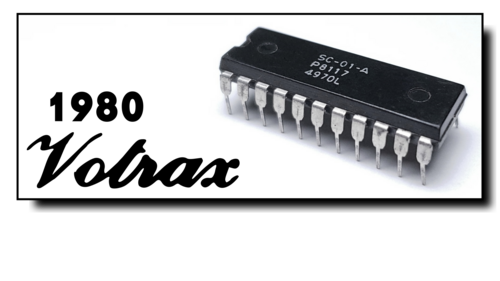
Votrax
~ the eulogy ~
The SC-01 shipped four years before I was born, on a continent I would not see for decades. What reached me was the sound and never the chip, which is the usual order for anyone whose arcade history is secondhand.
Richard T. Gagnon designed a speech synthesizer in 1970 and licensed it to Federal Screw Works, a Detroit parts manufacturer with no obvious reason to want one. The vocal division opened in 1971, took the Votrax name by 1974, and moved to Troy, Michigan. For most of the seventies it sold room-sized and rack-sized machines: the VS series, then the ML-1 in 1978, which could produce 128 phonemes and cost what a laboratory pays.
Then in 1980 the whole thing collapsed onto a single integrated circuit. The SC-01 was a 22-pin CMOS part with 64 phonemes and two inflection bits, and Byte listed it at seventy dollars in single quantity in 1982. That price is the whole story of what happened next. Speech stopped being a capital purchase and became a part you could solder onto a hobby board.
~ the dossier ~
| Born | 1971, as the vocal division of Federal Screw Works in Detroit |
|---|---|
| Peak | the SC-01, in arcade cabinets and in the Kurzweil Reading Machine |
| Killed | June 1994 |
| Lifespan | 23 years |
| Made by | Federal Screw Works, from a design by Richard T. Gagnon |
| Killed by | a lost patent case, years after the speech business was gone |
~ how it talked ~
You did not give the SC-01 text. You gave it phoneme codes, six bits at a time, and it strung them together with a fixed duration and one of four inflection levels. There was no dictionary and no parser on the chip, so anything that wanted to read English had to convert spelling to phonemes first, in software, before the chip ever saw it.
That is why it sounds the way it sounds. The transitions between phonemes are approximate, the stress is mechanical, and English pronunciation rules are irregular enough that the conversion step got things wrong constantly. Votrax sold the Type 'N Talk in 1980 to solve exactly this: a box with an RS-232 port that accepted plain text, did the letter-to-sound conversion itself, and drove an SC-01 on the other side. The Personal Speech System followed in 1982.
~ the arcade years ~
Midway put Votrax speech in Wizard of Wor and Gorf in 1981, and Gottlieb put it in Q*bert in 1982 and in a run of pinball tables. Q*bert is the famous one, because the developers pointed the chip at a random phoneme sequence and let it produce nonsense, then drew a speech balloon full of punctuation above the character. A synthesizer built to pronounce English correctly became beloved for a noise nobody intended.
The chip went further than that. A Votrax synthesizer flew on DOVE-OSCAR 17, an amateur radio satellite launched in 1990, broadcasting voice telemetry to anyone with a receiver. And the Kurzweil Reading Machine for the Blind used Votrax hardware to read printed pages aloud, which is the application that actually justified the research.
~ what happened to the company ~
1984 was the break. Votrax either declared bankruptcy or came within inches of it, and the business that came out the other side was pointed at phone interfaces rather than speech chips. It merged with Vynet Corp in 1987 and was renamed Vysion around 1992, by which point nothing about it resembled the company that had made the SC-01.
Vysion lost a patent case to PATCO Inc and filed for bankruptcy in June 1994. The remnants reorganized as Maxxar in 1995. Open Solutions bought that in 2004, and it ended up inside Fiserv in 2013, running banking software. The SC-01 outlived every one of those corporate forms. People still buy the chip on arcade forums to repair Q*bert boards, and when they cannot find one they buy a modern emulator board that pretends to be it.
~ leave a rose ~
an anonymous tribute. one rose per visitor per day.
@}-->-- ... roses left here
~ leave a wreath ~
a rose fades by morning. a wreath stays on this grave for good, with your name on it.
from $1, paid once through stripe. it keeps the graveyard running: the hosting and the nightly digging. adopt it and the headstone reads "maintained in memory by" you. the groundskeeper plants new wreaths at the next tending, usually within a day.
» one email a week: new graves and the anniversaries of the dead. subscribe
other gadgets: Samsung Galaxy Note 7, Meta Portal, Sendo, Pyramid Technology
also died in the 1990s: Softlanding Linux System, Pyramid Technology, Octel Communications
~ leave a note ~
visitors before you have left these graveside notes. anonymous welcome.