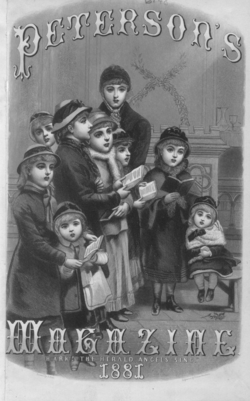
Peterson's Magazine
~ the obituary ~
Charles Jacobs Peterson and George Rex Graham edited the Saturday Evening Post together, and they worked out that there was room beside Godey's Lady's Book for a magazine that did the same thing for a dollar less. Peterson launched his in Philadelphia in January 1842 at two dollars a year against Godey's three. He then spent six years failing to settle on a name for it. Volume one went out as The Lady's World of Fashion, which became The Lady's World, then briefly The Artist and Lady's World after it swallowed a magazine called The Artist in June 1843, then The Ladies' National Magazine, and only with volume thirteen in January 1848 did the masthead read Peterson's.
Peterson had read law at the University of Pennsylvania, graduated in 1838, was admitted to the bar and never practiced a day. What he did instead was edit, and in the early 1840s part of that work happened at Graham's Magazine, where the story is that Poe came back from an illness in April 1842, found Peterson sitting at his desk doing his job, and resigned on the spot. Whether or not that one is true, there is a letter from Poe of 3 February 1842, a month after the first number of Peterson's new magazine, placing his colleague on a list of journalistic ninnies.
The other name on the masthead was Ann S. Stephens. She was a genuine co-editor and the magazine was content to let readers think she ran the place, which she did not. Her name first appears in the contents for volume three in 1843 and is still there in 1887, the year after she died, and when she founded her own title in 1856 it was eventually merged into this one. Her lasting fame came from somewhere else entirely: her serial Malaeska was reprinted in 1860 as the first of Beadle's dime novels, which is where that whole American form begins. Emily H. May, far less remembered, ran even longer, from 1843 to 1892.
What a subscriber got was fiction wrapped around pictures, and the pictures were the expensive part. The half-year volume for January to June 1870 carries thirteen steel engravings and six pieces of sheet music, plus a wood-engraving count the magazine printed itself: sixty-seven in the January number, eighty-five in February, then fifty-three, fifty-seven, sixty-seven and seventy-one. Four hundred wood engravings in six months. In that same January number the editors claimed to have spent close to a million dollars on illustration over the preceding decade, and advertised a Berlin needlework pattern printed in twelve colors as something no other American periodical was giving away at all.
~ the case file ~
| Born | January 1842 in Philadelphia, under the title The Lady's World of Fashion |
|---|---|
| Peak | 140,000 claimed in 1869 against Godey's 106,000, at two-thirds the price |
| Killed | April 1898, absorbed into Argosy with the May number |
| Lifespan | 56 years and 4 months, about 676 monthly numbers |
| Made by | Charles Jacobs Peterson, with Ann S. Stephens co-editing from 1843 |
| Killed by | Frank Munsey, who bought magazines in order to feed other magazines |
~ the undercut ~
The trade directories are the only outside check that exists on any of this, and they say the undercut worked. George P. Rowell's 1869 list has Peterson's claiming 140,000 a month and Godey's claiming 106,000. Rowell's own more skeptical advertising list the same year puts Peterson's at 110,000, still ahead. By 1876 he was estimating both of them downward and keeping the order: Peterson's 60,000, Godey's 40,000, at two dollars against three. A dollar less, and ahead in every count anybody made.
The Civil War shows up in this magazine as a paper bill. Peterson kept the war off his pages on the theory that his readers wanted somewhere not to think about it, and in the January 1864 number the editors explained what that had cost: paper was running at nearly twice the 1862 price, and theirs was the only magazine that had neither raised its club rates nor cut its page count, surviving on what they called a diminished profit. They also used both war Januaries to claim the largest circulation of any ladies' periodical in the United States or the world, which nobody was in a position to audit.
The decline started long before anybody died. From 140,000 in 1869 to 60,000 in 1876 is a collapse, and it happened eleven years before Peterson went. He died on Friday 4 March 1887, and the May issue told readers he had left every department so thoroughly organized that nothing would change, which is what a magazine says when it has no successor to announce. Stephens had gone a little over six months earlier. Frank Lee Benedict, who had been writing fiction in these pages since 1857, was running the place by 1894.
~ one hundred and two volumes ~
From January 1842 the magazine ran two volumes a year, six numbers in each, and for half a century it did not slip once. Volume thirteen opens in January 1848, which is exactly what six years of that arithmetic predicts, and the old sequence closes at volume 102, number 6, in December 1892. Fifty-one years, 102 volumes, 612 monthly numbers, no missing beats. Then the publishers started a new series in January 1893 and the numbering came apart inside two years, to the point where four library catalogs now give four different answers for what volume 1898 was. The January 1898 issue settles it the only way that counts, by printing its own: New Series Volume VIII, and in brackets beside it, Old Series Volume CVII.
~ ten cents, broadway ~
That same cover is the whole ending in one object. Across the top it says THE PETERSON, the possessive gone, and under that, TEN CENTS A COPY. At the foot: The Peterson Company, 280 Broadway, New York. A two dollar Philadelphia women's monthly built to undercut Godey's had turned into a ten cent New York general magazine at a dollar a year, running a life of John Brown and a story by Paul Laurence Dunbar.
It lasted four more numbers. The last issue of The Peterson Magazine is April 1898, and from May the subscribers were getting Argosy instead, Frank Munsey having bought the title in order to pour its circulation list into something he already owned. Godey's Lady's Book, the magazine the whole fifty-six year exercise had been aimed at, outlived it by about four months and was then absorbed by something called The Puritan.
~ leave a rose ~
an anonymous tribute. one rose per visitor per day.
@}-->-- ... roses left here
~ leave a wreath ~
a rose fades by morning. a wreath stays on this grave for good, with your name on it.
paid once through stripe. payments are handled by OÜ Lakeview, the small company that keeps rip.so running. the money pays for the hosting and the nightly digging. adopt it and the headstone reads "maintained in memory by" you. the groundskeeper plants new wreaths at the next tending, usually within a day.
» one email a week: new graves and the anniversaries of the dead. subscribe
other news: Dichtbij.nl, Suck.com, China Public Opinion Supervision Net, Micro Hebdo
also died in the pre-1980s: Kenbak-1, Kolokol, Compatible Time-Sharing System
~ leave a note ~
visitors before you have left these graveside notes. anonymous welcome.