The San Francisco Oracle
~ the last words ~
A head shop paid for it. Ron and Jay Thelin ran the Psychedelic Shop on Haight Street and put up seed capital for a neighborhood paper in the summer of 1966, which led to a series of meetings that produced exactly one issue of something called P.O. Frisco, twelve tabloid pages dated 2 September 1966. The initials stood for Psychedelphic Oracle, a title Bruce Conner had suggested. It was a compromise between every faction in the room and satisfied none of them, and the Thelins said they would pull the money unless the whole thing was started again.
It was. New offices behind the Print Mint on Haight Street, new editors in George Tsongas and John Bronson, a new name, and a numbering sequence that began again at one. The first issue of The San Francisco Oracle is dated 20 September 1966 and looks like an ordinary underground tabloid. Bronson and Tsongas did two issues, fell out with Allen Cohen and Gabe Katz, and left. Katz became art editor from issue three and Cohen took the editorship and kept it to the end, with Michael Bowen as art director. After issue five the whole operation moved into Bowen's old premises at 1371 Haight Street, near Masonic, and the new office stayed open twenty-four hours a day.
A week after issue three hit the street in early November, Cohen was arrested inside the Thelins' shop for selling a copy of Lenore Kandel's The Love Book to a vice squad officer. The case became a free speech cause with a national audience. The paper had been running for eight weeks.
What it printed was a mix almost nobody else was attempting: verse, Eastern religion, reports from the neighborhood, and page layouts where the art came first and the text was poured in around it. Allen Ginsberg wrote for it, and so did Gary Snyder, Lawrence Ferlinghetti, Michael McClure and most of the Beat writers still living in the city, with Bruce Conner and Rick Griffin among the artists. The full masthead title, printed in hand-lettered script across the top of each cover, was The Oracle of the City of San Francisco.
~ the record ~
| Born | 20 September 1966 in Haight-Ashbury, 3,000 copies, fifteen cents |
|---|---|
| Peak | a print run around 125,000, with the editors claiming pass-around readership over half a million |
| Killed | February 1968, with issue twelve |
| Lifespan | about 17 months and twelve issues |
| Made by | Allen Cohen as editor, Michael Bowen as art director, seeded by the Thelin brothers' head shop |
| Killed by | the end of the neighborhood it was written for |
~ the ink fountain ~
From issue six the paper changed printers, moving from Waller Press to Howard Quinn. The new shop let the artists come in on Sundays while the paper was actually on the press and experiment with it. What they arrived at was split-fountain printing: wooden dams wedged into the ink fountain so that different colored inks could be fed in at the same time and bleed into each other across the sheet. The result was a page that shaded continuously from one color into the next, which nobody had done on newsprint before and which was genuinely hard to read in places.
Circulation answered immediately. The paper had started at 3,000 copies, reached about 15,000 by issue four, 50,000 by issue five, then ran 60,000 to 75,000 of issue six and more of issue seven. From six onward every issue went back on the press for at least a second printing, sometimes with the contents changed between runs. The peak print run was around 125,000. The editors put the pass-around readership above half a million, which is a guess about how many hands each copy went through and was never audited by anyone.
I have only ever seen the Oracle as scans, and scans are the wrong medium for it. The whole achievement is wet ink bleeding across cheap paper as the sheet moves, and a JPEG flattens that into a picture of a page. The covers still look extraordinary at 6397 pixels wide. What you are looking at is the output, not the trick.
~ issue five ~
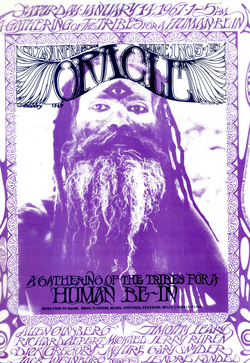
The cover of Volume 1, Number 5, January 1967, fifteen cents, is not really a cover. It is a poster, and the paper is what was attached to it. Hand-lettered across the top in purple: SATURDAY JANUARY 14 1967, 1 to 5 P.M., A GATHERING OF THE TRIBES FOR A HUMAN BE-IN. A bearded figure with a third eye fills the middle. The bottom third is the bill, lettered in the same hand, with Allen Ginsberg and Timothy Leary at the top and Lenore Kandel's name in the last line, two months after her book of poems had put the paper's editor in a police station. In a small box: FREE.
Above the names, in plain bold type that someone clearly decided had to be legible, runs the only practical instruction on the whole sheet: "BRING FOOD TO SHARE. BRING FLOWERS, BEADS, COSTUMES, FEATHERS, BELLS, CYMBALS, FLAGS."
The Be-In happened in Golden Gate Park that Saturday and is the event the Summer of Love is usually dated from. Issue six ran an astrologers' symposium on the Age of Aquarius. Issue seven carried the Houseboat Summit, a long unedited conversation between Alan Watts, Ginsberg, Leary and Snyder on a ferryboat in Sausalito, which Watts opened by asking whether to drop out or take over.
~ no issue thirteen ~
Issue twelve, dated February 1968, was the uncut transcript of a symposium at the Masonic Auditorium called 2000 A.D., with Watts talking to the futurist Herman Kahn and the psychologist Carl Rogers. Seventeen months of covering one neighborhood as it happened, and the last thing the paper printed was a panel discussion about the next century. Nothing in it announced the end.
What ended first was the Haight. The Thelins' Psychedelic Shop, which had seeded the whole thing, had already closed its doors in October 1967. Staff who had left the city put out one 24-page one-shot called Harbinger from Middletown in July 1968. That November a different group launched the San Francisco Oracle of the Spiritual Revolution out of Larkspur under Phillip Davenport, which managed seven issues to November 1969 and was a religious magazine wearing the name. Others went to the San Francisco Express Times, which ran from January 1968 to March 1969 and then became the San Francisco Good Times. Students at San Francisco State got there before any of them, with an eight-page parody called the Orifice edited by Ben Fong-Torres, who went on to Rolling Stone.
Allen Cohen spent much of the rest of his life on the Oracle, assembling the facsimile edition that Regent Press published in 1990 so the color could be seen again on paper. He died in 2004. Twelve issues is a short run by any measure, and it is also why the paper reads the way it does: the Oracle stopped while the thing it was describing was still there.
~ leave a rose ~
an anonymous tribute. one rose per visitor per day.
@}-->-- ... roses left here
~ leave a wreath ~
a rose fades by morning. a wreath stays on this grave for good, with your name on it.
paid once through stripe. payments are handled by OÜ Lakeview, the small company that keeps rip.so running. the money pays for the hosting and the nightly digging. adopt it and the headstone reads "maintained in memory by" you. the groundskeeper plants new wreaths at the next tending, usually within a day.
» one email a week: new graves and the anniversaries of the dead. subscribe
other news: AllThingsD, Talk, Blottr, Quokka Sports
also died in the pre-1980s: Le Petit Vingtième, DuMont Television Network, Servet-i Fünun
~ leave a note ~
visitors before you have left these graveside notes. anonymous welcome.