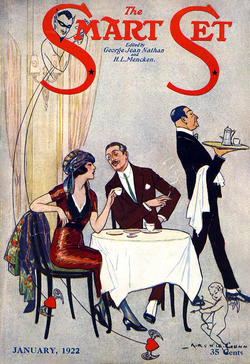
The Smart Set
~ the last words ~
Colonel William d'Alton Mann was a Civil War veteran who published Town Topics, a New York gossip weekly whose income came less from its readers than from the wealthy people who paid to stay out of it. Historians have been blunt about the arrangement. No one was named outright, veiled suggestions were provided, and most of the revenue Mann drew from the magazine came from offering to suppress forthcoming columns for a price. In 1900 he decided that same social world deserved a literary magazine too, and called it The Smart Set, subtitled The Magazine of Cleverness, written by and about what Ward McAllister had called the Four Hundred.
Mann dated the first issue 10 March 1900 and put Arthur Grissom, a young poet he had taken off the Town Topics staff, in the editor's chair. Grissom set the formula and it survived almost the whole run: a hundred and sixty pages opening with a novelette, then a short play, then verse, with epigrams dropped in wherever a page came up short. The first cover by Kay Womrath showed a couple in evening dress dancing on strings held by a grinning Pan, the S's of the title slashed in vermilion. It cost twenty five cents. Grissom bought O. Henry's The Lotos and the Bottle for fifty dollars in cash, then died of typhoid fever in December 1901.
By 1905 circulation had reached a hundred and sixty five thousand, which is the highest it ever went. In 1906 the blackmail allegations around Town Topics broke into public view and about twenty five thousand readers walked immediately, because both magazines had the same owner and everybody in New York knew it. Charles Hanson Towne, who had been pushing new writers such as James Branch Cabell into the pages, resigned in 1908 to join Theodore Dreiser at The Delineator. The men who replaced him hired a twenty eight year old Baltimore newspaperman to review books. The reviews were loud enough that people started buying the magazine for them, and the next year a drama critic named George Jean Nathan arrived to match him.
Mann sold out in the spring of 1911 for a hundred thousand dollars to John Adams Thayer, an advertising man who had made his money pulling Everybody's Magazine out of a slump and then selling it on. Thayer wanted the social standing that came with the title. What he had bought was a magazine with a ruined name, and he spent three years failing to repair it.
~ the record ~
| Born | 10 March 1900, 160 pages at twenty five cents |
|---|---|
| Peak | 165,000 in 1905, then 250,000 under Hearst in 1925 |
| Killed | June 1930, eight months after the Crash |
| Lifespan | 30 years and 3 months |
| Made by | Col. William d'Alton Mann, who also published Town Topics |
| Killed by | Hearst's rewrite of what it was for, then the Crash |
~ the year ezra pound was on the payroll ~
In 1913, on Mencken's recommendation, Thayer handed the editorship to Willard Huntington Wright with complete control of the content. Wright said he wanted the kind of magazine Europe could support and America had never attempted, hired Ezra Pound as an overseas talent scout, and began printing D. H. Lawrence, Joseph Conrad, W. B. Yeats and Ford Madox Ford. Advertisers withdrew their money. Readers left. Wright was also overpaying his authors out of the magazine's checkbook and quietly funding a prototype of a more radical publication with Mencken on the side, and Thayer fired him in 1914 after a single year.
The firing worked in reverse. That one year had pulled in a readership of people who read for a living, including Sinclair Lewis, Dreiser, Edmund Wilson, Alfred Kazin and a young Harold Ross, who launched The New Yorker in 1925. Thayer was by then out of money and signed the magazine over to Colonel Eugene Crowe in exchange for forgiveness of his debts. Crowe had no interest in running a magazine and passed it to Eltinge Warner, who handed the editorial side to Mencken and Nathan and kept the accounts for himself.
~ the pulps that paid for it ~
Mencken and Nathan moved into a smaller office with a staff of exactly three, the two of them plus a secretary named Sara Golde. Circulation under their editorship sat between forty and fifty thousand. To cover costs they built a side business out of their own slush pile. Manuscripts they considered too poor for The Smart Set went into a pulp called The Parisienne, launched in 1915 on wartime curiosity about France, and it made real money. They sold it to Warner and Crowe in 1916, repeated the trick with Saucy Stories, and in 1920 did it a third time with a title called Black Mask.
Black Mask is the one that outlived everybody. It was started as a throwaway funding instrument for a literary monthly and went on to publish Dashiell Hammett and Raymond Chandler and to set the shape of American detective fiction for decades. The parent magazine meanwhile was printing Edna St. Vincent Millay's Barbara on the Beach in November 1914, two stories from James Joyce's Dubliners in May 1915, which was the first time Joyce appeared in any American publication, and F. Scott Fitzgerald's Babes in the Woods in September 1919.
~ the harding piece ~
Warren Harding died in August 1923 and his body went by train from San Francisco to Ohio, with the newspapers turning the procession into weeks of national mourning for a president those same papers had been sour about while he was alive. Mencken and Nathan wrote a satire of the funeral and sent it to be set in type. The printers read it on the stone and reported it to the owner.
Warner killed the piece. "I don't give a damn what you thought of him," he told them. "Harding was our President, after all." Then he announced that he would sell the magazine within the year. The two editors had just discovered that total artistic control was something the owner could take back in an afternoon, so they went to Alfred A. Knopf and started The American Mercury, which they owned a piece of. Their parting recommendation was Morris Gilbert, who accepted the editorship without being told the magazine was for sale.
~ the young woman's magazine ~
Hearst bought it in 1924 and gave editorial control to George D'Utassey, who replaced The Magazine of Cleverness with a new subtitle: True Stories from Real Life. Gilbert resigned. Circulation climbed to two hundred and fifty thousand by 1925, well past anything Mencken and Nathan had reached, on the strength of Hearst promoting it across his other papers. In 1929 he merged it with McClure's, which he had also just acquired, into The New Smart Set under Margaret Sangster, subtitled The Young Woman's Magazine. The Crash came that October. The magazine stopped in June 1930.
Reynal & Hitchcock published an anthology of the best of it in 1934, and Louis Kronenberger reviewed that book in The New York Times Book Review in language nobody normally spends on a magazine four years dead. "You had the feeling, then, that some day you would sentimentalize over the years when The Smart Set was in its prime. You were very conscious that it was making literary history; you knew that it was teaching a literary America that went about on all fours how to walk." In 2007 Drexel University launched an online journal under the same name and listed Owen Hatteras, a pen name Mencken and Nathan had shared, on its masthead. The university is clear that the link is honorary.
~ leave a rose ~
an anonymous tribute. one rose per visitor per day.
@}-->-- ... roses left here
~ leave a wreath ~
a rose fades by morning. a wreath stays on this grave for good, with your name on it.
paid once through stripe. payments are handled by OÜ Lakeview, the small company that keeps rip.so running. the money pays for the hosting and the nightly digging. adopt it and the headstone reads "maintained in memory by" you. the groundskeeper plants new wreaths at the next tending, usually within a day.
» one email a week: new graves and the anniversaries of the dead. subscribe
other news: CNN iReport, The Superficial, McClure's, KernelTrap
also died in the pre-1980s: McClure's, Magnavox Odyssey, Penn Central
~ leave a note ~
visitors before you have left these graveside notes. anonymous welcome.