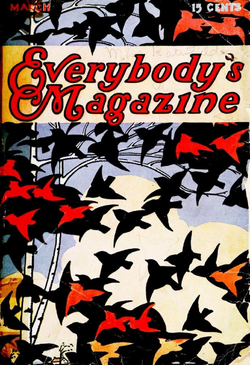
Everybody's Magazine
~ the obituary ~
Everybody's Magazine was started in 1899 by John Wanamaker, the Philadelphia merchant who had done as much as anyone to invent the American department store. He took almost no part in running it. The magazine mixed non-fiction with new fiction and sold respectably without mattering to anybody. By 1903 it had a hundred and fifty thousand readers, and Wanamaker sold the whole thing for seventy five thousand dollars to a group headed by Erman Jesse Ridgway. The Ridgway Company, which published it from then on, was a subsidiary of Butterick, the dress pattern house.
In the summer of 1904 the magazine began running a series by the Boston financier Thomas W. Lawson about how money actually moved through the trusts. Frenzied Finance ran until February 1908 under the editor John O'Hara Cosgrave, and it took the circulation past half a million and kept it there. Spartacus Educational puts the peak at seven hundred and fifty thousand in 1908. Lawson also bankrolled a quarter of a million dollars in advertising for the series he was himself writing.
That run made the magazine and also decided what it would be. Everybody's spent the next decade as a muckraking title during the years when muckraking was the most powerful thing in American publishing. Trumbull White edited it from 1912 to 1914 and turned the front of the book over to English writers arguing about whether Europe was going to war, H. G. Wells and Bernard Shaw among them. Shaw's Pygmalion was serialized in the November 1914 number, illustrated by May Wilson Preston, by which point the argument had stopped being hypothetical.
The war took the circulation under three hundred thousand. From 1915 the magazine dropped the possessive off its cover and called itself simply Everybody's. By the late 1920s it was selling around fifty thousand copies, a fifteenth of what it had reached while Lawson was writing.
~ the case file ~
| Born | 1899, founded by the merchant John Wanamaker |
|---|---|
| Peak | 750,000 by 1908, on the back of Frenzied Finance |
| Killed | March 1929, merged into the pulp Romance |
| Lifespan | 30 years |
| Made by | the Ridgway Company, a Butterick Publishing subsidiary |
| Killed by | the end of the muckraking decade, then a slide into pulp |
~ the series that advertised itself ~
Frenzied Finance ran for three and a half years, and the circulation history of Everybody's is more or less the circulation history of that one series. It arrived at a hundred and fifty thousand readers. It touched seven hundred and fifty thousand, settled back to five hundred thousand when the last installment came out, and held above the half million mark for years afterward. The quarter of a million dollars spent advertising it came out of Lawson's pocket rather than the publisher's.
What Cosgrave bought with that decision was a place next to McClure's at the center of the muckraking decade. Four years earlier the title had been a department store owner's side venture that nobody in New York had any reason to read. It made somebody rich, too. John Adams Thayer pulled Everybody's out of a slump and took a fortune out of selling it, and in the spring of 1911 he spent a hundred thousand dollars of that money buying The Smart Set.
~ the red house murder ~
Underneath the politics the magazine always ran fiction, and the fiction outlasted the politics. Jack London appeared in it, so did O. Henry and the adventure writer Talbot Mundy, and A. A. Milne's detective novel The Red House Mystery was serialized from August to December 1921 under a different title, The Red House Murder. Dornford Yates and Raoul Whitfield wrote for it in the later years.
By 1926 the fiction was all that was left and Everybody's had become a pulp, which is what a general interest magazine turns into when the general interest has moved somewhere else. In 1929 it was folded together with Romance, another title in the same stable. The last issue of Everybody's Magazine is dated March 1929.
~ a comeback that printed nothing ~
In 1931 the publisher Alfred A. Cohen bought the title out of Butterick and hired F. Orlin Tremaine to bring it back. No issues are known to have been produced. It was declared discontinued without ever reappearing, so the whole revival survives as a transaction and nothing else.
Tremaine got handed one of these twice. Twelve years later he was the business manager on the 1943 attempt to restart St. Nicholas, the children's monthly that had stopped in February 1940. That one managed four issues before it stopped as well.
~ leave a rose ~
an anonymous tribute. one rose per visitor per day.
@}-->-- ... roses left here
~ leave a wreath ~
a rose fades by morning. a wreath stays on this grave for good, with your name on it.
paid once through stripe. payments are handled by OÜ Lakeview, the small company that keeps rip.so running. the money pays for the hosting and the nightly digging. adopt it and the headstone reads "maintained in memory by" you. the groundskeeper plants new wreaths at the next tending, usually within a day.
» one email a week: new graves and the anniversaries of the dead. subscribe
other news: Luxist, OhmyNews International, Hírszerző.hu, IslamOnline
also died in the pre-1980s: Société d'électronique et d'automatisme, V-Cord, The Electrical Experimenter
~ leave a note ~
visitors before you have left these graveside notes. anonymous welcome.