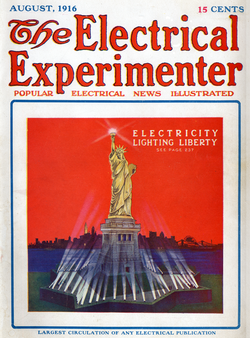
The Electrical Experimenter
~ the obituary ~
Hugo Gernsback arrived from Luxembourg in February 1904 with a dry-cell battery design he had failed to patent in Europe, hoping to sell it to American car companies. He ended up in a New York boarding house and found that radio parts were nearly impossible to buy in the city. With a fellow lodger he started an import business to sell them by mail. The Electro Importing Company catalog grew to sixty-four pages and filled up with technical articles explaining how to use what it was selling. In 1908 the catalog took the title Modern Electrics, and by April of that year Modern Electrics was a magazine.
He sold that one in order to start another. The last issue with Gernsback as editor was March 1913, and the first issue of The Electrical Experimenter was dated May 1913. Modern Electrics went through a run of mergers and retitlings and became Popular Science Monthly in 1915, which is still on the shelf.
The August 1916 cover sums up the proposition. Fifteen cents. The Statue of Liberty floodlit from below with rays coming off the torch, captioned ELECTRICITY LIGHTING LIBERTY with a page reference beside it. The subtitle across the top reads Popular Electrical News Illustrated, and along the bottom edge in small caps: "LARGEST CIRCULATION OF ANY ELECTRICAL PUBLICATION". About a hundred thousand people were reading it.
Gernsback put fiction in it from the beginning, his own included, because the point of the magazine was imagination applied to hardware. In a 1916 editorial he argued that a real electrical experimenter worthy of the name had to have a vision of the future. Ten years later that line of thinking produced Amazing Stories, the first magazine given over entirely to science fiction, and eventually the award with his name on it.
~ the case file ~
| Born | May 1913, New York, published by the Electro Importing Company |
|---|---|
| Peak | around 100,000 readers, fifteen cents an issue |
| Killed | August 1931, by then titled Science and Invention |
| Lifespan | 18 years, 220 issues |
| Made by | Hugo Gernsback |
| Killed by | the 1929 bankruptcy, then the Depression |
~ tesla wrote five ~
Between August 1917 and July 1919 Nikola Tesla wrote five articles for the magazine, and in 1919 it ran his autobiography in installments across several issues. Tesla was in his sixties and well past the years when anyone was funding him, and a popular electrical monthly was one of the few places still printing him at length. My Inventions exists as a book because this magazine serialized it.
Gernsback kept widening what counted as the subject. The June 1918 cover added a second title, Science and Invention, and the contents stretched into chemistry and mechanics. In August 1920 the new name took over as the main one. That is the moment The Electrical Experimenter stopped existing as a title, while the magazine underneath it carried on without missing an issue.
My own distance from this is a matter of era. I am a computer engineer who came up on a later generation of exactly this format, Turkish hardware magazines and then donanimhaber, read over a modem and paid for by the minute. Gernsback's monthly sold you the parts and then taught you what to do with them, and that arrangement still had seventy years of life in it when he lost the company.
~ february 1929 ~
The money was gone by 1927. WRNY, the radio station Experimenter Publishing had put on the air in 1925 from the eighteenth floor of the Roosevelt Hotel, was losing around fifty thousand dollars a year, and it had just been given a new transmitter across the river in New Jersey and then television equipment on top of that. In August 1928 WRNY began broadcasting a 48-line mechanical television picture an inch and a half square, which readers could build a receiver for using plans printed in the magazines. It was the first regularly scheduled television programming anywhere.
Meanwhile Hugo Gernsback was drawing a salary of fifty thousand dollars a year and his brother Sidney thirty-nine thousand. The governor of New York State was paid twenty-five. By 1928 the creditors had their own accountants sitting in the office going through the spending.
On 20 February 1929 an involuntary bankruptcy petition was filed by three small creditors owed roughly two thousand dollars apiece. That detail fed conspiracy theories for decades, until somebody checked and found all three worked at the law firm acting for the paper supplier and the printer, who were owed over three hundred thousand between them, and had each been handed an overdue invoice to get proceedings started. Liabilities came to six hundred thousand dollars against assets of a hundred and eighty-two thousand.
The receiver kept everything publishing and not one issue was missed. At the April auction the magazines went for five hundred thousand dollars and the radio stations for a hundred thousand more, and the creditors were paid ninety-five cents on the dollar, which the lawyers handling it said they had never seen a forced sale manage. Gernsback walked out and started over. Science Wonder Stories was on the newsstand by 3 May and Radio Craft followed on 5 June, a title that under later names stayed in print until 2003.
~ the name went first ~
B. A. MacKinnon renamed the company twice and tried to pay off the purchase out of the revenue, which was a reasonable plan in 1929 and a hopeless one by 1931. The Depression took the advertisers and then the readers. Radio-Science Publications stopped with the August 1931 issues, and Bernarr Macfadden's Teck Publishing picked up what was worth keeping from September. Radio News and Amazing Stories went on without him. Science and Invention was sold off separately and folded into Popular Mechanics, and that is where the thing that began as The Electrical Experimenter ends: 220 issues, May 1913 to August 1931.
Gernsback wrote about his own publishing history repeatedly for the rest of his life, including a sixteen-page retrospective in 1958. The bankruptcy appears in it as a single sentence. In the spring of 1929 the magazines were sold to other interests.
~ leave a rose ~
an anonymous tribute. one rose per visitor per day.
@}-->-- ... roses left here
~ leave a wreath ~
a rose fades by morning. a wreath stays on this grave for good, with your name on it.
paid once through stripe. payments are handled by OÜ Lakeview, the small company that keeps rip.so running. the money pays for the hosting and the nightly digging. adopt it and the headstone reads "maintained in memory by" you. the groundskeeper plants new wreaths at the next tending, usually within a day.
» one email a week: new graves and the anniversaries of the dead. subscribe
other news: Google Bulletin, Backfence, The Global Mail, DailyFinance
also died in the pre-1980s: Longitudinal Video Recording, de Havilland, V-Cord
~ leave a note ~
visitors before you have left these graveside notes. anonymous welcome.