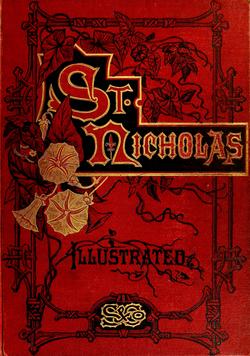
St. Nicholas
~ the last words ~
In 1870 Roswell Smith of Scribner & Company wrote to Mary Mapes Dodge to ask whether she would edit a children's magazine that did not exist yet. She was an associate editor at the weekly Hearth and Home and had written Hans Brinker, or the Silver Skates. She had conditions. A children's magazine, she told him, must not be "a milk-and-water variety of the periodicals for adults. In fact, it needs to be stronger, truer, bolder, more uncompromising than the other." Children spend the day in school with their heads strained and taxed by lessons, she wrote, and when they get home they do not want to be bothered nor amused nor petted. "They just want to have their own way over their own magazine."
The first number is dated November 1873, under the title St. Nicholas: Scribner's Illustrated Magazine for Girls and Boys, forty eight pages in a press run of forty thousand. Within a few years it had absorbed much of its competition. Our Young Folks and The Children's Hour came in during 1874, The Schoolday Magazine and The Little Corporal in 1875, Wide Awake as late as 1893. It never reached the circulation of the biggest children's weeklies. At Christmas 1883 it had a hundred thousand subscribers while The Youth's Companion was running at five times that figure.
Dodge knew writers personally and could ask them for work directly. Frances Hodgson Burnett's Little Lord Fauntleroy started as a St. Nicholas serial in the November 1885 number, and her novella Sara Crewe followed in December 1887. Louisa May Alcott's Eight Cousins ran in it, as did Mark Twain's Tom Sawyer Abroad. When Dodge wrote to Rudyard Kipling asking for a fiction series, what came back were the Jungle Book stories. In 1881 Scribner withdrew from the magazine business entirely and The Century Company bought both of its titles, so Scribner's Monthly became The Century Magazine and St. Nicholas was renamed An Illustrated Magazine for Young Folks. That same year Dodge's eldest son Harry died, and in her grief she handed most of the daily work to her assistant, William Fayal Clarke. She stayed on the masthead until her own death in 1905.
Clarke had joined the staff in 1874 at twenty years old and was associate editor by 1878. Lacking Dodge's address book, he ran the magazine on departments instead of famous names, adding standing pages for short plays and for stamp collecting, and he held circulation at around seventy thousand for the rest of his tenure. He stepped down as editor in 1927 and retired the next year, after fifty four years at one magazine. Within a few years of his leaving, the numbers began to fall and never recovered.
~ the record ~
| Born | November 1873, from Scribner & Company, in 40,000 copies |
|---|---|
| Peak | 100,000 subscribers at Christmas 1883, about 70,000 for decades after |
| Killed | February 1940, plus a four issue revival that ended in June 1943 |
| Lifespan | 67 years, 70 counting the revival |
| Made by | Scribner & Company, then The Century Company |
| Killed by | six editors in twelve years, and a slide nobody stopped |
~ live to learn and learn to live ~
The St. Nicholas League opened in 1899 with that motto and a competition every month. Readers sent in poems, stories, drawings, photographs and puzzles. Winners received a gold badge, runners up a silver one, and anybody holding both became an honor member and was paid in cash.
The roll of winners is where the influence is easiest to see. Edna St. Vincent Millay placed seven poems in the League, more than any other contestant. E. B. White and Bennett Cerf both won essay contests. William Faulkner made the honor roll for his drawings and F. Scott Fitzgerald was cited for a photograph. White wrote about the thing in The New Yorker in 1934 and made no attempt to be modest on its behalf: "The fierce desire to write and paint that burns in our land today, the incredible amount of writing and painting that still goes on in the face of heavy odds, are directly traceable to St Nicholas."
~ six editors in twelve years ~
In November 1927, with Clarke gone, the chair went to George F. Thomson, who had edited Our Young Folks before St. Nicholas swallowed it in 1874. He lasted two years. After him the turnover never stopped: Albert Gallatin Lanier in 1930, May Lamberton Becker until 1932, Eric J. Bender until 1934, Chesla Sherlock in 1935, Vertie A. Coyne from 1936. The ownership moved as fast as the staff did. American Education Press bought the title in 1930 and renamed it St. Nicholas for Boys and Girls, then Educational Publishing Corporation bought it in 1935.
In 1940 the format was rebuilt around large type for beginning readers, a picture and story magazine rather than a literary one, and the slick paper was replaced with soft paper. The last issue of the original run is February 1940.
~ four numbers in 1943 ~
St. Nicholas came back with a March 1943 issue, owned and edited by Juliet Lit Sterne, with F. Orlin Tremaine as business manager, laid out to resemble the early years. It ran out in June after four issues. Tremaine had been hired for this exact job before. In 1931 the publisher Alfred A. Cohen bought Everybody's Magazine out of Butterick and installed him to bring that one back, and no issues were ever produced at all.
The bound volumes survive in quantity because the magazine sold the binding as a service: for a small fee a subscriber mailed in six issues and got back a hardback with crimson covers and the title stamped in gold. Henry Steele Commager edited two anthologies out of the run for Random House, in 1948 and again in 1950, by which point the publisher he was working for was being run by Bennett Cerf, who had won one of the League's essay contests as a boy.
~ leave a rose ~
an anonymous tribute. one rose per visitor per day.
@}-->-- ... roses left here
~ leave a wreath ~
a rose fades by morning. a wreath stays on this grave for good, with your name on it.
paid once through stripe. payments are handled by OÜ Lakeview, the small company that keeps rip.so running. the money pays for the hosting and the nightly digging. adopt it and the headstone reads "maintained in memory by" you. the groundskeeper plants new wreaths at the next tending, usually within a day.
» one email a week: new graves and the anniversaries of the dead. subscribe
other news: Stand News, The Toast, TUNeZINE, NEWSru.com
also died in the pre-1980s: Camera Work, Judge, Oz
~ leave a note ~
visitors before you have left these graveside notes. anonymous welcome.