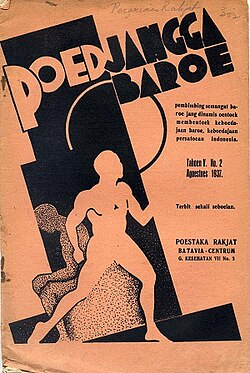
Poedjangga Baroe
~ the obit ~
Sutan Takdir Alisjahbana edited the literary pages of a paper called Pandji Poestaka, and in September 1932 he wrote to a young poet named Armijn Pane asking him to bring in Amir Hamzah so the three of them could start something. They spent months on letters. In October, Hamzah wrote to fifty writers asking for work, forty of them people who had already published in Alisjahbana's section. In January 1933 they met in Batavia and went through a budget.
They also wrote to ten sultans asking them to subscribe, on the theory that traditional patronage would steady the thing and soften its reception. One said yes, Syarif Muhammad Alkadrie of Pontianak. Then the Dutch publishing house Kolff and Co fell out with them over printing costs, so the founders published it themselves, and July 1933 replaced May as the launch month.
The unusual part sat outside the poetry. The Dutch colonial government ran its own publisher, Balai Pustaka, which printed in regional languages and in Dutch while keeping a careful eye on content. Poedjangga Baroe was written almost entirely in Indonesian and edited entirely by Indonesians, with nobody in the colonial administration to answer to. The 1928 Youth Pledge had declared Indonesian the language of unity five years earlier. This was the first magazine written mainly in Indonesian with an all-Indonesian editorial board.
The August 1937 cover says the rest of it. Tahoen V, No. 2, monthly, published by Poestaka Rakjat in Batavia-Centrum, with the mission printed on the front in small type: a guide to the new, dynamic enthusiasm to form a new culture, the culture of a united Indonesia. The design behind the words is pure thirties, a figure cut into flat orange shapes against a black arc. It would not look out of place on a European art magazine of the same year.
~ the rap sheet ~
| Born | July 1933, self-published in Batavia, at least 64 pages an issue |
|---|---|
| Peak | fewer than 150 paying subscribers, ever |
| Killed | February 1942, a final issue covering December 1941 onward |
| Lifespan | 8 years 7 months, about 90 issues |
| Made by | Armijn Pane, Amir Hamzah and Sutan Takdir Alisjahbana |
| Killed by | the Japanese invasion of the Dutch East Indies |
~ a hundred and fifty ~
The paid subscriber count never passed a hundred and fifty. The historian Heather Sutherland traces that to two conditions outside the magazine's control: most of the population could not read, and the educated minority who could were holding their serious conversations in Dutch. An Indonesian-language magazine for intellectuals was addressing readers schooled to think in Dutch.
It still drew over a hundred and twenty five contributors and staff. Most were Sumatran and most had been through Dutch-language schools, and they were about twenty five on average when they first appeared in it. Armijn said later that what they shared was a view of life rather than a style.
The output across those years comes to roughly ninety issues and more than three hundred poems. The prose side is thinner: five plays and a single novel, with a long run of essays around them.
~ the argument it was for ~
The real content was the fight. Between September 1935 and June 1939 the magazine ran a sequence of polemics about how much Westernization Indonesia needed and how much of its own tradition it should keep. Alisjahbana and Armijn argued that you could not build a modern country without understanding European history. Sanusi Pane argued for Eastern values with Western technique. Nobody won, and the magazine printed all of it.
On language it was less neutral. The entire November 1933 issue went to Alisjahbana writing about Indonesian itself, and in June 1938 the magazine convened the first seminar on the Indonesian language, at Surakarta. Politically it stayed deliberately vague, partly to keep the censors away and partly to protect contributors who had government jobs. The result is a magazine that printed both a sonnet for Rosa Luxemburg and notes on fascism.
~ february 1942 ~
Japan invaded the Dutch East Indies in February 1942 and the colonial government collapsed. The final issue covers December 1941 through February 1942, and the editors wrote in it that they intended to keep publishing as long as that remained possible. No further issue appeared.
A second series appeared after the occupation, run by Alisjahbana with a new generation including Chairil Anwar, dated March 1948 and actually out in May, opening with an attack on the Indonesian leadership for its indifference to what people had suffered. That version ran until 1954 and was replaced by Konfrontasi. The critic H. B. Jassin's verdict on the revival was that it was unoriginal, and the dates on this grave stop at 1942 for that reason.
~ why a turk reads this with recognition ~
I recognize the language half of this from the opposite side of it. Turkey changed its alphabet in 1928 and founded a language institution in 1932 to settle what Turkish was going to be. That project ran on dictionaries and on people arguing in print about how much old vocabulary to throw out. Indonesia took on the identical problem in the identical decade against a colonial government, on a hundred and fifty subscriptions.
The magazine is mostly unread now even in Indonesia, and most of the individual pieces have gone. What stuck is the label: critics call the writers of 1933 to 1942 the Poedjangga Baroe generation, so a publication that could not find two hundred buyers ended up naming a decade of a national literature.
~ leave a rose ~
an anonymous tribute. one rose per visitor per day.
@}-->-- ... roses left here
~ leave a wreath ~
a rose fades by morning. a wreath stays on this grave for good, with your name on it.
paid once through stripe. payments are handled by OÜ Lakeview, the small company that keeps rip.so running. the money pays for the hosting and the nightly digging. adopt it and the headstone reads "maintained in memory by" you. the groundskeeper plants new wreaths at the next tending, usually within a day.
» one email a week: new graves and the anniversaries of the dead. subscribe
other phenomena: YouTube Original Channel Initiative, This Is Why You're Fat, NetAid, Puck
also died in the pre-1980s: Puck, Wire Recording, Tefifon
~ leave a note ~
visitors before you have left these graveside notes. anonymous welcome.