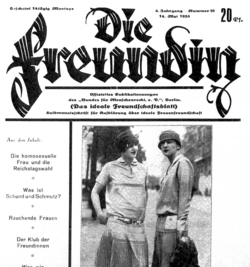
Die Freundin
~ the last words ~
Weimar Berlin is a place I have only read about. Die Freundin was a German magazine written for lesbian women, and it was banned fifty-one years before I was born, so there is no angle from which I get to claim any of it. What makes it worth a page here is the format. Underneath the politics it was a community paper with a classifieds section at the back, which is a thing I do understand, running seventy years before anyone built the online version.
The first two issues, dated 8 August and 12 September 1924, went out as an insert inside Blätter für Menschenrecht, the monthly members' paper of the Bund für Menschenrecht. The Bund was one of the large homosexual-rights organizations in Germany and claimed 48,000 members in the 1920s. Its publisher was Friedrich Radszuweit, who ran a small Berlin press and treated the whole catalog as one pool, moving articles between his titles and reprinting them years apart.
From the third issue it was a magazine of its own: eight to twelve pages set in two columns, with no illustrations inside. It cost 30 pfennig in 1924 and 1925, then 20 pfennig after that. You could subscribe anywhere in Germany or Austria, and in Berlin you could buy it off a street seller. Some issues printed a line on the front page stating that it was permitted to be displayed in public, which is the sort of reassurance you only print when the question is live.
Nobody knows the print run for certain. Laurie Marhoefer, working from the files of the Berlin board that policed trashy and obscene writings, puts it at 7,000 a week. The rival title Frauenliebe was doing 10,000 in 1930. Whatever the exact figure, it is generally taken to have been the most widely circulated lesbian magazine in the German-speaking world, and it kept that position until the 1980s, which says more about the fifty years in between than it does about the magazine.
~ the record ~
| Born | 8 August 1924, Berlin, as an insert in Blätter für Menschenrecht |
|---|---|
| Peak | weekly from 1929, around 7,000 copies an issue |
| Killed | 15 March 1933 |
| Lifespan | 8 years |
| Made by | Bund für Menschenrecht, published by Friedrich Radszuweit |
| Killed by | the Nazi ban on homosexual periodicals |
~ what was in it ~
Just over half the editorial pages were fiction: serialized novels alongside short stories. The rest was a lead article and then a long run of reader letters. The cover carried a photograph of a woman, frequently a nude at the readers' request, with the contents listed down one side. The issue in front of me is number 10 of the fourth volume, 14 May 1928, twenty pfennig, fortnightly on Mondays, and the first item on the cover is "The homosexual woman and the Reichstag election".
Those letters are now the reason historians read it. The editors kept asking for them. In 1925 they appealed to readers to send in their own writing, and in 1927 they restructured the magazine to make room, under headings like "Letters to 'the girlfriend'" and "Our readers have the floor". Women wrote in about their jobs and about not having children in a decade that was loud about eugenics. The best-known regular contributor was Ruth Margarete Roellig, who had trained as an editor back in 1911 and wrote Berlins lesbische Frauen, the guidebook to the city's lesbian bars.
The leading articles were mostly written by men. Radszuweit wrote many of them, as did Paul Weber and Bruno Balz, who edited the magazine from 1928 to 1930 and went on to write some of the most famous German film songs of the Nazi years. How the women reading a lesbian magazine felt about the male bylines on its front pages is not recorded anywhere.
~ banned twice before the ban ~
In 1926 it did not appear on its own at all, running instead as a supplement inside another of the house titles. The reason is not known. The second interruption is documented: from June 1928 to July 1929 Die Freundin fell under the law for the protection of youth from trashy and obscene writings, which meant newsstands could no longer display it. Radszuweit suspended the title and put out a substitute called Ledige Frauen, Single Women, which managed 26 issues and dropped any pretense by numbering its 1929 run as the fourth volume and carrying "Freundin" as a subtitle.
It returned in July 1929 and went weekly, out every Wednesday. In March 1931 the same obscenity rule caught it again, this time with no replacement title at all.
~ nummer 11 ~
Radszuweit died of cancer in the spring of 1932. He had adopted his partner Martin Budszko before his death, which is how a man named Martin Radszuweit comes to appear on the 1932 issues as editor and publisher. Circulation across every title in the house was falling by then.
In August 1931 Radszuweit had published an open letter to Adolf Hitler in Die Freundin. Cases of homosexuality inside the NSDAP had been in the papers, and his argument was that since some of the ablest people in the party were themselves "people who love the same sex", Hitler should instruct his Reichstag deputies to vote for the repeal of Paragraph 175. That paragraph criminalized sex between men and did not touch women, but the magazine campaigned against it for nine years anyway, because the standing proposal was to widen it.
Number 11 of the ninth volume came out in March 1933, about six weeks after Hitler took the chancellery, and that was the end. Every homosexual periodical in Germany was banned as degenerate. German Wikipedia dates the final issue to 15 March in one section and to 8 March in another, and nobody has settled it, which is roughly the standard of record-keeping a press gets when the state that closed it had no interest in filing the paperwork.
~ leave a rose ~
an anonymous tribute. one rose per visitor per day.
@}-->-- ... roses left here
~ leave a wreath ~
a rose fades by morning. a wreath stays on this grave for good, with your name on it.
paid once through stripe. payments are handled by OÜ Lakeview, the small company that keeps rip.so running. the money pays for the hosting and the nightly digging. adopt it and the headstone reads "maintained in memory by" you. the groundskeeper plants new wreaths at the next tending, usually within a day.
» one email a week: new graves and the anniversaries of the dead. subscribe
other phenomena: Popular Science Predictions Exchange, Kanal X, The Button, Bonsai Kitten
also died in the pre-1980s: Video Cassette Recording, Byte Shop, Kelmscott Press
~ leave a note ~
visitors before you have left these graveside notes. anonymous welcome.