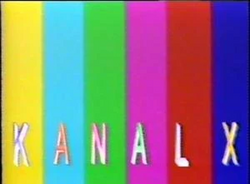
Kanal X
~ the last words ~
The transmitter put out eight watts. That covered the south of Leipzig and a slice of the city center, which in March 1990 was all Kanal X needed. It went on air on 17 March 1990, the night before East Germany held the first free election in its history, and it opened with a warning spoken straight to camera: "Vorsicht. Sie sind jetzt auf Sendung bei Kanal X. Es kann gefährlich werden. Auch für Sie. Noch können Sie abschalten." Careful, you are now on air with Kanal X, this could get dangerous, for you too, and there is still time to switch off.
The first night ran work by an East German video artist, then a homemade report about the election nobody had voted in yet, then a news bulletin lifted from CNN. The second night ended early because the station had no license to be broadcasting at all, which was the condition it operated under for its entire life.
The idea came out of an exhibition. In November 1989, weeks after the Wall opened, West German video artists showed work in Leipzig, and one of them, Ingo Günther from Düsseldorf, got talking with a Leipziger named Jörg Seyde about how much people in Leipzig were still not being told. The two decided to go on air as pirates and pulled in whoever they knew. Norbert Meissner, a video artist from Cologne whose parents had left the GDR before the Wall went up, came over to help. The practical problem was training: in East Germany you learned video at Adlershof, where the state broadcaster was, and nowhere else. Sony was asked for equipment and donated a camera with an edit suite, several thousand D-Mark of hardware given away to people with no license and no address.
What went out was a mix of local and international news with video art dropped between the items, plus the subjects the party press had never run: the environmental wreckage around Leipzig, the state of the housing stock. The street surveys were the popular part. Kanal X asked passersby about renaming streets, about the coming D-Mark, about what unification was going to feel like, and broadcast the answers unfiltered. The slogan was "Alles dreht sich um Leipzig, wir drehen mit", everything here revolves around Leipzig and we are filming along with it.
~ the record ~
| Born | 17 March 1990, the night before the GDR's first free election |
|---|---|
| Peak | Six broadcasts of roughly two hours, over the south of Leipzig on 8 watts |
| Killed | April 1991 |
| Lifespan | About thirteen months |
| Made by | Ingo Günther, Jörg Seyde and a Leipzig video crew |
| Killed by | West German media law, arriving with reunification |
~ the roof ~
The antenna stood on the roof of the building where the SED city leadership had run Leipzig. Under pressure from the Round Table the party cleared it out, and the citizens' movement groups moved in and renamed it the Haus der Demokratie. The same thing happened in Berlin, Rostock, Halle and several other cities that winter, civil society taking over the administrative buildings of the old power.
Günter Jähnig, who co-founded a disability association that still has offices in the building, described the feeling as a kind of vertigo: every time you had driven past this place there was a distance to it, and now suddenly you were inside. That a pirate station under the same roof was breaking federal media law was no secret to anyone there, and it bothered nobody. Walking down the street had been illegal eighteen months earlier.
~ six nights ~
Kanal X went on air six times. Each broadcast ran about two hours, and the station's own archive is the source for that count, which is lower than the impression its press coverage left. There was no schedule. Some nights were prerecorded tapes, some were live, and people who had read about it in the paper turned up at the studio door and were put on camera.
The premiere does not exist anymore. Tape cost money, so cassettes were recorded over and reused, and 17 March 1990 went under a later show. Two complete broadcasts survive, from October and December 1990. The Berlin taz wrote the thing up on 3 April 1990 under a headline arguing that the whole station was a work of art. Spiegel TV turned up, so did a Japanese crew. Some of the bills got paid by shooting commercials for East German products and filing segments to West German broadcasters.
This reached Turkey as a line in a news bulletin about an election, if it reached it at all, and what I find hard to get my head around now is not the politics but the arithmetic. Six broadcasts. Twelve hours of television across the year Germany changed shape, and for those twelve hours Leipzig was talking to itself on a screen rather than being talked at.
~ the bundespost ~
The end came in April 1991 and it was administrative. Unification put West German broadcasting law over the whole territory, the Bundespost began enforcing it, and the legal vacuum Kanal X had been standing in simply filled up. Operating an unlicensed transmitter now carried the prospect of prison. An application to turn the station into a licensed local broadcaster was made and refused.
The organization outlived the channel. Kanal X continued until 1994 as a registered association, producing material for other broadcasters with the same cameras. Everything that survived went to the Archiv Bürgerbewegung Leipzig: over five hundred cassettes, more than a hundred hours of it digitized, much of it people on the street being asked what the D-Mark was going to do to them. On 7 November 2024 the Leipzig city history museum screened a film about the station, thirty-four years after the first broadcast.
~ leave a rose ~
an anonymous tribute. one rose per visitor per day.
@}-->-- ... roses left here
~ leave a wreath ~
a rose fades by morning. a wreath stays on this grave for good, with your name on it.
paid once through stripe. payments are handled by OÜ Lakeview, the small company that keeps rip.so running. the money pays for the hosting and the nightly digging. adopt it and the headstone reads "maintained in memory by" you. the groundskeeper plants new wreaths at the next tending, usually within a day.
» one email a week: new graves and the anniversaries of the dead. subscribe
other phenomena: Popular Science Predictions Exchange, Bonsai Kitten, The Button, Initiative Q
also died in the 1990s: Layered, Inc., Pro-Am Sports System, Microsoft Home
~ leave a note ~
visitors before you have left these graveside notes. anonymous welcome.