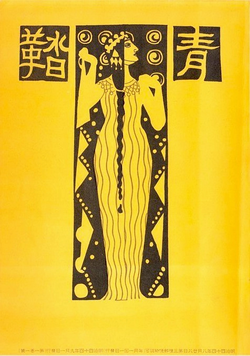
Seitō
~ the eulogy ~
"In the beginning, woman was truly the sun. An authentic person. Now she is the moon, a wan and sickly moon, dependent on another, reflecting another's brilliance." That is Hiratsuka Raichō, in the manifesto she wrote for the first issue of Seitō, and it is the sentence every history of Japanese feminism opens with. She was twenty five and had signed it with a pen name she was using for the first time.
A thousand copies went to press on 1 September 1911 at twenty five sen each. Five women founded it, nearly all of them recent graduates of Japan Women's University, which had been open barely a decade: Hiratsuka, Yasumochi Yoshiko, Nakano Hatsuko, Kiuchi Teiko and Mozume Kazuko. The society they built around it called itself the Seitōsha, after the Blue Stockings who had met in London in the 1750s, and the name in Japanese was supplied by Hiratsuka's mentor Ikuta Chōkō. The money came from members' dues at thirty sen a month and from advertising, with Hiratsuka's mother covering the rest. The first office was Mozume Kazuko's own room in her father's house.
The print run sold out. More than three thousand letters arrived at the office that month, some ordering subscriptions and some asking for personal advice from women with nowhere else to send the question. The issue opened with a poem by Yosano Akiko, already the most famous woman poet in the country, which ran ahead of the manifesto and became a slogan on its own: the day has arrived when the mountains are about to become active, and all the women who lay dormant are rousing themselves. The cover was drawn by Naganuma Chieko, later Takamura Chieko, another graduate of the same university, and shows a woman in a sleeveless western dress with her face turned up.
It launched as a literary project. Article one of the charter said the point was to advance women's literature and let each member show her innate gifts. In October 1913 that opening clause was rewritten to say the point was to urge the awakening of women, and the change of a dozen characters is where it stopped being a literary magazine.
~ the dossier ~
| Born | 1 September 1911, 1,000 copies at 25 sen, sold out |
|---|---|
| Peak | around 3,000 copies a month, over 110 contributors |
| Killed | February 1916, issue 52, with no announcement |
| Lifespan | September 1911 to February 1916 |
| Made by | the Seitōsha, thirty women led by Hiratsuka Raichō |
| Killed by | four years of bans, then pressure put on the booksellers instead |
~ the list of banned numbers ~
The censorship worked issue by issue rather than wholesale, and the record of it reads as a list of what the Japanese state could not tolerate in print. The April 1912 number was banned over a story by Araki Iku called The Letter, in which a woman remembers a night with a man she met in a tavern. Police came for the last remaining copy at the Mozume house, and the Mozume family then evicted the society from the premises, so that ban cost them their office as well as the issue.
The February 1913 supplement was banned over an article by Fukuda Hideko on the solution to the woman question, on the stated ground that its socialism disturbed public peace and order. That is the one that mattered. Hiratsuka had run those supplements specifically to repair the magazine's reputation after a bad year of newspaper coverage, and instead the ban radicalized it. June 1915 went for an article by Harada Satsuki, written as a letter from a woman in prison to a man, which argued that abortion should be legal; the ground recorded there is injury to public morals. A ban on the February 1914 number over an Itō Noe story about a woman fleeing an arranged marriage appears in English sources and not in the Japanese ones, which is roughly the state of the whole count. Four are solid. The usual figure given is five or six.
Running alongside the formal bans was the scandal coverage, which the Bluestockings partly brought on themselves and then refused to apologize for. In 1912 the contributor Otake Kōkichi wrote about a fashionable five-colored French liqueur as though she had drunk it, which she had not, and separately mentioned to journalists that members of the society had visited the Yoshiwara licensed quarter. Her uncle, a painter, had paid for that visit on the theory that women arguing about women's position ought to see what was being sold there. Three of them went, Hiratsuka among them, and talked to a courtesan. The Tokyo papers ran it for months. The term New Woman flipped meaning in the process, from a woman waking up to a woman of loose habits, and contributors in the provinces started writing under false names.
~ when itō noe took it over ~
Hiratsuka's health gave out in 1914. The September issue never appeared, October was her last as editor, and from the January 1915 number Itō Noe had the whole thing. Itō was nineteen, turning twenty that same month, and an anarchist. The handover issue carried both their statements side by side, Hiratsuka's titled Seitō and I, Itō's titled On Taking Over Seitō.
Her first act was to abolish the rules. From now on, she wrote, Seitō will have no regulations, no policies, no convictions and no principles. She opened the pages to readers and pushed the content harder toward social questions. She also translated Emma Goldman into Japanese for it. She ran it for about thirteen months.
Seven years later she was dead. On 16 September 1923, in the martial law that followed the Great Kantō earthquake, military police took Itō, the anarchist Ōsugi Sakae and Ōsugi's six year old nephew to the Kempeitai headquarters in Kōjimachi and killed all three, then put the bodies down a well. Captain Amakasu Masahiko admitted to strangling the two adults, though the autopsies showed beating that did not match his account. He was sentenced to ten years and was quietly paroled after about three. Itō was twenty eight.
~ how it actually stopped ~
There is no closing editorial anywhere in it, and no dissolution notice for the society either. The 52nd number came out in February 1916 and nothing followed it. Japanese reference works mostly file it as an indefinite suspension rather than a closure, which is the honest description: Itō left, and nobody picked it up.
By then the magazine was broke. The historian Horiba Kiyoko blames the collapse in sales on the First World War, which took the newspapers' attention off women's questions and put it somewhere else, and Seitō barely covered the war at all. And the Home Ministry had moved from banning issues to warning the distributors and bookshops that they would be fined for carrying it.
That last mechanism is the one that still reads as modern a century later. Banning a specific issue is slow and public, and it generates sympathy; the editors had absorbed four years of it without stopping. Making it expensive for the people in the middle, the ones with no stake in the argument and a business to protect, costs the state nothing and never has to be defended in public. Hiratsuka went on to found the New Women's Association in 1919 and helped get the law banning women from political activity amended in 1922. She died in 1971 at eighty five, having outlived her magazine by fifty five years.
~ leave a rose ~
an anonymous tribute. one rose per visitor per day.
@}-->-- ... roses left here
~ leave a wreath ~
a rose fades by morning. a wreath stays on this grave for good, with your name on it.
paid once through stripe. payments are handled by OÜ Lakeview, the small company that keeps rip.so running. the money pays for the hosting and the nightly digging. adopt it and the headstone reads "maintained in memory by" you. the groundskeeper plants new wreaths at the next tending, usually within a day.
» one email a week: new graves and the anniversaries of the dead. subscribe
other phenomena: COMDEX, Technorealism, Angry Penguins, People of Walmart
also died in the pre-1980s: Angry Penguins, Le Ménestrel, MITS
~ leave a note ~
visitors before you have left these graveside notes. anonymous welcome.