Le Ménestrel
~ the obituary ~
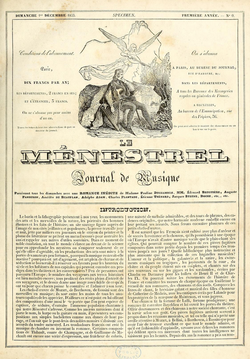
The first thing Le Ménestrel ever printed was a free sample. The sheet is dated Sunday 1 December 1833 and the number in the top right corner is not 1, it is 0, with the word SPÉCIMEN sitting between the date and the issue number. A journal de musique, printed in Paris, with an engraved angel playing a lyre across the top of the page and the terms of business laid out on either side of her. Ten francs a year in Paris. Subscriptions taken at the office of the journal, 21 rue d'Hanovre.
The strapline across the front says what you were actually buying. The paper appeared every Sunday with an unpublished romance inside it, words and music, by composers it named on the cover. First of all, a subscriber was paying for a song a week, with the criticism arranged around it.
Joseph-Hippolyte l'Henry started it, and it stayed small. Through its first decades it ran in the hundreds of copies an issue, the least of the music weeklies competing for the same few thousand Parisians who bought sheet music and went to the opera. In February 1840 it went to auction, losing money and short of the subscriptions it needed, and a new music publishing partnership between Jacques-Léopold Heugel and Jean-Antoine Meissonnier bought it. Heugel took over as director and Jules Lovy stayed on running the editorial side until his death in 1863. From that point the journal was the house organ of a publishing firm, and the free song every Sunday was that firm's catalog.
Composers wrote in it themselves. A dictionary of composers' prose indexes 64 articles in its columns: Offenbach announcing an operetta competition in July 1856, Gounod on Beethoven's Ninth in 1874, and later still Saint-Saëns and Nadia Boulanger.
~ the case file ~
| Born | Sunday 1 December 1833, a specimen issue numbered zero |
|---|---|
| Peak | a Paris weekly, a few hundred copies an issue in its early decades |
| Killed | 24 May 1940, year 102, numbers 19 to 21 |
| Lifespan | 107 years, six of them suspended |
| Made by | Joseph-Hippolyte l'Henry, then the Heugel house from 1840 |
| Killed by | the German advance on Paris |
~ issue zero ~
I keep coming back to that number 0 in the corner. A free specimen issue with no price and no subscriber attached to it is a move I know from a completely different industry: ship a working demo, let people hold it, then ask for money in the second release. Someone did that with a letterpress and an engraved angel in 1833, and it bought the thing a hundred and seven years.
What follows is stranger than it looks. The next Sunday, 8 December 1833, the masthead reads PREMIÈRE ANNÉE, N° 2. There is no n° 1 and there never was. The specimen appears to have been counted twice over, as both the zeroth number and the first, so the paper ran 0, 2, 3, 4, 5 out of the gate and nobody ever went back to fix it.
The other detail on that first sheet is the address. The main point of contact given is the bureau of the journal itself, with a street number on it, because a subscription in 1833 meant a person physically walking to rue d'Hanovre or sending money somewhere that had to be real.
~ the years it was not there ~
A hundred and seven years is the span rather than the run. Le Ménestrel stopped dead twice before it stopped for good, and both times it came back.
The issue of Sunday 28 August 1870 carries a notice telling subscribers that in the present grave circumstances the paper believes it should suspend publication for the month of September, and that everyone's subscription would shift a month later to compensate. The war with Prussia then ran over that plan entirely. The next issue appeared on 3 September 1871, a year and a week later, opening with the line that the Ménestrel was resuming after an interruption so painful, following thirty six years of regular progress. The repair job is printed on every masthead that autumn: the issues ran double-dated 1870-71, so a subscriber could bind the volume with no visible break in it. Année 37 ended up stretching from December 1869 to November 1871, swallowing the missing year whole.
The second stop had no cosmetics. The last issue before the First World War is dated Saturday 5 September 1914, the day before the Marne, and its notice says the management sees itself obliged, to its great regret, to suspend publication, in the firm hope of resuming very soon. The next issue is dated Friday 17 October 1919. The running number proves nothing came out in between: 4354 on the last one, 4355 on the first one back. Four whole years of this paper, 1915 through 1918, do not exist. The French national library has 104 years of it digitized out of a 108 year span, and the four it is missing were never printed.
~ 24 may 1940 ~
The masthead of the last issue says everything without meaning to. Across the top: 102e Année, Nos 19 à 21, Parait tous les Vendredis. Then the date line, which carries three Fridays where it should carry one, running 10 May to 24 May 1940. The address by then was rue Vivienne in the second arrondissement. A copy was one franc fifty.
It had been limping like that since the war started. The paper went quiet in July 1939 and did not come back until 8 December, and the library's index records that comeback issue as carrying numbers 29 through 49 at once, five months of a weekly compressed into a single object. From there it ran fortnightly, two numbers to an issue, until the May 1940 one took three. The German breakthrough at Sedan had come in the middle of that month and Paris fell on 14 June. There is no farewell editorial anywhere in that issue, because at the point where you fold three weeks into one you are still planning to get the next one out.
This time there was no resumption. The occupation ran four years and the French music press was reorganized around it, so when the war ended there was no Ménestrel left to bring back. It had come through the Commune and the Marne, and it stopped at the third one.
~ the house outlived the paper ~
Heugel the publisher kept going long after Heugel the journal stopped. The firm stayed independent until 1980, when it was sold to Éditions Alphonse Leduc, and the catalog it had built across a century and a half went with it. So the back half of the arrangement survived: the sheet music business that the journal had existed to advertise is still in print under another company's name, while the journal that advertised it has been dead since the spring of 1940.
What is left is a little over five thousand fascicles in the French national library's scans, which makes Le Ménestrel one of the densest single sources on French musical life in the nineteenth century. It is read now almost entirely by people looking for something else. A trade weekly that runs long enough stops being journalism and turns into evidence.
~ leave a rose ~
an anonymous tribute. one rose per visitor per day.
@}-->-- ... roses left here
~ leave a wreath ~
a rose fades by morning. a wreath stays on this grave for good, with your name on it.
paid once through stripe. payments are handled by OÜ Lakeview, the small company that keeps rip.so running. the money pays for the hosting and the nightly digging. adopt it and the headstone reads "maintained in memory by" you. the groundskeeper plants new wreaths at the next tending, usually within a day.
» one email a week: new graves and the anniversaries of the dead. subscribe
other phenomena: Esuvee, X10 Wireless Technology, COMDEX, Seitō
also died in the pre-1980s: Seitō, Angry Penguins, Vice Versa
~ leave a note ~
visitors before you have left these graveside notes. anonymous welcome.