Vice Versa
~ the eulogy ~
The entire print run was about a dozen copies. Edythe Eyde was twenty five and working as a secretary at RKO Radio Pictures in Hollywood, where her boss had given her an instruction she took more literally than he meant it: she was to look busy at her desk whether or not anything had arrived to do. Very little arrived. She used the hours typing a magazine for lesbians and called it Vice Versa.
The first issue went out in June 1947. She typed each number twice over, an original with carbons behind it, which put her somewhere around ten or twelve readable copies. That was the hard limit of the machine on her desk, since carbon paper stacked too deep stops producing a page and starts producing a smudge. There was no address on it and no name anyone could be arrested under. There was a subtitle, centered under the title in the same typewriter face: America's Gayest Magazine.
Nothing went through the post office. Federal obscenity law governed what the mails were allowed to carry, and writing that treated homosexuality as ordinary was precisely the kind of thing it was used against. So she put copies directly into the hands of women she knew and asked them to pass them on when they were finished. The distribution network was her own arm's length and whatever that reached.
I grew up on the opposite side of this problem. Around 2003 I was paying by the hour in Turkish internet cafes that existed because copying had become free and nobody could put a stop to it, which made any single copy worth close to nothing. Vice Versa ran on inverted physics. Twelve was the whole edition, and every copy was an object that had to be put into a specific person's hands. The scarcity was not a strategy, it was the shape of the law pressing down on a typewriter.
~ the dossier ~
| Born | June 1947, typed at an RKO desk in Hollywood |
|---|---|
| Peak | about a dozen copies an issue, handed over in person |
| Killed | February 1948, the ninth issue |
| Lifespan | nine monthly issues |
| Made by | Edythe Eyde, writing as Lisa Ben |
| Killed by | a new job with no idle time at the typewriter |
~ what the august number contained ~
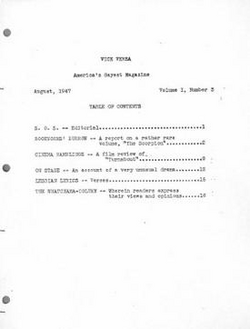
Volume one, number three, dated August 1947. The contents page lists six items, and the page numbers printed against them run up to sixteen. It opens with an editorial titled S. O. S. Then Bookworms' Burrow, described on the contents line as a report on a rather rare volume, The Scorpion. Then Cinema Ramblings, a film review of Turnabout, which was a body-swap comedy about a husband and wife who wake up in each other, picked for a magazine named Vice Versa by someone who was clearly enjoying herself.
After that comes On Stage, an account of a very unusual drama. Then Lesbian Lyrics, listed simply as verses. The issue closes with The Whatchama-Column, where readers express their views and opinions, which in practice meant a handful of women writing back to a magazine that had no return address. Eyde wrote most of what appeared under all six of those headings herself.
~ lisa ben ~
She signed her writing Lisa Ben. Rearrange the letters and it spells lesbian. Edythe D. Eyde was born in San Francisco on 7 November 1921, and the pen name outlived the magazine by nearly seventy years.
The magazine stopped because the job did. She left RKO, and the next secretarial work came with people around her desk and no private hours in it. Nine issues was where it ended. In the 1950s she turned up again in the orbit of the Daughters of Bilitis, writing for The Ladder, the organization's own magazine. She also wrote parody lyrics, taking standards and rewriting them for an audience that had no songs of its own, and performed them. She died on 22 December 2015 at ninety four.
~ where the copies went ~
For a publication with an edition in the low double digits, Vice Versa survived unusually well. Copies came through in private hands, and surviving issues now sit at ONE Archives at USC, which holds one of the largest LGBTQ collections anywhere. Scans of the issues have been online for years, which means a magazine built to be undetectable in 1947 is now one search away from anyone.
The National Lesbian and Gay Journalists Association put her in its hall of fame in 2010 and created an award in her name in 2015, giving her the first one a few months before she died. The historians who write about early American gay publishing generally start the clock at Vice Versa, which beat ONE Magazine to print by more than five years and did it with no printer and no budget.
~ leave a rose ~
an anonymous tribute. one rose per visitor per day.
@}-->-- ... roses left here
~ leave a wreath ~
a rose fades by morning. a wreath stays on this grave for good, with your name on it.
paid once through stripe. payments are handled by OÜ Lakeview, the small company that keeps rip.so running. the money pays for the hosting and the nightly digging. adopt it and the headstone reads "maintained in memory by" you. the groundskeeper plants new wreaths at the next tending, usually within a day.
» one email a week: new graves and the anniversaries of the dead. subscribe
other phenomena: Sky Scottish, iLoo, itiraf.com, User Friendly
also died in the pre-1980s: MITS, Electronic Arrays, Angry Penguins
~ leave a note ~
visitors before you have left these graveside notes. anonymous welcome.