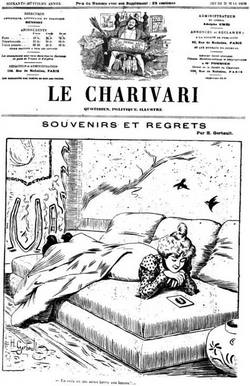
Le Charivari
~ the obit ~
Charles Philipon already published La Caricature, an anti-monarchist illustrated weekly printed on expensive paper, and the government was bleeding him with censorship fines. On 1 December 1832 he and his brother-in-law Gabriel Aubert launched a cheaper daily alongside it to spread the risk. The content was lighter and less openly political, printed on cheaper stock. It went by subscription at six francs a month. The name came from a village punishment: a charivari was the crowd that assembled outside your house banging pots and pans until you were shamed into behaving.
The press law of 9 September 1835, written after the riots of 1833 and 1834, hit Le Charivari with a hundred thousand franc bond and banned political caricature outright. The paper did not fold. It turned its draftsmen onto bourgeois daily life instead, on the lawyers and landlords of respectable Paris, and that redirection produced the work that now hangs in museums. Ownership changed hands constantly for the next few decades, mostly because of fines and stamp taxes rather than editorial failure.
It was never a big paper. Circulation fell to 800 copies a day in 1836 and recovered to a little over 2,000 the following year. In 1846 the average print run was 2,740, against 32,885 for Le Siècle. In August 1861 it sold 2,250. A daily moving a couple of thousand copies set the visual grammar for political cartooning across Europe for the next hundred years.
In 1841 the London wood engraver Ebenezer Landells and the journalist Henry Mayhew took the model wholesale and put a French noun on their own masthead. Punch carried that subtitle for the next hundred and fifty years, long after its readers had stopped knowing what it pointed at.
~ the rap sheet ~
| Born | 1 December 1832 in Paris, under Louis-Philippe |
|---|---|
| Peak | a new front-page lithograph daily, average run 2,740 copies in 1846 |
| Killed | August 1937 |
| Lifespan | 104 years |
| Made by | Charles Philipon and Gabriel Aubert |
| Killed by | collapsed sales, a year after it joined the Salengro smear campaign |
~ a drawing a day ~
Consider the daily lithograph as a production problem. Every working day for roughly fifty years, somebody drew a finished image in greasy crayon onto a prepared limestone block, and the stone went to press that night. Not a reprint, not a stock cut. A new one.
Honoré Daumier produced close to 3,900 lithographs for the paper plus hundreds of wood engravings, which is most of his life's output, delivered on a newspaper schedule. The other names on the rota were Cham, Paul Gavarni, Grandville, Gustave Doré, André Gill, Alfred Grévin, and Nadar before photography took him. After 1870 the process shifted to zincography and the stone went away, which saved time and cost the drawings some of their softness.
~ june 1926 ~
That month Le Charivari stopped being a daily. It came back as an eighteen-page illustrated weekly at one franc, run by the caricaturist Sennep, who stayed about a year. The title was then bought by the Société française des périodiques illustrés, directed by men close to Action française, and the covers went to Ralph Soupault and BiB. A paper founded to mock a king finished its run owned by the far right.
In 1936 it joined Gringoire in the campaign of lies against Roger Salengro, the Popular Front interior minister, who was falsely accused of deserting his unit in 1916. Salengro killed himself that November. Le Charivari published for another nine months of falling sales and disappeared in August 1937, a hundred and four years after Philipon's first number.
~ the second charivari ~
The title was revived in June 1957 as a bimonthly under Noël Jacquemart, a journalist of the far right, with heavy use of cartoons and three album-format specials by the caricaturist Pinatel. That version lasted until October 1976. The only thing the two Charivaris share is the word on the cover.
The original run is now scanned at the Bibliothèque nationale and you can page through a century of it for free. What does not survive the scan is the one thing a subscriber was actually paying for: the drawing on the front was about something that had happened yesterday, and tomorrow there would be another one.
~ leave a rose ~
an anonymous tribute. one rose per visitor per day.
@}-->-- ... roses left here
~ leave a wreath ~
a rose fades by morning. a wreath stays on this grave for good, with your name on it.
paid once through stripe. payments are handled by OÜ Lakeview, the small company that keeps rip.so running. the money pays for the hosting and the nightly digging. adopt it and the headstone reads "maintained in memory by" you. the groundskeeper plants new wreaths at the next tending, usually within a day.
» one email a week: new graves and the anniversaries of the dead. subscribe
other news: A.frame, Lemondrop, Faking News, INteRNeTTo
also died in the pre-1980s: Processor Technology, Stereo-Pak, Fire!!
~ leave a note ~
visitors before you have left these graveside notes. anonymous welcome.