Sovremennik
~ the obit ~
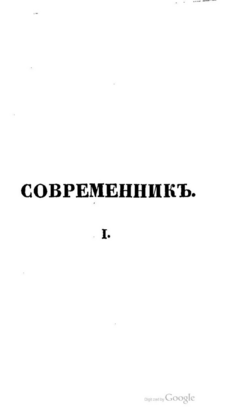
On the last day of 1835 Pushkin wrote to Count Benckendorff, head of the Third Section, asking to be allowed to publish a journal. Permission came back on 10 January 1836 and was good for one year. The first volume appeared on 11 April by the Russian calendar, 23 April by the one the rest of Europe was using, under a half-title that says only СОВРЕМЕННИКЪ and a Roman numeral one.
It did not work. The censor passed volume one at 2,400 copies and volume two at the same, then volume three at 1,200 and volume four at 900: a print order cut in half and then cut again inside eight months. The journal had about six hundred subscribers. Pushkin was losing money on it when he was killed in a duel in February 1837, and a fifth volume came out after his funeral, assembled by friends.
What saved it was a lease. Pyotr Pletnyov kept the title alive without much conviction until 10 September 1846, when he handed it over to Ivan Panaev and Nikolai Nekrasov on a ten-year arrangement at three thousand assignat rubles a year. Nekrasov took the editing from 1 January 1847 and turned a dying literary almanac into the most consequential magazine in the Russian language, which took him about eighteen months.
~ the rap sheet ~
| Born | 23 April 1836 (11 April old style), volume one, 2,400 copies |
|---|---|
| Peak | 7,125 subscribers in 1861, under Nekrasov |
| Killed | 9 June 1866 (28 May old style), by Highest Command |
| Lifespan | 30 years |
| Made by | Alexander Pushkin, licensed for one year by Nicholas I |
| Killed by | Karakozov's pistol, and a government looking for a reason |
~ what went through it first ~
Under Pushkin it carried Gogol's "The Nose" and Tyutchev. Under Nekrasov it printed Goncharov's The Same Old Story in 1847, Herzen's Who Is to Blame?, Turgenev's A Sportsman's Sketches and Rudin, and in 1852 the first thing Tolstoy ever published, Childhood, written by a twenty three year old serving in the Caucasus and signed with initials. The Sevastopol Sketches followed in 1855 while he was still at the siege.
Subscriptions tracked it. About two hundred in 1846, two thousand within a year of Nekrasov taking over, six thousand six hundred by 1860, and 7,125 in 1861, which for a thick monthly in a country with that literacy rate is an enormous number. Vissarion Belinsky set the critical line until his death in 1848, Nikolai Chernyshevsky joined in 1853 and Nikolai Dobrolyubov in 1856, and by 1860 the magazine was where the radical intelligentsia argued with itself in public.
~ the squeeze ~
Dobrolyubov died in 1861 at twenty five. Chernyshevsky was arrested on 7 July 1862 and held in the Peter and Paul Fortress, where he wrote What Is to Be Done?, which the magazine then printed across numbers three to five of 1863 after the censors somehow passed it. He was sentenced on 7 February 1864 to fourteen years of hard labor followed by lifelong Siberian exile. The emperor cut the hard labor to seven.
The journal itself had already been suspended for eight months from June 1862 for harmful direction. It came back in early 1863 with Saltykov-Shchedrin brought in to help hold it together, and with about four thousand subscribers left of the seven thousand it had before. Nekrasov spent the next three years running a magazine that the government had publicly warned once and could close whenever it felt like it.
~ 28 May 1866 ~
Dmitry Karakozov fired at Alexander II outside the Summer Garden on 4 April 1866 by the Russian calendar, and missed. Numbers of Sovremennik were among the things found on him. Nekrasov, who knew what was coming, read out a poem in praise of Count Muravyov at an English Club dinner that spring, an act of flattery so obvious that the room went cold and Moskovskie Vedomosti reported it on 20 April. It did not help. Muravyov is the one who proposed the closure.
The order was a Highest Command, announced by the chairman of the Committee of Ministers to the Minister of the Interior on 28 May 1866 by the Russian calendar, 9 June by ours. The official notice ran in Severnaya pochta on 3 June: both Sovremennik and Russkoye Slovo were terminated on the ground of their long-proved harmful direction. The editorial office had already been told on 1 June, the day the late-May number was due to go out. Subscribers were offered refunds for eight undelivered issues, so number four was the last one anybody received. Number five had been printed and was never released.
~ the name now ~
Search for Sovremennik today and you get a theater. The Moscow Sovremennik was founded in 1956 by Oleg Yefremov and a group of young actors who had trained together, and its site at sovremennik.ru is a large, busy, entirely modern operation selling tickets. The word does not appear anywhere on it in the sense of a journal. Two completely separate things picked the same ordinary Russian word for a contemporary, a hundred and twenty years apart, and the later one won the domain.
That is a kind of distance I can actually place. I read Russian nineteenth century fiction the way most people outside Russia do, in translation and out of order, with no sense of which magazine any of it first appeared in. Childhood reached me as page one of a collected Tolstoy. It reached its first readers in 1852 as an unsigned piece by somebody with initials, in a journal they had paid a subscription for and whose politics they could argue about. That second thing is what goes first when a serial dies and the books survive it.
~ leave a rose ~
an anonymous tribute. one rose per visitor per day.
@}-->-- ... roses left here
~ leave a wreath ~
a rose fades by morning. a wreath stays on this grave for good, with your name on it.
paid once through stripe. payments are handled by OÜ Lakeview, the small company that keeps rip.so running. the money pays for the hosting and the nightly digging. adopt it and the headstone reads "maintained in memory by" you. the groundskeeper plants new wreaths at the next tending, usually within a day.
» one email a week: new graves and the anniversaries of the dead. subscribe
other news: The Century Magazine, The Ladder, Mega Power, Medyakronik
also died in the pre-1980s: The Century Magazine, The Ladder, LEF
~ leave a note ~
visitors before you have left these graveside notes. anonymous welcome.