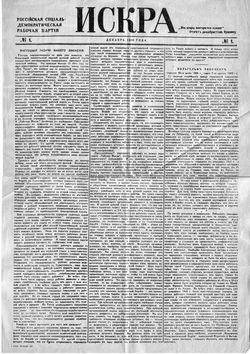
Iskra
~ the eulogy ~
Iskra was a newspaper designed around a smuggling problem. Russian socialists could not legally print anything in Russia, and the movement inside the country was a scatter of local circles that did not agree on much. Lenin's answer, worked out after his Siberian exile ended, was to publish abroad and ship the paper in, so that the distribution network would double as the party's organizational skeleton. A conference at Pskov in April 1900 approved his draft declaration for the editorial board, and Pskov became the hub for getting copies into the country.
The first number was printed in Leipzig and the masthead gives no day, only Dekabr 1900 goda. Russian historiography dates it 11 December in the old calendar, which is 24 December in the one Leipzig was using. Three thousand copies of it were found at the border on the first attempt. From the second issue the printing moved to Munich, to M. Ernst's shop on Senefelderstrasse.
It appeared monthly until 1902 and fortnightly after that, at a print run of around 8,000, which undersells it, because copies were reset and reprinted on three clandestine presses inside the empire, at Kishinev and Baku and at Uman in the Ukrainian provinces. In April 1902 the German government banned it from German soil and the board moved to London, then to Geneva in 1903. Lenin and Martov used the correspondence networks built around the paper to assemble the Second Party Congress.
That congress is where it went wrong. The RSDLP split into Bolsheviks and Mensheviks, and the fight immediately became a fight over who controlled Iskra, because Iskra was the only thing the party actually owned. Plekhanov tried to make peace with the people who had walked out over a vote to cut the editorial board from six seats to three, and told Lenin he would resign otherwise. Lenin resigned first, in November 1903, from both the board and the Party Council. Plekhanov then invited the entire old board back, and the Mensheviks had the central organ.
~ the dossier ~
| Born | 24 December 1900, printed in Leipzig, dated only December 1900 |
|---|---|
| Peak | about 8,000 copies an issue, reprinted on secret presses inside Russia |
| Killed | October 1905, with issue 112 |
| Lifespan | 4 years and 10 months, 112 issues |
| Made by | Vladimir Lenin, Georgi Plekhanov, Julius Martov and Vera Zasulich |
| Killed by | the 1903 party split, then the revolution it had been calling for |
~ number one ~
The front page of the first issue is worth looking at because it sets out the whole program in its furniture. The title runs across the top in heavy type. On the left, in small letters, the party's name. On the right, the epigraph: Iz iskry vozgoritsya plamya, from a spark a flame will flare up, credited on the page itself to the Decembrists' reply to Pushkin. The line is from Alexander Odoevsky, writing back from Siberian imprisonment.
The lead article is Lenin's, headed "The Urgent Tasks of Our Movement". The entire right-hand column of three is an obituary of Wilhelm Liebknecht, who had died near Berlin on 7 August that year. A paper calling for a Russian underground vanguard gave a third of its first front page to a German parliamentarian, which says something about where the Russian movement thought it belonged.
~ the split ~
With the Mensheviks running it, Iskra spent 1904 arguing with Lenin's faction, and the Russo-Japanese War briefly cooled things down because both sides wanted to use the war against the government. Issue 56 told social democrats to stop wasting energy on small scuffles with the police and put everything into a general struggle. In August the Central Committee proposed bringing Lenin back onto the board and calling a conciliation conference. His followers, the ones the party called the stone-hard, took that as a betrayal and in December 1904 started their own paper, Vperyod.
So the thing Iskra had been built to prevent, a movement talking past itself in separate publications, was the thing it produced. It stopped with number 112 in October 1905, in the middle of the revolution it had spent five years predicting. A paper under the same name came back in September 1917 as the organ of the Menshevik Internationalists and was closed by the Bolsheviks in December.
~ 37a clerkenwell green ~
During the London year the paper was edited out of a small office at 37a Clerkenwell Green, with the printing arranged through the Social Democratic Federation. The building had opened in 1738 as the Welsh Charity School and by then housed a succession of radical organizations. In 1933 it became the Marx Memorial Library, which it still is, Grade II listed and holding sixty thousand items of working-class history.
The other monument went up in Uman, in what is now Cherkasy Oblast, where one of the secret reprint shops worked. The plaque was in Ukrainian and said that the Leninist newspaper Iskra was reprinted here in secret in 1903. Soviet city planners put the name on streets in Moscow, Saint Petersburg and half a dozen provincial cities, and a scatter of local papers around the old union still print it on their own mastheads. None of them is this one.
~ leave a rose ~
an anonymous tribute. one rose per visitor per day.
@}-->-- ... roses left here
~ leave a wreath ~
a rose fades by morning. a wreath stays on this grave for good, with your name on it.
paid once through stripe. payments are handled by OÜ Lakeview, the small company that keeps rip.so running. the money pays for the hosting and the nightly digging. adopt it and the headstone reads "maintained in memory by" you. the groundskeeper plants new wreaths at the next tending, usually within a day.
» one email a week: new graves and the anniversaries of the dead. subscribe
other news: Radio Belgique, PC Extreme, 10 daily, Personal Computer News
also died in the pre-1980s: Radio Belgique, Mickey Mouse Magazine, The United Network
~ leave a note ~
visitors before you have left these graveside notes. anonymous welcome.