Scînteia
~ the obituary ~
The name was borrowed. Romanian revolutionaries in Bolshevik Russia had printed a Scânteia through 1919 in Odessa, and the title is a translation of Iskra, the paper Lenin ran from exile. It came back in Romania itself on 15 August 1931 as the official voice of the Communist Party, printed clandestinely in Bucharest under an editor named Gheorghi Crosnev, and it stayed illegal until 1940, when the collapse of relations with the Soviet Union made a crackdown certain. The 1953 spelling reform swapped the â for an î, which is why the paper changed the way it spelled itself halfway through.
King Michael's coup of 23 August 1944 took Romania out of the Axis, and Scânteia was back on the streets legally from 21 September. Silviu Brucan, who was on that first staff as managing editor, described his colleagues later as a collection of illiterates and working men who were anything but journalists. His line on Miron Constantinescu, the first editor in chief, was that the man needed a calligrapher and a grammarian to make his articles intelligible. Number 22, on 13 October 1944, carried a piece headed The Fascist Scoundrel Is at Work. Number 49, on 8 November, carried twelve extra pages for the anniversary of the October Revolution and almost no information in any of them.
Once the party held the state, the paper became the instrument through which the state announced what it had decided. Sorin Toma, editor from 1947 to 1960, used it to run the campaign that drove the poet Tudor Arghezi out of print. In 1961 the regime declared 15 August, the date of the paper's first Romanian issue, to be Romanian Press Day, which says exactly what the relationship was between the party organ and everybody else's newspaper. The print numbers were enormous and no reader demand produced them: 299,548,052 copies across 1965, an average of 820,679 a day.
By December 1989 it employed more than three hundred journalists and the morning run was past 1.5 million. The last editor in chief, Ion Mitran, had held the job since 1985.
~ the case file ~
| Born | 15 August 1931, printed illegally in Bucharest for the Romanian Communist Party |
|---|---|
| Peak | over 1.5 million copies a day in 1989, with more than 300 journalists |
| Killed | Friday 22 December 1989, with issue 14,726 |
| Lifespan | 58 years, less a four-year gap from 1940 |
| Made by | the Central Committee of the Romanian Communist Party |
| Killed by | the Romanian Revolution |
~ the house it was printed in ~
The paper got a building named after it, which very few newspapers manage. The Combinatul Poligrafic Casa Scînteii "I.V. Stalin" went up north of Bucharest in the Socialist Realist style that Moscow was exporting at the time, and the reference to Stalin was quietly dropped from the name during de-Stalinization. Scînteia was printed there until 1989. Young pioneers were photographed gathering at the Lenin statue in front of it.
It is still standing and it is still a press building. The name now is Casa Presei Libere, the House of the Free Press, which is a rename rather than a demolition. The paper also had a junior edition, Scînteia Tineretului, running from November 1944 for the communist youth organization.
~ number 14,726 ~
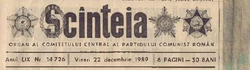
The scan is online and it settles the date better than any account of it does. Across the top: proletarians of all countries, unite. Then the nameplate, Scînteia, flanked by the orders the paper had been awarded, and under it the line organ of the Central Committee of the Romanian Communist Party. The dateline reads Anul LIX, Nr. 14 726, Vineri 22 decembrie 1989, six pages, fifty bani.
The headline across the front is about the great assembly of the working people of the Capital, over a photograph of the balcony at the Central Committee building. That assembly was the rally of 21 December, the one Ceaușescu called to condemn the events in Timișoara, and the one where the crowd broke into jeering on live television and did not stop. The paper went to press that night reporting it as a success, with the jeering left out.
The previous number, 14,725 of Thursday 21 December, had led on Comrade Nicolae Ceaușescu's speech, with a sidebar on the conclusion of his official visit of friendship to the Islamic Republic of Iran. He had been out of the country while Timișoara rose. By midday on the 22nd, while copies of 14,726 were still in circulation, he was lifting off the roof of the building on its front page.
~ the two days after ~
On 22 and 23 December a special edition appeared under the title Scînteia poporului, the people's spark, printed on one side of the sheet only. Two numbers came out that way. Then the masthead read Adevărul, with the editorial committee unchanged to begin with, which is how the organ of the Central Committee turned into a post-communist daily inside seventy-two hours.
The revolution outlawed every institution of the party, newspapers included, and most of Scînteia's assets passed to Adevărul, which is still publishing and dates itself to an older paper of that name from 1888. So the presses never stopped and the staff mostly stayed. What ended on 22 December 1989 was a word on a nameplate, and the thing it had been the organ of.
~ leave a rose ~
an anonymous tribute. one rose per visitor per day.
@}-->-- ... roses left here
~ leave a wreath ~
a rose fades by morning. a wreath stays on this grave for good, with your name on it.
paid once through stripe. payments are handled by OÜ Lakeview, the small company that keeps rip.so running. the money pays for the hosting and the nightly digging. adopt it and the headstone reads "maintained in memory by" you. the groundskeeper plants new wreaths at the next tending, usually within a day.
» one email a week: new graves and the anniversaries of the dead. subscribe
other news: Linux Journal, Trio, Yahoo India, Google News & Weather
also died in the 1980s: Telidon, Microtex 666, Commodore Plus/4
~ leave a note ~
visitors before you have left these graveside notes. anonymous welcome.