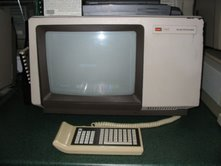
Telidon
~ the obit ~
Telidon stopped getting money the year I turned one. My first modem came thirteen years after that, and by then the question it had been built to answer was already settled. What makes it worth reading about now is how reasonable the wrong answer looked at the time. The bet was that the screen you would use for information at home would be a terminal you rented from the phone company, not a computer you bought.
The work started at the Communications Research Centre outside Ottawa in the 1970s, under a team led by Herb Bown, and the Department of Communications announced it publicly on 15 August 1978 with a four year development plan attached. The technical argument was real. European videotex drew its pictures by assembling blocks from a fixed character set, which meant the picture was locked to one grid forever. Telidon sent a description of the drawing instead, a set of instructions the terminal executed at whatever resolution it had. Put the same page on a better screen and you got a better picture with no change to the page. By early 1983 the approach had been standardized as NAPLPS, with AT&T contributing custom character sets and graphics macros.
The money was serious. Ottawa spent sixty nine million dollars, and industry partners put in something like two hundred million more, with Bell Canada alone accounting for half of that. It bought a decade of trials. Project Ida went live in South Headingley, Manitoba in 1980. Bell Canada's Vista ran in Toronto and Montreal with newspaper partners and somewhere between five hundred and a thousand terminals. Grassroots pushed twenty thousand pages of market prices and weather to prairie farmers, eventually reaching into the northern United States. Teleguide put touch screen kiosks in Toronto shopping malls. Down south, AT&T and CBS ran Venture One in New Jersey through 1982 and 1983, and Knight-Ridder's Viewtron used the standard in Florida.
~ the rap sheet ~
| Born | 15 August 1978, announced by the Department of Communications |
|---|---|
| Peak | Grassroots ran 20,000 pages of farm data, Vista put out 500 to 1,000 terminals |
| Killed | 31 March 1985 |
| Lifespan | six and a half years of federal money |
| Made by | the Communications Research Centre, under Herb Bown |
| Killed by | a $2,000 terminal that did one thing, in the years computers got cheap |
~ the price of the box ~
The government's own projection in 1978 was that terminals would fall to two or three hundred dollars by 1982. They landed between eighteen hundred and twenty five hundred, and stayed there. Late in the program AT&T got its Sceptre terminal down to four hundred, which was still four hundred dollars for a device that received one kind of service from one kind of provider.
That number is the whole story. A home computer in the same window cost a fraction of it and ran anything you fed it, including a modem and a terminal program that got you onto CompuServe. Telidon's graphics were better than what those machines put on screen in 1980 and worse than what they put on screen by 1985. The hardware curve went the wrong way underneath a standard that assumed the terminal would stay dumb.
~ what ran out ~
The trials kept discovering the same thing. People went through the pages in whatever they cared about faster than anyone could write more. A farmer would read every page of grain prices in a sitting. A shopper would exhaust the mall directory in ten minutes. The internal conclusion was that a system like this needed hundreds of thousands of pages to hold anyone, and the services had thousands.
Nobody had solved who writes all of that. The answer turned out to be everybody, for free, on a network with no central page budget, but that answer was fifteen years away and required the thing Telidon was designed to avoid: a general purpose computer at both ends.
~ the day the money stopped ~
Canadian government support ended on 31 March 1985. The commercial services went down around it rather than with it. NBC closed its system in January 1985, and ExtraVision along with Viewtron lasted until March 1986. Alex, the Bell Canada service that carried the technology furthest into the consumer market, did not launch in Montreal until December 1988 and died in 1994, which is how long a well funded idea can keep walking after the funding is gone.
What survived was the encoding. NAPLPS outlived the terminals and became the graphical basis of Prodigy in the United States into the early 1990s, which means millions of Americans looked at a Canadian graphics standard every evening without ever hearing the name. That is a strange kind of afterlife for a project whose entire pitch was that the picture would be worth the box.
~ leave a rose ~
an anonymous tribute. one rose per visitor per day.
@}-->-- ... roses left here
~ leave a wreath ~
a rose fades by morning. a wreath stays on this grave for good, with your name on it.
from $1, paid once through stripe. it keeps the graveyard running: the hosting and the nightly digging. adopt it and the headstone reads "maintained in memory by" you. the groundskeeper plants new wreaths at the next tending, usually within a day.
» one email a week: new graves and the anniversaries of the dead. subscribe
other protocols: OpenNI, WTLS, Minitel, NoseRub
also died in the 1980s: Microtex 666, Commodore Plus/4, Sord M5
~ leave a note ~
visitors before you have left these graveside notes. anonymous welcome.