Viewtron
~ the goodbye ~
Viewtron was switched off before I could read a sentence, so there is no version of this where I have a memory to hand over. What carries across is not the product. It is what the product found out.
Knight-Ridder built an online newspaper and then discovered that the people paying for it did not particularly want the newspaper. They wanted the mail and the live chat. That finding was sitting in a Florida subscriber report in 1985, and about fifteen years later I got a phone line in Turkey and did exactly the same thing with it. Nobody had to teach me. The news was available on the same connection and I was in a chat window.
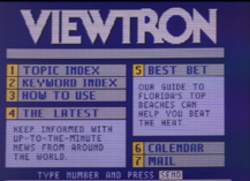
The service went live on 30 October 1983 across four counties around Miami, after six years of research that included a test in a hundred and twenty-five well-off homes in Coral Gables. It was videotex, patterned on the British Post Office's Prestel, running on a Tandem host with the pages drawn in NAPLPS graphics. The AT&T Sceptre terminal it needed was a dedicated appliance with a chiclet keyboard, and it cost nine hundred dollars, later cut to six.
The pricing kept moving because nothing worked. After May 1984 the terminal was rental only at $39.95 a month with the subscription included. Everybody else paid twelve dollars a month plus a dollar an hour. From October 1985 the service went national over Tymnet and Telenet with a surcharge of nine cents a minute at night and twenty-two during the working day, which is the tariff of a company that has stopped expecting volume.
~ the chronicle ~
| Born | 30 October 1983, in four counties around Miami |
|---|---|
| Peak | 20,000 subscribers nationally, up from 3,000 |
| Killed | 31 March 1986 |
| Lifespan | two years and five months |
| Made by | Knight-Ridder, with AT&T |
| Killed by | a newspaper company deciding it did not want to be an online service |
~ what people actually used it for ~
After it went national the subscriber base moved from three thousand to twenty thousand, which looked like the curve finally starting. Underneath it, the majority were canceling within six months, and the logs showed the heaviest use was not on the news feeds Knight-Ridder was spending its budget to produce. It was the email and the chatline. One account of the period puts it at roughly eighty percent of the budget going into news that generated under twenty percent of the revenue.
That is a company being told the answer in the clearest possible terms and reading it as a disappointment. The demand was for a way to reach other people. Knight-Ridder had built a delivery pipe and measured the wrong end of it.
~ the postmortem ~
Shortly after launch, vice president Reid Ashe circulated an internal memo about slow sales and infrequent use, concluding that customers treated the service as a toy. The memo contained a crossed-out passage warning that this business would not follow the newspaper model, that it would have lower barriers to entry and thinner margins. Somebody drew a line through the one paragraph that turned out to be correct.
The Independent Commodore Users Group tried to buy the service and the negotiation failed. It closed on 31 March 1986. AT&T had put over a hundred million into videotex and wrote it off as part of the court-ordered breakup of the Bell System, so the total burned on the idea was several times what Knight-Ridder admitted to.
~ the inheritance ~
Philip Meyer, who ran news and circulation research at Knight-Ridder then, gave the postmortem afterward. "We made the mistake of thinking in newspaper analogies. Thus the central computer was like a printing press in our minds, and telephone wires were the delivery trucks." That is a company describing the exact shape of what it could not see.
Knight-Ridder went back to its core business, which was newspapers, and ten years later was putting those newspapers on the web at a loss like everybody else. The information it needed to avoid the second decade of that was in its own subscriber data in 1985. It had already run the experiment and paid for the answer.
~ leave a rose ~
an anonymous tribute. one rose per visitor per day.
@}-->-- ... roses left here
~ leave a wreath ~
a rose fades by morning. a wreath stays on this grave for good, with your name on it.
from $1, paid once through stripe. it keeps the graveyard running: the hosting and the nightly digging. adopt it and the headstone reads "maintained in memory by" you. the groundskeeper plants new wreaths at the next tending, usually within a day.
» one email a week: new graves and the anniversaries of the dead. subscribe
other online services: Amazon Restaurants, malariacontrol.net, Slando, Make School
also died in the 1980s: TI-99/4A, NABU Network, Vectrex
~ leave a note ~
visitors before you have left these graveside notes. anonymous welcome.