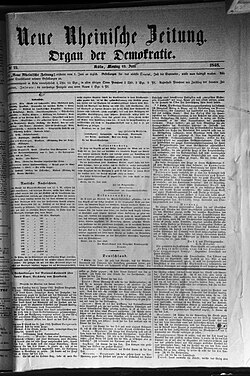
Neue Rheinische Zeitung
~ the obit ~
Marx had done this once before. He joined the editorial board of the Rheinische Zeitung in Cologne on 15 October 1842, when its subscriptions had fallen to 885; they later climbed past 3,000, at which point the Prussian cabinet met with the king present and decided in January 1843 to suppress it. He resigned on 17 March and the paper was closed on 31 March anyway. He came back to Cologne in April 1848 with a revolution running across the German states and started a second one named after the first.
The Neue Rheinische Zeitung published its first number on 1 June 1848: a four-page broadsheet with occasional supplements, carrying the subtitle Organ der Demokratie, a phrase that in 1848 pointed at the revolutionary democratic front across the German states. The board was seven men including Friedrich Engels, Wilhelm Wolff, Georg Weerth and Ernst Dronke, with Marx as editor in chief holding undisputed control of the line. It was financed by selling shares and taking loans, with paid advertising on top. Circulation ran between three and six thousand copies a number.
Prussia sued it repeatedly for slandering officials. In September 1848 a state of siege in Cologne forced it to suspend entirely, and a restart only became possible in mid-October. On 2 March 1849 soldiers arrived at Marx's house to arrest one of the writers; he refused to hand the man over and they eventually left. Then on 16 May a royal government note told Marx that the right of hospitality which he had so disgracefully abused was being withdrawn, that he was ordered out within twenty-four hours, and that otherwise he would be forcibly conveyed across the frontier. That order killed the paper.
What I had never pictured, before reading about this thing, was Marx as a working editor with a press run and a daily deadline. The standard image is a man in a library. The Neue Rheinische Zeitung was a commercial product that had to come out every morning and be paid for by subscribers, and the state closed it down by deporting the man who edited it.
~ the rap sheet ~
| Born | 1 June 1848, Cologne, in the middle of the German revolution |
|---|---|
| Peak | 6,000 subscribers on the rolls when it was suppressed |
| Killed | 19 May 1849 |
| Lifespan | 11 months, 301 numbers |
| Made by | Karl Marx as editor in chief, on a board of seven that included Friedrich Engels |
| Killed by | a Prussian expulsion order giving Marx 24 hours |
~ the red issue ~
Number 301 appeared on 19 May 1849, printed from end to end in red ink. Marx used the front of it to answer the expulsion order directly, asking why the official phrases and the official lies, and pointing out that anyone reading the paper's reporting on the European movement could hardly have failed to see the red thread running through all of it. The closing line is the one that gets quoted: we have no compassion and we ask no compassion from you.
Eleven months is a short life for a daily paper, and this one barely outlasted the revolution it was covering. Number 1 came out on 1 June 1848 and number 301 on 19 May 1849, with a forced suspension in between that ran from September into mid-October 1848.
~ three hundred and one numbers ~
The best known thing it published is a series of five articles on economics that Marx ran in April 1849 and never finished, because the suppression arrived first. They were collected in 1880 as Wage Labour and Capital and revised by Engels in 1891, which is the form most people have read them in. Marx himself contributed not fewer than eighty pieces to the paper.
Nobody can give an exact number, because contributions were unsigned and the manuscripts did not survive. English readers did not get most of it at all until 1977, when the Marx and Engels Collected Works published 357 of the 422 surviving articles in English for the first time, a hundred and twenty-eight years after the last one was set in type.
~ the name afterward ~
In January 1850 Marx started a monthly called Neue Rheinische Zeitung: Politisch-oekonomische Revue, edited from London and printed in Hamburg. It managed six issues. In 2005 an online paper in Cologne picked the name up again, and nrhz.de still answers today, which makes the title older than almost anything else in this cemetery and the publication under it younger than most.
~ leave a rose ~
an anonymous tribute. one rose per visitor per day.
@}-->-- ... roses left here
~ leave a wreath ~
a rose fades by morning. a wreath stays on this grave for good, with your name on it.
paid once through stripe. payments are handled by OÜ Lakeview, the small company that keeps rip.so running. the money pays for the hosting and the nightly digging. adopt it and the headstone reads "maintained in memory by" you. the groundskeeper plants new wreaths at the next tending, usually within a day.
» one email a week: new graves and the anniversaries of the dead. subscribe
other news: Engadget Japan, The Memory Hole, Amiga Force, Trove
also died in the pre-1980s: Eckert-Mauchly Computer Corporation, Polavision, Four Color
~ leave a note ~
visitors before you have left these graveside notes. anonymous welcome.