Amiga Force
~ the obit ~
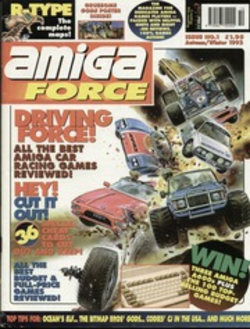
Amiga Force arrived at the end of 1992 from Europress Impact, which was assembling a stable of games magazines with Force in the title. Issue one carries no month, only Autumn/Winter 1992, which is why nobody agrees on its birthday: the Amiga Magazine Rack files it as November to December, and Wikipedia says it reached shops around September. It cost one pound ninety five for eighty four pages, Steve Shields was the editor, and the cover sold a feature on Amiga driving games over a photograph of cars coming apart in midair.
I was eight years old and on the wrong continent when issue one reached the shelves, and the computer I eventually got was a PC. Commodore International announced its own liquidation in April 1994, a month after this magazine's final issue, so the entire run sits inside the last stretch when the Amiga still had a future on paper. The scans are worth opening for the cover price alone: under two pounds, aimed at pocket money rather than at an enthusiast's budget.
~ the rap sheet ~
| Born | 1992, issue one cover-dated Autumn/Winter at £1.95 |
|---|---|
| Peak | 84 pages a month, 56 games reviewed in a single issue by the end |
| Killed | issue 16, March 1994 |
| Lifespan | sixteen issues across about eighteen months |
| Made by | Europress Impact, renamed Impact Magazines during 1993 |
| Killed by | its publisher going bust |
~ the no-disk decision ~
By 1992 the British Amiga magazine was a disk delivery system with paper wrapped around it. Amiga Format and Amiga Power and the rest competed on what was glued to the front, because a coverdisk with a playable demo on it was the most dependable way most readers were going to get new software onto the machine. Amiga Force went the other way and shipped without one.
That reads as a cost decision and probably was. A coverdisk meant a duplication run and a bagging line, and all of it had to come out of a cover price under two pounds. The consequence is that the magazine had to be worth buying for the writing, in a market where plenty of readers were buying the plastic and taking the magazine home as packaging.
~ the scores drift ~
You can watch the thing change shape across its own run. Issue one reviews fifteen games and the average score is eighty six percent, which is the number a new magazine posts when it is reviewing the classics everyone already owns and trying to be liked. Issue sixteen reviews fifty six games and averages seventy one percent. More coverage and harder marking, inside eighteen months, by an editorial team that had stopped being polite about budget rereleases.
The last issue is dated March 1994 and cost two pounds twenty five. Nick Roberts was editing by then and the cover is selling CD32 full motion video alongside a Jurassic Park review, which dates it precisely: Commodore's CD console was six months old and about to lose its parent company.
~ the day the publisher went ~
Europress Impact became Impact Magazines partway through 1993, and the scan credits catch the change happening between the February and August issues. In March 1994 the company went bust and took every title with it, Amiga Force included. One retrospective from the Commodore side claims Amiga Force was among the handful in the stable actually making money when it closed, which if true puts it in the worst category a magazine can occupy: profitable, and shut anyway, because the accounts that mattered were upstairs.
~ leave a rose ~
an anonymous tribute. one rose per visitor per day.
@}-->-- ... roses left here
~ leave a wreath ~
a rose fades by morning. a wreath stays on this grave for good, with your name on it.
paid once through stripe. payments are handled by OÜ Lakeview, the small company that keeps rip.so running. the money pays for the hosting and the nightly digging. adopt it and the headstone reads "maintained in memory by" you. the groundskeeper plants new wreaths at the next tending, usually within a day.
» one email a week: new graves and the anniversaries of the dead. subscribe
other news: The Memory Hole, Engadget Japan, Inkstone News, Galge.com
also died in the 1990s: Autodesk Animator, Yggdrasil Linux/GNU/X, CyberFlix
~ leave a note ~
visitors before you have left these graveside notes. anonymous welcome.