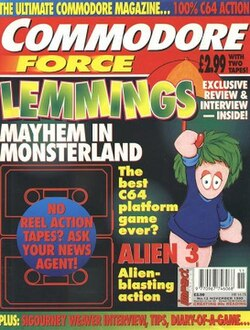
Commodore Force
~ the obit ~
Commodore Force lasted sixteen months and sold entirely through British newsagents, which puts it a long way from a Turkish kid in 1993. The C64 did get to me eventually, secondhand and years late, and by then the magazines built around it had all shut.
Commodore Force was Zzap!64 under a different name. The change was announced in Zzap! issue 90, where editor Steve Shields told readers the world had moved on since 1985 and the magazine needed to move with it. The real reason was simpler. Europress Impact already published Amiga Force and Sega Force, and a single "Force" brand was something an advertising agency could buy in one conversation. The new name was not for the readers. It was for the media buyers.
Issue 1 went on sale on 26 November 1992 with Oliver Frey's Lemmings painting on the cover, and the tape carried the first Lemmings most C64 owners had seen running on their own hardware. Lloyd Mangram was back on the letters page, which mattered a great deal to anyone who had read Zzap! since the eighties. Mangram was never a real person, just whoever happened to be editing, but removing him had been read as contempt for the readership and bringing him back was the apology.
~ the rap sheet ~
| Born | 26 November 1992, cover-dated January 1993 |
|---|---|
| Peak | one of only two profitable titles in the Impact stable |
| Killed | March 1994, at issue 16 |
| Lifespan | 16 months, 16 issues |
| Made by | Europress Impact, renamed Impact Magazines at issue 4 |
| Killed by | its publisher going into administration |
~ the funny part ~
That first issue, on sale in late November, was cover-dated January 1993. Everything after it inherited the gap, so the Christmas content landed in an issue labeled February and the newsagents spent months filing it wrong. The staff eventually fixed the drift by calling issue 11 an autumn special and quietly resetting the calendar.
There was a running feud with Commodore Format too, which outsold it. Force called its rival a PD fanzine and called itself the world's biggest C64 magazine. It ran a technical section called The Mighty Brian, named to mock Commodore Format's Mighty Brain letters page, written by Andrew Fisher, who went on to freelance for Commodore Format.
~ what was on the tapes ~
Europress knew what it was. The publisher privately treated its magazines as second purchases, the one you bought after the Future title you actually read, so each had to justify itself with something specific. For Commodore Force that was the tapes: two cassettes every month, in red and blue, carrying a full game plus a monthly cheat utility called Easy Lives. Issue 9 had The Blues Brothers on it, eighteen months after Titus had been selling the same game at full retail price, and issue 10 had Barbarian 2.
James Price, who edited from issue 10, later described assembling those tapes as a spirit-crushing job. Impact had no email, so licensing a game meant tracking a publisher down by phone and fax. Several of the games came through a deal with the compilation house Beau Jolly, and the Barbarian 2 coup turned out to be a problem: US Gold's budget label was still selling the game at retail, and Beau Jolly had not been in a position to license it in the first place.
~ the receivers ~
The last weeks read like a magazine being wound down by accountants. Ian Osborne, who was there, says the decision came down to cut the page count to 16 and have each issue put together by a freelance team of Impact staff in their own time. Issue 16, cover-dated March 1994, carried no new reviews at all and filled its space with reprinted cheats and tips.
Issue 17 was finished anyway, everything except the cover tape pages, and it had a proper reviews and previews section for the first time in months. Julian Gollop's Laser Squad was signed as the lead game for the tape. The issue was due in shops on 10 March 1994 and Impact went under before it reached a printer.
Every title in the stable closed with the publisher, including the two that had been making money, Commodore Force and Amiga Force. One thing did outlive it. Ian Osborne's column on unreleased C64 games, That Was The Game That Wasn't, became the model for the Games That Weren't archive, which has been running for longer than the magazine that invented it lasted.
~ leave a rose ~
an anonymous tribute. one rose per visitor per day.
@}-->-- ... roses left here
~ leave a wreath ~
a rose fades by morning. a wreath stays on this grave for good, with your name on it.
paid once through stripe. payments are handled by OÜ Lakeview, the small company that keeps rip.so running. the money pays for the hosting and the nightly digging. adopt it and the headstone reads "maintained in memory by" you. the groundskeeper plants new wreaths at the next tending, usually within a day.
» one email a week: new graves and the anniversaries of the dead. subscribe
other news: A Plus, paidContent, Crispy Gamer, Picture Post
also died in the 1990s: GO Corporation, Intellivision, Kiva Software
~ leave a note ~
visitors before you have left these graveside notes. anonymous welcome.