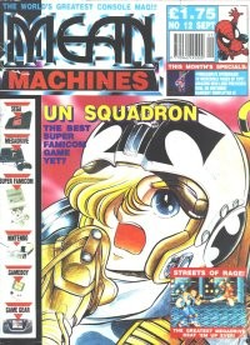
Mean Machines
~ the goodbye ~
Issue 24 reached the newsagents at the end of August 1992 with a September cover date, and the editorial inside opened with four words: "Mean Machines is dead!" Julian Rignall wrote that line, which was his right, because he had invented the magazine. Nothing had gone wrong. It was selling around 130,000 copies a month and EMAP had decided to cut it in half anyway.
The name started as a section rather than a magazine. Rignall built a console page into Computer and Video Games for the October 1987 issue, at a point when the British games press was still mostly about the ZX Spectrum and the Commodore 64, and the section grew until there was a Mean Machines Megaclub and a readership that clearly wanted its own title. He got a budget for a dummy, a sixteen page object now known as Issue Zero, of which about ten copies were ever printed. Designer Gary Harrod spent two weeks with him on the look and the tone. The real first issue went on sale in October 1990 with a conservative print run of roughly 35,000, and it sold out.
Issue one covered the Mega Drive, the Master System, the NES and the Game Boy, plus the Amstrad GX4000, which was off the market so fast that the Super Nintendo took its slot in the magazine's attention. Inside twelve months it was clearing 100,000 copies a month. In its second year it was the biggest selling console magazine in the country, and its publisher was already planning to take it apart for reasons of market structure rather than money.
It shut when I was eight years old, in a country where it was never on sale. Turkish consoles in that period arrived the same way British ones did, through importers rather than official distribution, so the problem the magazine existed to solve is one I recognize. The solution was not. No Turkish magazine was doing that job in 1992, and the English ones only became reachable for me once the web arrived, by which point print games journalism was fifteen years into its decline.
~ the chronicle ~
| Born | October 1990, after a dummy issue printed ten times |
|---|---|
| Peak | around 130,000 copies a month in 1992 |
| Killed | September 1992, with issue 24 |
| Lifespan | two years and 24 issues |
| Made by | EMAP, out of a console section inside Computer and Video Games |
| Killed by | its own publisher, cutting a healthy magazine into two smaller ones |
~ the import problem ~
Mega Drives and PC Engines turned up in Britain before Sega and NEC had any interest in selling them there properly. Small retailers brought machines in from Japan, modified them for British televisions and sold them on at a markup, and the games came along the same route. That is the market Mean Machines was built for. Following the lead of its parent magazine, it reviewed domestic and imported releases together, which meant a reader could read a full review of a game that would not have a UK release for another four months, if it ever got one.
It also meant the magazine was describing hardware most of its readers did not own and could only aspire to. Later territory lockouts and faster European release schedules made importing a niche hobby, and the specific gap Mean Machines sat in closed behind it.
~ mean yob ~
The letters page was run by a character called the Mean Yob, who did not exist. Rignall had started answering mail under the Yob name in CVG to make a dull page less dull, brought the persona across, and then made it considerably ruder. Readers wrote in specifically to be insulted by him.
The volume was real. A new gray sack of mail arrived at the office daily, and sorting it fell to a young staff writer named Richard Leadbetter, who later built Digital Foundry and spent his career measuring frame rates instead. The magazine's house tone, loud and completely sure of itself, is what British games writing spent the following decade either copying or apologizing for.
~ the split ~
After 24 issues EMAP decided the console market had resolved into two camps and that the magazine should follow. Mean Machines Sega and Nintendo Magazine System both launched in October 1992, the second one officially endorsed by Nintendo, and between them they were supposed to cover what one title had been covering. Nintendo Magazine System launched well, then settled below where the original had peaked. Mean Machines Sega started sliding, and at the end of 1993 EMAP launched Sega Magazine, which competed with its own independent Sega title.
Mean Machines Sega ran until 1997, after which the staff were folded into Official Sega Saturn Magazine. Nintendo Magazine System kept renaming itself until Future took the Nintendo license away from EMAP. The last thing to carry the name was Mean Machines PlayStation, which managed six issues with none of the original people on it and folded once Sony's own official magazine arrived. A title that peaked at 130,000 copies was replaced by a chain of smaller magazines, each one shorter lived than the last.
~ leave a rose ~
an anonymous tribute. one rose per visitor per day.
@}-->-- ... roses left here
~ leave a wreath ~
a rose fades by morning. a wreath stays on this grave for good, with your name on it.
paid once through stripe. payments are handled by OÜ Lakeview, the small company that keeps rip.so running. the money pays for the hosting and the nightly digging. adopt it and the headstone reads "maintained in memory by" you. the groundskeeper plants new wreaths at the next tending, usually within a day.
» one email a week: new graves and the anniversaries of the dead. subscribe
other news: Yankee Group, The Boston Phoenix, Creative Computing, Amstrad Computer User
also died in the 1990s: The Shadow of Yserbius, Livingston Enterprises, TBBS (The Bread Board System)
~ leave a note ~
visitors before you have left these graveside notes. anonymous welcome.