Amstrad Computer User
~ the goodbye ~
Amsoft was Amstrad's own software division, and in the autumn of 1984 it began printing a magazine about the computer Amstrad was selling. The first one carries the date August/September 1984 across 32 pages, and it is not called Amstrad Computer User. It is called CPC 464 User, subtitled The Official Amstrad Micro Magazine, and the only editorial credit in it is a consultant editor, Gareth Jefferson. So the magazine reviewing the CPC 464 was printed by the firm selling it. The first couple of issues went to members of the Amstrad User Club and nowhere else.
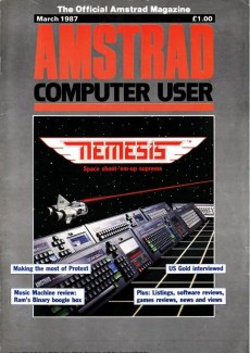
Issue 3, dated January/February 1985, was the first one a stranger could buy. It cost 95p, ran 84 pages, carried a slightly different title again, and credited Simon Rockman as editor. From issue 4 it went monthly. In June 1985, a month after the CPC 664 appeared on the cover, the masthead settled into the name it would carry to the end, and the Gallup software chart started running inside it.
What the magazine chose to be is the interesting part. Readers called it ACU, and it spent its pages on hardware and the technical side of the Amstrad range, with games pushed into a small section at the back. Circulation audited at 63,599 copies for January to June 1987, which was the high point. The final issue shipped when I was eight, in a country the CPC never had any real presence in, so what I have of it is a scan collection on the Internet Archive and nothing in my hands.
~ the chronicle ~
| Born | August/September 1984, as CPC 464 User, 32 pages |
|---|---|
| Peak | 63,599 copies audited January to June 1987 |
| Killed | May 1992, issue 90, published by HHL Publishing |
| Lifespan | 7 years, 9 months |
| Made by | Amsoft, a division of Amstrad, then four more publishers |
| Killed by | a CPC readership big enough for one magazine, and it was the other one |
~ five publishers in ninety issues ~
A house organ has a structural problem: the company paying for it also makes the thing being reviewed. Amstrad solved this by letting the magazine go. Amsoft handed it to Avralite, then Focus Magazines took over from March 1989, then the imprint went back to Avralite in July, then to MCM under the MCPC division from August 1990, and the last issue came out under HHL Publishing. One title, five publishers, and the readers mostly did not notice because the staff changed more often than the owners did.
~ 1989, four editors ~
Simon Rockman edited it for four years and then 1989 happened. Mark Evans arrived in April with a new assistant editor and a new office. Both were gone by May, replaced by Duncan Evans and a new staff writer. July brought Carlo Jolly along with a redesigned cover logo. October brought Guy Matthews. Chris Knight took the chair in June 1990 and held it until the end.
The games pages tell the same story in miniature. Scores went from star awards to percentages, then to a bar that filled up as the game got better, then back to percentages, then in April 1990 to a picture standing in for the number, which is how Laser Squad came to be rated with a sparkling smile. The section itself was renamed Meltdown in 1989 and was called Bomb Alley by August 1991. None of this is what a confident magazine does.
~ the successor that lasted six issues ~
The last issue of ACU is dated May 1992 and its farewell piece on page 6 is headed Say Hello, Wave Goodbye. Inside the same issue, HHL Publishing ran a two-page preview of CPC Attack!, the title replacing it, and an ad looking for people to staff it. CPC Attack! launched in June 1992 with a Tank Girl-style mascot named Amy Strad and a pair of 3D glasses taped to issue 1. It also ran features on the Mega Drive and the SNES, in a magazine about an 8-bit computer.
It closed in November 1992 after six issues. Amstrad Action, the independent rival ACU had spent eight years being more serious than, carried on until June 1995.
~ leave a rose ~
an anonymous tribute. one rose per visitor per day.
@}-->-- ... roses left here
~ leave a wreath ~
a rose fades by morning. a wreath stays on this grave for good, with your name on it.
paid once through stripe. payments are handled by OÜ Lakeview, the small company that keeps rip.so running. the money pays for the hosting and the nightly digging. adopt it and the headstone reads "maintained in memory by" you. the groundskeeper plants new wreaths at the next tending, usually within a day.
» one email a week: new graves and the anniversaries of the dead. subscribe
other news: Creative Computing, NTK, The Boston Phoenix, Gossip Cop
also died in the 1990s: STB Systems, The Shadow of Yserbius, Livingston Enterprises
~ leave a note ~
visitors before you have left these graveside notes. anonymous welcome.