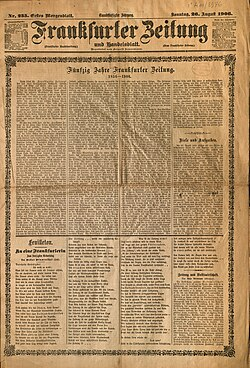
Frankfurter Zeitung
» see frankfurterzeitung.de as it lived, on the wayback machine
~ the last words ~
In 1856 Leopold Sonnemann bought a struggling Frankfurt market letter and gave it a new name. Political news and commentary started appearing next to the commodity prices. By the founding of the German Empire in 1871 the Frankfurter Zeitung had become the main voice of the liberal bourgeois opposition that sat outside parliament. It argued for peace in Europe before 1914 and kept arguing for it during the war.
It had been banned once already. Prussia occupied Frankfurt in July 1866 and shut the paper down, so Sonnemann moved to Stuttgart and kept his subscribers supplied for three months with a substitute sheet called the Neue Deutsche Zeitung. On 16 November 1866 the paper reappeared in Frankfurt under its own name. That was the pattern for the next seventy-seven years: suppressed, then back again.
Under Weimar it supported the republic and backed Stresemann's reconciliation policy through the 1920s, which made it one of very few genuinely democratic papers in the country and a standing target for the nationalist right. Its reputation rested on the feuilleton, edited by Benno Reifenberg, where Joseph Roth published hundreds of pieces between 1923 and 1933. Siegfried Kracauer ran the Berlin feuilleton. Walter Benjamin wrote for it.
Everything above happened long before I was alive, and a German liberal daily killed in 1943 has no personal thread to this site at all. It does have a Turkish one, and that part rarely gets mentioned.
~ the record ~
| Born | 1856, Leopold Sonnemann bought a failing Frankfurt market letter |
|---|---|
| Peak | the Weimar feuilleton, with hundreds of Joseph Roth pieces between 1923 and 1933 |
| Killed | 31 August 1943, banned by Hitler in May |
| Lifespan | 87 years |
| Made by | Leopold Sonnemann, then IG Farben, then the Nazi party's own publisher |
| Killed by | one article about Dietrich Eckart, printed 23 March 1943 |
~ the Constantinople bureau ~
The paper ran a news bureau in Constantinople, and the man in charge of it was Paul Weitz, a hard critic of German militarism and of his own government's secret cooperation with the genocidal policies of the Young Turks. Around him worked Max Rudolf Kaufmann, a Swiss-born journalist arrested and deported in 1916 for criticizing German militarism and for letters to Berlin describing the state of the Ottoman army in the Caucasus.
Also on that desk was Friedrich Schrader, who by 1914 had more than two decades in the city behind him and commanded every major language of southeastern Europe and the Middle East. He stayed through the war years and wrote for German readers about modern Turkish literature, which in a Frankfurt commercial daily was nobody's idea of a circulation driver.
~ what Goebbels kept it for ~
After 1933 the Jewish contributors had to go, Kracauer and Benjamin among them, and the Jewish publisher Heinrich Simon was forced under the Schriftleitergesetz to surrender his ownership. Goebbels then protected what was left, because a paper that still printed the occasional critical article was useful abroad as evidence of a freedom that no longer existed at home.
The paper used the gap. On 17 June 1934 it was the only publication in Germany to print von Papen's Marburg speech, in its evening edition, from a text someone had slipped to the newsroom. The edition was confiscated and the speech was banned. In June 1934 the title was sold to IG Farben, whose directors liked its place in German life and thought it good publicity; within a few years they gave it up, having concluded there was no longer any domestic public opinion left to influence. In 1938 it was sold again, quietly, to a subsidiary of the Nazi party's own publishing house.
~ the Eckart article ~
On 23 March 1943 the paper published a piece by Herbert Kuesel about Dietrich Eckart, the man Hitler had dedicated Mein Kampf to. In May, Hitler banned the Frankfurter Zeitung over it. Kuesel escaped a prison sentence only by reporting for military service. The last issue came out on 31 August 1943, and the reason given to readers was a shortage of manpower and materials.
Benno Reifenberg wrote to Willy Bretscher afterward that only someone who had felt the graveyard silence of the Third Reich on his own body could measure what a public counter-position had meant to thinking people in Germany, and that when the Frankfurter Zeitung was shut down it was as if the last candle in a half-dark room had been blown out.
~ the refounding that was refused ~
After the war the old staff gathered in Freiburg im Breisgau to bring the paper back with its former business manager. The occupation authorities had forbidden the reissue of any newspaper that had appeared during the Nazi years, which caught the Frankfurter Zeitung precisely because it had survived until 1943. So on 24 December 1945 they founded a magazine instead, Die Gegenwart, under French license. On 29 November 1946 Erich Dombrowski started the Allgemeine Zeitung in Mainz, meant as the successor, with its masthead set in Fraktur as the visible sign of the inheritance.
All Allied press restrictions were lifted on 23 September 1949. On 31 October the Allgemeine Zeitung told its readers it was merging itself and its newsroom into a newly founded paper called the Frankfurter Allgemeine Zeitung. The FAZ does not describe itself as the successor organization, despite the number of former Frankfurter Zeitung journalists who launched it. It does own the old domain: frankfurterzeitung.de and frankfurter-zeitung.de both redirect to faz.net today. The name is owned, the inheritance declined.
~ leave a rose ~
an anonymous tribute. one rose per visitor per day.
@}-->-- ... roses left here
~ leave a wreath ~
a rose fades by morning. a wreath stays on this grave for good, with your name on it.
paid once through stripe. payments are handled by OÜ Lakeview, the small company that keeps rip.so running. the money pays for the hosting and the nightly digging. adopt it and the headstone reads "maintained in memory by" you. the groundskeeper plants new wreaths at the next tending, usually within a day.
» one email a week: new graves and the anniversaries of the dead. subscribe
other news: Film School Rejects, DNAinfo, NewsTilt, CNN iReport
also died in the pre-1980s: Magnavox Odyssey, The Smart Set, McClure's
~ leave a note ~
visitors before you have left these graveside notes. anonymous welcome.