Radio Belgique
~ the obit ~
Germany invaded neutral Belgium on 10 May 1940. The army held for eighteen days before Leopold III surrendered, and the government went first to France and then to London. The national broadcaster, the INR, had sabotaged its own transmitters before the Germans could take them; a lot of its staff followed the government across the Channel. Four months after the surrender, on 28 September 1940, those people were back on the air from a BBC studio, talking to the country they had left.
Radio Belgique in French and Radio België in Dutch were the same operation under two names, run inside the BBC's European Service with the backing of the government in exile. The French side went to Victor de Laveleye, a former Liberal minister of justice; the Dutch side to Jan Moedwil, whose real name was Fernand Geersens. A news agency, INTERBEL, was set up to feed it, carrying on the work of the pre-war Belga. The broadcasts were aimed at Belgium and at the Belgian Congo both.
It started very small. Fifteen minutes an evening, 21:00 to 21:15, with French and Dutch taking alternate nights, which meant each half of the country heard its own language every other day. From the spring of 1941 there was a morning edition and a second one at 17:30, enough for one program a day in each language. Only in March 1943 did it settle into the shape it kept until the end, a French bulletin at 19:15 and a Dutch one at 20:30, every day.
~ the rap sheet ~
| Born | 28 September 1940, London, four months after Belgium surrendered |
|---|---|
| Peak | a daily French bulletin at 19:15 and a Dutch one at 20:30, from March 1943 |
| Killed | 16 September 1944 |
| Lifespan | just under 4 years |
| Made by | the BBC European Service, for the Belgian government in exile |
| Killed by | the liberation of Belgium |
~ the sign on the wall ~
On 14 January 1941 de Laveleye went on and asked his listeners for a rallying mark. He wanted something they could write everywhere and recognize on sight, so that anybody wanting the occupation to end would know from the walls how many others wanted the same thing. He picked the letter V, because it starts victoire in French and vrijheid in Dutch, which made it the one mark that worked in both halves of the country at once.
Within weeks the letter was going up on walls well past Belgium, into the Netherlands and northern France. The BBC took the idea over and ran it as a campaign across the occupied continent. On 19 July 1941 Churchill made the sign with his fingers in public, and after that it belonged to everybody. Almost nobody outside Belgium connects it to a fifteen-minute slot on a borrowed frequency.
The station's other famous line is routinely misattributed. English sources credit de Laveleye with inventing "on les aura, les Boches," but the phrase came out of Verdun in 1916 and he was quoting it back. The one that was genuinely the station's own belongs to Moedwil, who closed the Dutch broadcasts with a rhyme that Flemish listeners could still recite decades later: we do our best and we are not counting on luck, we will get them yet, the moffen. It rhymes in Dutch, boffen against moffen, which is most of why it stuck.
~ a crime to listen ~
The Germans understood what they were dealing with. They rebuilt the seized INR into two collaborationist stations, Radio Bruxelles in French and Zender Brussel in Dutch, put jammers on the London signal, and in December 1940 made listening to Radio Belgique a criminal offense. None of it worked especially well. The audience for the London broadcasts stayed far larger than the one for the approved stations, and people listened with an ear pressed to the cabinet, through a wall of interference, in rooms picked for not being overlooked.
Charles de Gaulle used the station in 1942 for a speech on Franco-Belgian friendship. Paul Lévy, a journalist who had been in the resistance, worked there too. The broadcasts worked mostly on morale, and the government in exile knew it; the nightly fact that somebody in London was still addressing Belgium in both its languages was a good part of the message.
~ after the liberation ~
The Belgian government had already built the replacement. Radiodiffusion Nationale Belge broadcast from London and New York, and later from Léopoldville, and it started reaching Belgium itself in September 1944 as the armies moved through. Brussels was liberated on 3 September. Radio Belgique went off the air thirteen days later, on 16 September 1944, with no recorded ceremony. By then the occupation it had been broadcasting past was over in most of the country.
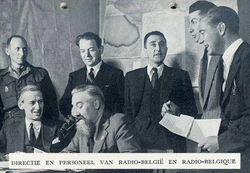
The surviving photograph of the staff is dated 4 September 1944, the day after Brussels fell, and its printed caption runs in Dutch and French on the same line: the management and staff of Radio-België and Radio-Belgique. Eight men around one microphone with a map behind them. De Laveleye became minister of public education that same month and was one of the Belgians who worked on the United Nations Charter. He died in Ixelles on 14 December 1945 at fifty-one, just under fifteen months after the station went silent. His commentaries were collected and published four years after that, under the station's own on-air identification: Ici Radio Belgique.
~ leave a rose ~
an anonymous tribute. one rose per visitor per day.
@}-->-- ... roses left here
~ leave a wreath ~
a rose fades by morning. a wreath stays on this grave for good, with your name on it.
paid once through stripe. payments are handled by OÜ Lakeview, the small company that keeps rip.so running. the money pays for the hosting and the nightly digging. adopt it and the headstone reads "maintained in memory by" you. the groundskeeper plants new wreaths at the next tending, usually within a day.
» one email a week: new graves and the anniversaries of the dead. subscribe
other news: Iskra, News Deeply, J's GOAL, PC Extreme
also died in the pre-1980s: Mickey Mouse Magazine, Iskra, The United Network
~ leave a note ~
visitors before you have left these graveside notes. anonymous welcome.