2LO
~ the goodbye ~
2LO began transmitting on 11 May 1922 from the top floor of Marconi House, on the Strand in London. It ran a hundred watts on about 360 meters, and the Post Office permit allowed it one hour a day, either late morning or in the middle of the afternoon, and speech only. Music came later. The call sign was an allocation rather than a name. 2LO was the London license Marconi had been issued for an experimental station. It was the second British station to broadcast to a schedule, after Marconi's own 2MT out at Writtle in Essex, which had started in February.
Six months in, the whole thing changed hands. On 14 November 1922 the station passed to a newly formed consortium called the British Broadcasting Company, and at six that evening Arthur Burrows read a news bulletin supplied by Reuters, then read it again more slowly and asked listeners to write in and say which speed they preferred. Birmingham and Manchester came on the following night. The studio moved to 2 Savoy Hill on 1 May 1923, and on 6 April 1925 the transmitter itself moved to the roof of Selfridges on Oxford Street, where a bigger set put out two kilowatts from an aerial strung 250 feet up between two masts at either end of the store.
What ended it was not failure but architecture. Through the twenties the BBC ran a city-by-city system, a separate low-power station with its own call sign for each city, each of them audible for about twenty-five miles in daylight. By the end of the decade it wanted two programs covering the whole country, so it built a twin transmitter station at Brookmans Park in Hertfordshire, the first in the world designed to put out two services at once. Brookmans Park came into service on 21 October 1929 carrying the London Regional program, and the Selfridges transmitter was switched off the same day.
~ the chronicle ~
| Born | 11 May 1922, from the top floor of Marconi House on the Strand |
|---|---|
| Peak | 14 November 1922, when the BBC's first broadcast went out through it at six in the evening |
| Killed | 21 October 1929 |
| Lifespan | 7 years, 5 months |
| Made by | Marconi's Wireless Telegraphy Company, then the British Broadcasting Company |
| Killed by | the Regional Scheme, which scrapped the city transmitters for national networks |
~ seven minutes, then listen ~
The condition worth remembering is the one attached to the original license. 2LO was allowed to transmit for seven minutes. Then it had to stop for three while the operator listened on 2LO's own wavelength for an official message ordering it off the air. Every ten minutes of British broadcasting in 1922 contained three minutes of the broadcaster holding still and waiting to be told off. The BBC's own engineering historian notes drily that no such message was ever received, and files the rule next to the man with a red flag who had to walk in front of early motor cars.
It was a licensing condition, not a technical one. Spectrum in 1922 belonged to the Admiralty and the Post Office, who had been running it through the war, and the fear was that entertainment would get in the way of aircraft and other services that mattered. The seven-and-three rule is the sound of a regulator refusing to commit. Within five years the same regulator had given the BBC a royal charter, and there were nearly three million licenses in force by the end of 1929, against roughly eighty-eight thousand in March 1923.
Some of what the BBC still does started on this transmitter. The first outside broadcast went out from Covent Garden on 8 January 1923. At midnight on New Year's Eve that year it carried the twelve chimes of Big Ben for the first time, picked up by a microphone slung about fifteen feet above the bells inside a biscuit tin packed with cotton wool, with ships' sirens on the Thames audible underneath; from March 1924 that became a twice-daily fixture and it has not stopped since. Regular dance band relays from the Savoy Hotel began in October 1923. London's first children's program and its first general news bulletin both went out on 23 December 1922.
~ the transmitter that outlived the station ~
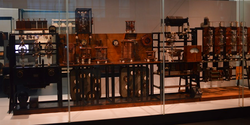
A 2LO transmitter survives, and almost nothing about that sentence is simple. The Science Museum in London holds an object catalogued as the Marconi 1.5kW Transmitter used by 2LO, built at Chelmsford in 1922. It is not the set that was on air at the end, which was the Selfridges one; it is the earlier Marconi House machine, retired in April 1925 and kept as a standby until 1929. Nor is it quite intact. It was found in pieces in a storeroom at Brookmans Park about twenty-five years later, and two BBC engineers reassembled it in the 1950s, putting most of the components back in their original positions and filling the gaps with parts of the right period. The BBC and Crown Castle gave it to the museum together on 7 November 2002, after a BBC Symphony Orchestra concert in Birmingham. It stands two meters high and five and a half meters wide, and it is in the Information Age gallery behind one long sheet of glass.
The ending itself has no artifact at all, because there was no ceremony. The changeover to Brookmans Park was done by what the BBC called sliding in: the new station ran at full power only outside program hours at first, half an hour in the morning and an hour after midnight, and the slot was widened week by week until the old transmitter was simply not needed. No last words from 2LO are recorded anywhere, and the trade press of the period reports the handover as an engineering schedule that slipped by a week. What did get noticed was the new announcement. A Paris wireless magazine, hearing the London Regional Station introduce itself for the first time, reported that it had come on the air saying "London Bridge calling."
~ leave a rose ~
an anonymous tribute. one rose per visitor per day.
@}-->-- ... roses left here
~ leave a wreath ~
a rose fades by morning. a wreath stays on this grave for good, with your name on it.
paid once through stripe. payments are handled by OÜ Lakeview, the small company that keeps rip.so running. the money pays for the hosting and the nightly digging. adopt it and the headstone reads "maintained in memory by" you. the groundskeeper plants new wreaths at the next tending, usually within a day.
» one email a week: new graves and the anniversaries of the dead. subscribe
other news: Tumblr Storyboard, News of the World, Le Charivari, A.frame
also died in the pre-1980s: Le Charivari, Processor Technology, Stereo-Pak
~ leave a note ~
visitors before you have left these graveside notes. anonymous welcome.