Mickey Mouse Magazine
~ the obituary ~
Three different magazines carried this name in seven years, and the only thing they reliably shared was the mouse on the front. The first ran from January to September 1933, nine issues, produced by Kay Kamen and his partner Streeter Blair and given away rather than sold. Kamen was the man Walt Disney had hired in 1932 to handle merchandising, and he is the reason Mickey ended up on wristwatches and breakfast cereal boxes. A magazine was just another surface.
Two months after the first one stopped, a second started. From November 1933 to October 1935 Mickey Mouse Magazine was a promotion for dairies, twenty four issues of it, and the distribution channel was the milk round. Edited by Hal Horne, who ran advertising and publicity at United Artists, it arrived at American front doors in the hands of the man delivering the milk, because the dairy had paid to put it there.
The third one is the one people collect. In the summer of 1935 Horne put out a newsstand version, with Kamen and Walt Disney Enterprises behind him, and by October it was monthly. Horne got nine issues out before his own money gave way. In early June 1936, with the July issue already going to press, he handed the magazine over to Kamen, and the year after that Kamen brought in Western Publishing to actually produce it. Western is where the modern Disney comic book comes from, and the magazine is where Western learned the job.
~ the case file ~
| Born | January 1933, a free handout from Kay Kamen's merchandising office |
|---|---|
| Peak | 300,000 a month as a 1933 giveaway, 148,000 sold of the first newsstand issue |
| Killed | September 1940, the 60th newsstand issue, 64 pages |
| Lifespan | seven years across three magazines of the same name |
| Made by | Kay Kamen and Hal Horne, then Western Publishing |
| Killed by | a conversion into Walt Disney's Comics and Stories |
~ the milk route ~
Stay on the dairy version for a second. A character owned by a film studio in California was being used as an inducement to buy milk from a local creamery, and the physical object that carried him was a magazine the creamery paid for, handed over by a man on a delivery route at six in the morning. There was no newsstand in the chain anywhere and no cover price. The reader got it because somebody else's marketing budget had decided they should.
That worked for twenty four issues and then stopped working, which is how giveaways usually go. The 1935 switch to newsstands is the moment the magazine had to justify its own existence to a child holding a dime, and the content changed accordingly. It got bigger and it got more comics in it, and the last issues ran sixty four pages.
~ fifty thousand dollars ~
Horne ordered 300,000 copies of each of the first three newsstand issues and sold fewer than half of them. He cut the print runs after that and sales kept falling anyway. In a letter to Roy Disney at the end of December 1935 he put his own losses at a figure that still reads badly: the magazine, he wrote, had cost him a terrific amount of heartaches and exactly fifty thousand dollars, all of which seemed such a crime when you considered how it had been loved by the people who read it. Roy wrote back in February more concerned with saving Horne from a loss than with getting any revenue, and let the next year run without royalties. It was not enough, and six months later Horne was out.
What Horne actually owned, and what makes him worth remembering, was the jokes. He had been filing and cross-referencing gags on three by five cards since 1931, and by 1935 he had something like six million of them in steel cabinets filling several rooms of a New York office building, which he rented out to comedians, columnists and advertising agencies. In 1936 Walt Disney bought the whole file for twenty thousand dollars, which Michael Barrier reads as partly a way of compensating Horne for the magazine. A 1941 Disney publicity photo shows an actress being walked through it by a librarian, captioned as the room of a million jokes.
~ the holiday number ~
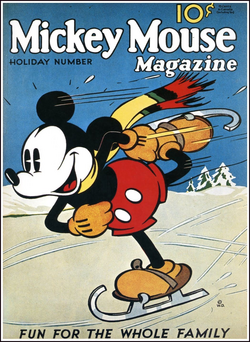
One surviving 1935 cover carries the whole enterprise on it. Mickey is on ice skates with a sled over one shoulder, mid-stride against a blue winter sky. The title fills the top in fat white letters with Magazine trailing after it in script, and HOLIDAY NUMBER sits underneath in small capitals. Up in the corner, in yellow, the price: 10 cents, with a line of tiny type beside it reading 15 Cents In Canada, Including Tax. Across the bottom of the cover runs the pitch, which is not aimed at the child holding it: FUN FOR THE WHOLE FAMILY.
Inside, the magazine leaned harder and harder on material it had not made. Reformatted Sunday pages from Floyd Gottfredson and Ted Osborne's Mickey Mouse strip turned up in the January 1937 issue, with Al Taliaferro's Silly Symphony Sundays a month later, all of it recut and recolored to fit. Barrier dates the real influx to that July. A serialized reprint of an actual Mickey Mouse daily continuity, Mighty Whale Hunter, did not arrive until February 1939. Otto Messmer, who had drawn Felix the Cat, contributed original illustrations between 1935 and 1937.
Barrier's verdict on the result is hard to argue with. The magazine resembled an established children's title, he writes, but the level of inspiration was low, the drawings often weak and even amateurish. The reprinted strips stood out precisely because they were professional, and for years the editors gave them about five pages an issue and seemed to begrudge those.
~ what it turned into ~
The September 1940 issue was the sixtieth and the last. The following month Western and Dell put out the first number of Walt Disney's Comics and Stories, standard comic book size, ten cents, and that title ran until 2020. Everything carried over except the name. The same artists worked off the same newspaper strips at the same ten cents, under a masthead that could now hold characters besides the mouse.
The name itself came back in 1988 on something unrelated. Welsh Publishing Group ran a quarterly Mickey Mouse Magazine for small children under license from Disney, thirty four issues from Winter 1988 to Fall 1995, a dollar ninety five a copy with a Guide for Grown-Ups section at the back for the parent. It claimed nothing from the original. The first cover called itself the Premier Issue and the indicia numbered from one, so a title that had reached sixty in 1940 began again at the beginning.
There is no childhood memory of mine to attach to any of this. The whole thing finished in 1940 on American newsstands, and no edition of it circulated where I grew up. What did reach me, decades later and in Turkish, was the format it invented: a cheap Disney comic book with reprinted newspaper strips inside, sold to children who had no idea a milkman had once been part of the delivery system.
~ leave a rose ~
an anonymous tribute. one rose per visitor per day.
@}-->-- ... roses left here
~ leave a wreath ~
a rose fades by morning. a wreath stays on this grave for good, with your name on it.
paid once through stripe. payments are handled by OÜ Lakeview, the small company that keeps rip.so running. the money pays for the hosting and the nightly digging. adopt it and the headstone reads "maintained in memory by" you. the groundskeeper plants new wreaths at the next tending, usually within a day.
» one email a week: new graves and the anniversaries of the dead. subscribe
other phenomena: Burly Bear Network, Max Power, Stick Figure Death Theatre, Planet Stories
also died in the pre-1980s: Kaizō, Fawcett Comics, Planet Stories
~ leave a note ~
visitors before you have left these graveside notes. anonymous welcome.