Radio 270
~ the goodbye ~
Radio 270 started test transmissions on 4 June 1966 from the Oceaan 7, a Dutch fishing lugger built in 1939 that had worked out of Antwerp until a Yorkshire syndicate bought her for £2,500. Regular programs began within the week. She carried a 150 foot mast and a 10 kilowatt RCA transmitter, and lay at anchor about four miles off Scarborough, broadcasting on 1115 kilohertz. That works out to 269 meters, which the station rounded up for the name.
The company was Ellambar Investments, put together by four local businessmen: Don Robinson, Bill Pashby, Roland Hill, Leonard Dale, who took the chair. Its public face was Wilf Proudfoot, a Scarborough grocer and former Conservative MP, who served as managing director. The program director was an Australian named Noel Miller, and the ship was registered in Honduras in his name. That registration was the whole legal architecture: a foreign flag over international water, with a British company selling the advertising from an office on land.
Working the Oceaan 7 was closer to fishing than to broadcasting. A storm in November 1966 sent water over the deck and into the studio, and the ship moved south to shelter in Bridlington Bay. Three disc jockeys, one of them nineteen, were sacked after asking to be taken off during the worst of the weather. On 28 October 1966 an unstamped envelope arrived carrying a bomb threat. Radio London sat on 1133 kilohertz, close enough to cause interference, and each station accused the other of having moved.
The Marine Broadcasting Offences Act came into force at midnight on 14 August 1967. It worked by criminalizing the British end of the operation rather than the ship: no British subject could work for an offshore station or sell advertising on one, which starved the thing of staff and revenue without anyone having to board it. Radio 270 ran until one minute before the deadline, when Vince Allen, who was Rusty on air, closed the station with the national anthem. The Oceaan 7 came into Whitby the following morning. She was broken up in 1969, and her transmitter went to a Dutch pirate in 1970.
~ the chronicle ~
| Born | June 1966, four miles off Scarborough, after tests on 4 June |
|---|---|
| Peak | 10 kilowatts on 1115 kilohertz, heard along the northeast coast |
| Killed | 14 August 1967 |
| Lifespan | 1 year, 2 months |
| Made by | Ellambar Investments, fronted by former MP Wilf Proudfoot |
| Killed by | The Marine Broadcasting Offences Act 1967 |
~ the sticker ~
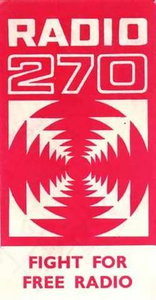
The surviving artifact from Radio 270 is not an aircheck or a photograph of the ship. It is a campaign sticker, red on white, with the wordmark stacked over a sunburst that reads as a transmitter pattern or a globe depending on how long you look at it. Underneath, in capitals: FIGHT FOR FREE RADIO.
The campaign behind it was real. The station sold political advertising, which no licensed British broadcaster could do, and it spent that airtime arguing against the bill written to close it. The Postmaster-General, Edward Short, condemned it by name. A station with fourteen months to live was running an electoral argument against its own government from a boat in heavy weather.
~ the audience nobody counted ~
How many people actually listened is the one fact that cannot be settled. The memorial site run by former staff claims four million. The Scarborough Maritime Heritage Centre claims fifteen million and a hundred mile reach. Neither figure came from a ratings panel, because no panel measured a station that legally did not exist, and ten kilowatts of medium wave off a lugger does not reach fifteen million people on any arithmetic anyone has shown.
What is documented is narrower and more interesting. It was heard well along the Yorkshire and Durham coast, and it worked as a starting job. Paul Burnett went from the Oceaan 7 to a long career on national radio. Roger Gale went from it into Conservative politics and became an MP.
~ the monopoly, seen from somewhere else ~
Britain in 1966 had one broadcaster and an appetite for pop music that the broadcaster would not serve, so the gap got filled from the water. Turkey had the same monopoly shape for much longer: TRT held the entire spectrum well into my lifetime, and I grew up with exactly the number of channels the state decided to run.
What broke it used the same reasoning as a ship in international waters. Magic Box put Star 1 into Turkish homes in 1990 by transmitting from Germany, on the argument that a signal originating outside the border was outside the monopoly. Radio 270 had to register a lugger in Honduras to make that case. Twenty-three years later it was being made with a satellite uplink, and a few years after that it was a license application.
~ leave a rose ~
an anonymous tribute. one rose per visitor per day.
@}-->-- ... roses left here
~ leave a wreath ~
a rose fades by morning. a wreath stays on this grave for good, with your name on it.
paid once through stripe. payments are handled by OÜ Lakeview, the small company that keeps rip.so running. the money pays for the hosting and the nightly digging. adopt it and the headstone reads "maintained in memory by" you. the groundskeeper plants new wreaths at the next tending, usually within a day.
» one email a week: new graves and the anniversaries of the dead. subscribe
other media music: Aupeo, Beyond Oblivion, Billboard Türkiye, Vitaminic
also died in the pre-1980s: The Masses, Blue Book, Two-Fisted Tales
~ leave a note ~
visitors before you have left these graveside notes. anonymous welcome.