Swinging Radio England
~ the eulogy ~
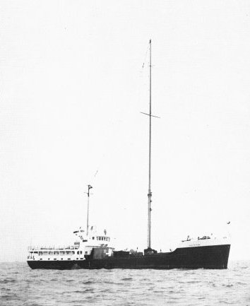
Swinging Radio England started transmitting on 3 May 1966 from a ship anchored four and a half miles off Frinton-on-Sea in Essex, and it called itself the World's Most Powerful. Two 50 kilowatt AM transmitters sat in prefabricated rooms that had been lowered into the holds of the MV Olga Patricia, a supply ship the United States had built for the Second World War and later renamed the MV Laissez Faire. One transmitter was Radio England. The other was Britain Radio, which played easy listening and billed itself the Hallmark of Quality. Two stations sharing one hull and one crew.
The idea belonged to Don Pierson, a man from Eastland, Texas, who had already financed Wonderful Radio London and wanted to do it again at twice the scale. Everything about the sound was imported from America. The jingles came from PAMS in Dallas, out of a package originally cut for WABC in New York, and the rapid-fire news bulletin at quarter past the hour was copied off WFUN in Miami. The announcers were called boss jocks. British listeners in 1966 had the BBC Light Programme on one side and a line of pirate ships on the other, and Pierson's bet was that the loudest and most American of them would take the audience.
It never got the chance. Pierson had hired Continental Electronics of Dallas on a turn-key contract to build the antenna, against the advice of Bill Carr, the Fort Worth engineer who had done the antenna work on Wonderful Radio London. Carr had suggested a 200-foot mast with the signal shunt-fed to the top. What arrived was a second mast strapped to the first, carrying an outstretched triangular boom with a heavy insulator hanging off the end of it. Tom Danaher, who had designed the Radio London mast, looked at it and said the boom would fail under the swinging weight of the feed cable. It came down onto the deck two hours after the ship left Miami.
A British engineer got the station on the air with an improvised replacement, and then the real problem surfaced. Carr had proposed three frequencies without being able to research how they behaved in Europe, and nobody had done that research. Radio England's 845 kilohertz sat on top of an Italian state station in Rome. The two alternatives, 795 and 815, were too close to the 809 a BBC network was using in Scotland. The Italian government complained, so the twins swapped frequencies, which left Radio England on a lower-powered channel at 1322 kilohertz. Britain Radio covered a wide area after that. Radio England covered almost nothing, sold almost no advertising against what it did cover, and was closed on 13 November 1966 by a new general manager whose first assignment was to shut it down.
~ the dossier ~
| Born | 3 May 1966, four and a half miles off Frinton-on-Sea, Essex |
|---|---|
| Peak | 50 kW on paper, billed as the World's Most Powerful |
| Killed | 13 November 1966 |
| Lifespan | 6 months, 10 days |
| Made by | Don Pierson of Eastland, Texas, financed by North and West Texas investors |
| Killed by | An antenna that fell off and a frequency nobody could hear |
~ the men holding the money ~
The venture was a Texas operation run out of Mayfair. Financial management ended up with Pierce Langford III of Wichita Falls, who also ran the political career of Senator John Tower. Advertising sales went to William E. Vick of Amarillo on an exclusive contract, and Vick moved his family to London and set up a British company called Peir Vick, Ltd at 32 Curzon Street, living above the offices. Across the road at number 17 sat Radlon Sales, which did the same job for Wonderful Radio London.
Vick then signed two more exclusive contracts, one with a public relations firm that threw launch parties and one with Radiovision Broadcasts International, a company formed in January 1966 as a subsidiary of Pearl and Dean, the people who sold advertising on British cinema screens. RBI had been set up because the American ABC networks wanted to expand their program and broadcasting interests in Britain. So the money came from investors in North and West Texas who had never seen the ship, the sales were handled by a cinema advertising subsidiary with no radio experience, and the public relations firm spent heavily on promotion for a station that could not be received. The investors formed factions and the factions fought.
~ the frequency fight ~
Everything else about this venture is decoration around the reception problem. The British government did not get round to the Marine Broadcasting Offences Act until the following August, so the law had nothing to do with this death. Physics and a rushed contract did the work on their own. A medium wave signal does not care what your jingle package cost, and the handful of clear channels the project could reach were already occupied by people with transmitters on land and governments behind them.
Britain Radio had the compensation of a paying customer. It carried The World Tomorrow, the religious program presented by Herbert W. Armstrong and his son Garner Ted, and that sustaining income kept the easy listening side solvent while the top forty side starved. The one station on the ship that sounded nothing like 1966 was the one that worked.
Nothing about this reached Turkey, and not only for the obvious reason that it was a North Sea medium wave signal aimed at the English coast. It could not even reach the English coast properly. The people in London who were supposedly its audience mostly heard about it rather than heard it, which makes the surviving airchecks a strange kind of document: a station whose entire pitch was the loudness of its signal, preserved in recordings made by the handful of people close enough to receive it.
~ what happened to the ship ~
By late September 1966 Pierson was out of day-to-day control and William Vick had promoted Britain Radio's program chief, Jack Curtiss of San Francisco, to general manager of both stations. Curtiss was told to close Radio England and replace it with a Dutch-language service, the thinking being that a Dutch station would be outside the reach of the British law everyone could see coming. The replacement was announced as Swinging Radio Holland until the official Radio Holland complained, so it went on the air in mid-November 1966 as Radio Dolfijn.
Britain Radio outlived its twin by three months and went off on 22 February 1967. A storm damaged the antenna, the ship put into Amsterdam for repairs, and Ted Allbeury, lately of Radio 390, took over as managing director and renamed the station Radio 355. Several Radio 390 presenters crossed over with him. The Laissez Faire kept working until the summer of 1967 and was among the last of the ships to leave.
~ leave a rose ~
an anonymous tribute. one rose per visitor per day.
@}-->-- ... roses left here
~ leave a wreath ~
a rose fades by morning. a wreath stays on this grave for good, with your name on it.
paid once through stripe. payments are handled by OÜ Lakeview, the small company that keeps rip.so running. the money pays for the hosting and the nightly digging. adopt it and the headstone reads "maintained in memory by" you. the groundskeeper plants new wreaths at the next tending, usually within a day.
» one email a week: new graves and the anniversaries of the dead. subscribe
other media music: Kludge, Dischi Ricordi, Gimlet Media, SoundTracking
also died in the pre-1980s: Compatible Time-Sharing System, Philles Records, Der Sturm
~ leave a note ~
visitors before you have left these graveside notes. anonymous welcome.