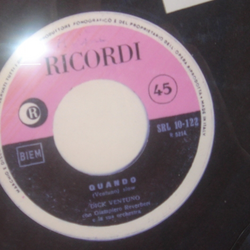
Dischi Ricordi
~ the last words ~
Casa Ricordi had been publishing sheet music in Milan since 1808, which meant that by the 1950s it owned a great deal of Italian music on paper and none of it on record. Nanni Ricordi, a member of the family, and his colleague Franco Crepax, whose brother Guido drew the comics, argued for going into the record business. Dischi Ricordi S.p.A. was formally born on 1 October 1958, run as its own company while being wholly owned by the publishing side. English-language sources often date the founding to 1959; the Italian record says 1958, and so does every category the company is filed under.
The first release that same month was a Maria Callas album, chosen to assert continuity with the publisher rather than a break from it. By November the label was issuing Giorgio Gaber singles, which was the actual direction of travel. Nanni Ricordi's idea had come from sitting in Milan clubs listening to people writing songs that no company would put out, and his answer was to become the company that would. Ornella Vanoni signed on 10 July 1958 and Gaber on 27 October.
What followed is most of the canon. Gino Paoli and Umberto Bindi. A sub-label called Tavola Rotonda set up purely to launch new writers, with the understanding that anyone who worked would be moved up to the parent, which is how Sergio Endrigo and Enzo Jannacci got their first solo records. Later the Dik Dik and Equipe 84 ran the charts of 1966, and in 1967 Alessandro Colombini found and launched Lucio Battisti. Then the progressive years, with Banco del Mutuo Soccorso and Napoli Centrale. Ricordi also held the Italian distribution for Island, so that Cat Stevens and Bob Marley reached the country with a Ricordi logo somewhere on the package.
~ the record ~
| Born | 1 October 1958, Milan, inside a publisher founded in 1808 |
|---|---|
| Peak | first and second at Sanremo in 1994, its last year |
| Killed | 1994 |
| Lifespan | 36 years |
| Made by | Nanni Ricordi and Franco Crepax |
| Killed by | BMG buying the Ricordi group |
~ what the shops were for ~
The detail that explains why this worked is not a signing. When the label was founded, the publisher owned eighteen shops around Italy selling sheet music and instruments, and the decision was taken at the same moment to turn them into record shops as well. A new label with no distribution leverage suddenly had eighteen storefronts obliged to stock and push its own pressings.
It is the kind of structural advantage that does not appear in any discography and decided a decade of Italian pop anyway. Ricordi could sign an unknown writer, press him, and guarantee the record was physically present in the country's better music shops the week it came out. Competitors had to negotiate for that.
~ the 1963 walkout ~
Five years in, the man who built it left. Nanni Ricordi fell out with the publishing arm that still owned the company, took the job of artistic director at RCA Italiana in Rome, and brought Paoli and Endrigo with him. Crepax went too, to CGD. Vincenzo Micocci came the other way from RCA to replace him and rescued the thing almost immediately, with Bobby Solo's "Una lacrima sul viso" passing a million copies in 1964, by which point Guido Rignano had arrived as president and the company had passed to shareholders in Varese and Milan. The family name stayed on the label for another three decades after the family had effectively stopped running it.
~ the last Sanremo ~
In 1994 Dischi Ricordi took both first and second place at the Sanremo festival, with Aleandro Baldi and Giorgio Faletti. In the same year Rignano signed the deed selling the Ricordi group to BMG. The label was folded into BMG Ariola's Italian operation and came out the other side as BMG Ricordi, a name, and the Ricordi catalog has been passed between multinationals ever since. The 1808 publishing house still exists and still trades under the Ricordi name, which is why the brand reads as alive; the record company that signed Gaber does not.
Italy is the distance here, but it is a shorter distance than it looks from Ankara. Turkish pop in the 1960s and 70s ran heavily on aranjman, where an imported melody got Turkish lyrics written over it, and Italian songs were among the most borrowed material in the country. A good deal of what Turkish audiences heard as Turkish pop in those years started as something a Milan label had pressed first. The songs crossed. The company never had to.
~ leave a rose ~
an anonymous tribute. one rose per visitor per day.
@}-->-- ... roses left here
~ leave a wreath ~
a rose fades by morning. a wreath stays on this grave for good, with your name on it.
paid once through stripe. payments are handled by OÜ Lakeview, the small company that keeps rip.so running. the money pays for the hosting and the nightly digging. adopt it and the headstone reads "maintained in memory by" you. the groundskeeper plants new wreaths at the next tending, usually within a day.
» one email a week: new graves and the anniversaries of the dead. subscribe
other media music: Gimlet Media, SoundTracking, Mixwit, 60dB
also died in the 1990s: Convex Computer, Univel, AMSD Ariadna
~ leave a note ~
visitors before you have left these graveside notes. anonymous welcome.