Radio Veronica
~ the goodbye ~
On 15 October 1959, in the Hotel Krasnapolsky in Amsterdam, a group of Dutch radio and television retailers founded what they called a league of free radio dealers. Their complaint was narrow and commercial. Dutch broadcasting was a closed arrangement of membership associations in Hilversum, organized around religious and political blocs, and not one of them would sell a shopkeeper airtime to advertise a radio set. Somebody at that meeting pointed out that Radio Mercur had been broadcasting to Denmark from a ship since 1958, and that a vessel anchored outside territorial waters was outside the rules too.
They called the station Vrije Radio Omroep Nederland, shortened to VRON, until somebody noticed it was being confused with VERON, the Dutch amateur radio society. The replacement came from a series of verses by the children's writer Annie M.G. Schmidt about a sheep called Veronica. A former German lightship, the Borkum Riff, was refitted in the port of Emden and anchored off Scheveningen under a Panamanian flag, later a Guatemalan one. The first test transmission went out on 18 April 1960, and Veronica treated that date as its birthday ever afterward. On 17 May it settled on 192 meters, which is 1562 kHz, and that number became the station's identity.
For the first few years the programs sounded like Hilversum with advertisements. What changed it was the hiring of a 23-year-old student named Willem van Kooten as program director. He had been listening to American music radio and rebuilt Veronica around it, with a looser way of talking and with station identifications that were sung rather than announced. The style left a vocabulary behind in ordinary Dutch. Words like alarmschijf for the record of the week and gouwe ouwe for an oldie came off that ship. From 2 January 1965 the station published a weekly chart that became the Veronica Top 40, which is still the Dutch singles chart today under a different owner. By 1969 Veronica was simply the station, with a fixed schedule from 1969 and a touring drive-in show where listeners could stand and watch a disc jockey play records, a format the legal broadcasters copied within a few years. Its competition was other ships: Radio Caroline reached the Dutch coast in 1964, and by 1973 there were half a dozen of them out there.
~ the chronicle ~
| Born | 18 April 1960, first test transmission from the converted lightship Borkum Riff |
|---|---|
| Peak | 800,000 average daytime listeners in spring 1970, 9% of everyone over 15 |
| Killed | 31 August 1974 at 18:00, the evening before the law took effect |
| Lifespan | 14 years, 4 months |
| Made by | a league of Dutch radio and TV dealers, later run by the Verweij brothers |
| Killed by | the Dutch law implementing the 1965 Strasbourg Agreement on offshore stations |
~ the boat and the wavelength ~
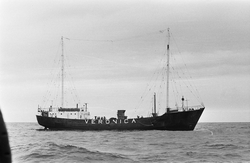
The Borkum Riff was replaced in November 1964 by a converted Icelandic trawler called the Norderney, which is the ship most Dutch people picture when they picture Veronica: black hull with VERONICA painted along it in white capitals, and a wire antenna slung between the fore and aft masts. On 30 September 1972 at one in the afternoon the station moved from 192 meters to 538, and had a new jingle package made around the number. That wavelength outlived everything else: when a Dutch commercial station launched in 1992 it named itself Radio 538, which it still is.
The sea got a vote as well. During a storm on 2 April 1973 the Norderney dragged its anchors and went aground on the beach at Scheveningen, a hundred meters south of the harbor mole. Thousands of listeners drove out that weekend to look at it, producing a twenty-kilometer traffic jam between Scheveningen and Nootdorp. Veronica was back on air within two weeks, borrowing Radio Caroline's ship the Mi Amigo in exchange for new studio equipment.
The trick Veronica was using turned up in Turkey thirty years later with different hardware. Turkish broadcasting was a state monopoly held by TRT, and the first private Turkish channel got around it in 1990 with a satellite uplink in Germany, coming down on Turkish sets and legally out of reach at the point where it was transmitted. I was six. I remember nothing about the jurisdiction argument and quite a lot about there suddenly being more than one thing to watch. Parliament amended the constitution in 1993 and set up a broadcasting regulator the year after.
~ the bomb ~
On 15 May 1971, three divers planted an incendiary device on the hull of the Mebo II, the transmitter ship of Radio Noordzee Internationaal. Veronica had been paying RNI two hundred thousand guilders a month to keep it out of the Dutch market, RNI had tried to buy its way out of the arrangement, and the plan was to burn the ship badly enough that it would have to be towed into a harbor and silenced. The Mebo II's crew saw the divers leaving in a rubber boat, and the police had all three ashore by morning.
It came apart in four days. The divers, led by the Mebo II's own former captain Tom van der Linden, had been paid 25,000 guilders by a Veronica shareholder and advertising adviser named Norbert Jürgens, who was arrested on 17 May. The following day Veronica's director Bull Verweij went on television and said he had given Jürgens money to do something about the ship, and the police arrested him on 19 May. Verweij maintained he had only ordered the Mebo II cut loose from its anchor so it could be towed to Scheveningen, and that the firebomb was Van der Linden's own idea. The court gave all five of them a year. Veronica paid for the damage, and RNI never filed a complaint.
The bombing is why the law arrived when it did. A commercial pirate playing pop to teenagers is an argument about broadcasting policy; an arson attack at sea with a conviction attached is an argument about the rule of law, and it moved the debate in The Hague from the first to the second. Veronica understood this, and on 18 April 1973, the day its ship was refloated, its supporters marched on the Binnenhof and handed the Speaker of the Dutch parliament a petition carrying somewhere between 1.8 and 2 million signatures. The crowd estimates ran from fifty thousand, which was the police figure and already a postwar record for The Hague, up past a hundred thousand depending on which paper you read. The same week Veronica began signing up members for an onshore organization; supporters paid one guilder and got a card calling them a Luistervis, a listening fish.
~ six in the evening ~
The Dutch senate ratified the Strasbourg Agreement on 22 January 1974, and the royal decree followed on 12 August. The law did not attack the transmitter, which was anchored in international water and out of reach. It attacked everybody on land, making it an offense to supply an offshore station or to buy advertising on one. It came into force at midnight on 1 September, so Veronica stopped the evening before, at six on Saturday the 31st, while stopping was still something it chose to do.
Bull Verweij and his brother Jaap were aboard the Norderney for it. The last two records, by the Dutch account, were the saxophone solo from "What Love" by The Collectors and then "Heather", an instrumental from an album The Carpenters had put out that year, and after that two verses of the Wilhelmus. The chief technician pulled the crystal out of the transmitter a few seconds early. Radio Noordzee, the ship Veronica had firebombed three years before, went off the air two hours later. Hundreds of people waited on the quay at Scheveningen for the boat bringing the disc jockeys in, and every member of staff was dismissed.
The organization survived because it had been built in advance. The Veronica Omroep Organisatie was founded on 28 June 1973, fourteen months before the ship went quiet, modeled on TROS, which was itself a legalized sea pirate. Its first broadcast as a licensed Dutch public broadcaster went out on 28 December 1975, and what it was given was an hour opening the new classical network Hilversum 4, presented by a comedian in character. Fifteen years of annoying the Dutch state bought the pop pirate one hour a week of chamber music.
The Norderney was sold for scrap in 1983, rescued at the last minute, and converted into a floating nightclub that worked its way from Middelburg to Antwerp. It was towed to Monnickendam for the launch party of a new commercial station called Radio Veronica on 31 August 2003, picked for the anniversary, and has been moored at the NDSM wharf in Amsterdam-Noord since 2013. That 2003 station is still on the air, owned since June 2023 by the Belgian group Mediahuis. Its website has no history page and mentions neither the ship nor the year 1960, which is at least honest, since what changed hands was a license on a name. A word people once signed two million petition sheets for is now a rock format with a cookie banner.
~ leave a rose ~
an anonymous tribute. one rose per visitor per day.
@}-->-- ... roses left here
~ leave a wreath ~
a rose fades by morning. a wreath stays on this grave for good, with your name on it.
paid once through stripe. payments are handled by OÜ Lakeview, the small company that keeps rip.so running. the money pays for the hosting and the nightly digging. adopt it and the headstone reads "maintained in memory by" you. the groundskeeper plants new wreaths at the next tending, usually within a day.
» one email a week: new graves and the anniversaries of the dead. subscribe
other media music: VIVA Zwei, TVT Records, thesixtyone, Džuboks
also died in the pre-1980s: The Penny Magazine, Kee Games, National Telephone Company
~ leave a note ~
visitors before you have left these graveside notes. anonymous welcome.