The Penny Magazine
~ the eulogy ~
One penny. That is the whole design brief, and everything else about this magazine follows from the coin. A stamped newspaper in 1832 cost several times as much, because the government put a duty stamp on anything carrying news and taxed the paper it was printed on. Lord Brougham's position was that a newspaper ought to cost a penny rather than sevenpence. Charles Knight could not sell news at a penny without paying the duty, so he sold everything except news.
The idea arrived on a walk in March 1832, when M. D. Hill said to Knight, "Let us have a Penny Magazine!" They took it to Brougham, and a committee of the Society for the Diffusion of Useful Knowledge approved the plan after what Knight remembered as some hesitation. He wrote down his own position without decoration: "I undertook the risk of the publication, and was appointed to be its editor." The Society sponsored it. Knight was the one who would lose money if it failed.
The first number appeared on Saturday 31 March 1832. Eight pages, one sheet folded twice, printed from stereotype plates on Edward Cowper's steam cylinder presses at William Clowes's works. Before it went out Knight had written to the Solicitor of Stamps and been told the first two numbers would not be liable to stamp duty, and he then spent thirteen years working what he called the ill-defined line that separated the essayist from the newspaper writer. By the end of 1832 the sale had reached 200,000 in weekly numbers and monthly parts. In the preface he wrote that December he did the arithmetic out loud: "there are 200,000 purchasers of one periodical work. It may be fairly calculated that the number of readers of that single work amounts to a million."
That reach happened because the thing cost a penny and because it had pictures in it, and those two facts were in tension from the first week. Woodcuts were expensive. Knight admitted that the costly ones could scarcely be ventured upon in the early days, and only from the autumn of 1832 did he start running reproductions of the Laocoon and the Apollo Belvedere, which is where the magazine got its reputation.
~ the dossier ~
| Born | 31 March 1832, published every Saturday for the Society for the Diffusion of Useful Knowledge |
|---|---|
| Peak | 200,000 weekly copies by the end of 1832, which Knight read as a million readers |
| Killed | 27 December 1845 |
| Lifespan | almost 14 years |
| Made by | Charles Knight, who was publisher, editor and the man carrying the risk |
| Killed by | cheap newspapers that learned to print woodcuts of their own |
~ what it would not print ~
The Penny Magazine carried no party politics and said so on the front of itself. It carried no fiction either, which separated it from Chambers's Edinburgh Journal, started in Edinburgh a few weeks before Knight's and running a short story every week. The Society's purpose was useful knowledge, and the project had a defensive edge: its target was the unstamped radical weeklies that Knight described as dangerous in principle and coarse in language.
So the reader got natural history and antiquities, illustrated with engravings of objects sitting in museums. Wikipedia's summary of the result is that it proved too dry and too Whiggish, which is an opinion, though it is hard to improve on. With the news and the politics both ruled out, and the fiction along with them, what was left to sell was the pictures, and those sold extremely well for about ten years.
~ the number for 27 October 1832 ~
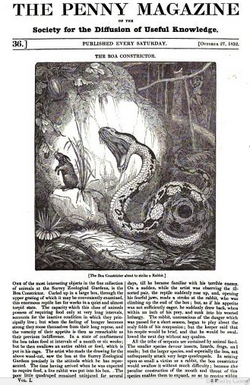
The cover of that week survives and it is worth describing, because it shows what a penny bought. Across the top, the title and then "of the Society for the Diffusion of Useful Knowledge", with "PUBLISHED EVERY SATURDAY" ruled underneath. The whole upper half of page one is a woodcut of a boa constrictor coiled in undergrowth. The two columns of close-set type below it explain the animal, and they pause to say that the artist who made the drawing had seen the boa himself at the Surrey Zoological Gardens, in the attitude he has represented. There is no advertisement anywhere on the page.
~ the copies abroad ~
The format traveled faster than the magazine did. Das Pfennig-Magazin started in Leipzig in 1833 with eight pages and woodcuts, reached something near 100,000 copies by 1847 and lasted until 1855. Édouard Charton brought out the first Magasin pittoresque in Paris on 9 February 1833, two columns on eight pages, probably printing from stereotype plates supplied by Knight himself. In the United States J. S. Redfield reissued the magazine in twenty-four parts at twenty-five cents each, from plates he bought from Knight. There was an Irish Penny Magazine as well.
Knight sold his own printing plates to his foreign imitators, which says plainly enough how he understood the project. The engravings were the thing, and he wanted as many of them in circulation as he could manage.
~ the end, in Knight's own words ~
He improved it in 1841 with a second series and recorded the result in one flat sentence: "And yet the sale fell off." When he closed the weekly on 27 December 1845 he named the cause himself, and he named it correctly. Demand had fallen for many causes, he wrote, "particularly the extended sale of newspapers, and the application of wood-engravings to their illustration." The Illustrated London News had launched in 1842 and was putting woodcuts beside actual news. Knight had spent thirteen years carefully not being a newspaper, and the newspapers came to him.
He tried once more. Knight's Penny Magazine ran from January 1846 as six monthly parts, leaning on reading rather than engravings, and he shut it in June with a note that its sale was scarcely remunerating. The Society suspended its own operations on 11 March 1846, after the losses on the Biographical Dictionary. Fourteen volumes of the original sit free to read on HathiTrust.
One more date belongs on the file. The stamp duty that shaped the entire project was cut to a penny in 1836 and repealed outright in 1855, ten years after the magazine had already stopped.
~ leave a rose ~
an anonymous tribute. one rose per visitor per day.
@}-->-- ... roses left here
~ leave a wreath ~
a rose fades by morning. a wreath stays on this grave for good, with your name on it.
paid once through stripe. payments are handled by OÜ Lakeview, the small company that keeps rip.so running. the money pays for the hosting and the nightly digging. adopt it and the headstone reads "maintained in memory by" you. the groundskeeper plants new wreaths at the next tending, usually within a day.
» one email a week: new graves and the anniversaries of the dead. subscribe
other news: Fusion TV, Think Secret, Jeuxvideo.fr, PlayStation: The Official Magazine
also died in the pre-1980s: Kee Games, National Telephone Company, Servet-i Fünun
~ leave a note ~
visitors before you have left these graveside notes. anonymous welcome.