Džuboks
~ the eulogy ~
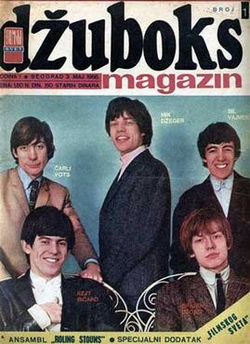
Džuboks means jukebox. The Belgrade publishing house Duga already put out a film weekly called Filmski svet, and a few months after a three-day guitar festival at the Belgrade fairgrounds its journalists decided the country needed a rock paper. They had nobody on staff who could write one, so they went to Nikola Karaklajić, a forty-year-old international chess master who presented record shows on Radio Belgrade. The first issue appeared on 3 May 1966, technically as a special supplement to the film magazine, at one and a half new dinars. The newsroom argued about whether to lead with the Beatles or the Stones. The Stones won the cover and the print run of 100,000 sold out in three days.
It was the first publication in Yugoslavia built primarily around rock, though not the country's first music magazine: Ritam had come out of Novi Sad four years earlier covering jazz and pop. What makes the claim stick is how little the thing looked like it came from a socialist country. The historian Radina Vučetić's assessment is that nothing from the front cover to the back marked it as Yugoslav at all, no Tito and no Party. Karaklajić said there was no political interference in what he printed. The only episode he remembered was a League of Communists representative asking for a meeting shortly after launch, to look at what was going on and advise them to be careful not to look like somebody's agency.
It printed record charts from the United States, Britain, France and Italy, then Dutch and Norwegian ones, and occasionally charts from the Philippines and Singapore. The frequencies and schedules of Western radio stations went in as well, so readers could tune them, along with ordering instructions for foreign music magazines. Sheet music ran with the English lyrics printed underneath, which local bands used to learn the covers. The first run managed 39 issues and stopped in June 1969.
Five years later it came back. On 1 July 1974 Dečje novine of Gornji Milanovac restarted it, with the newsroom still in Belgrade, as a special edition of the women's magazine Lada, which is why the first twenty-five issues are titled Ladin Džuboks. It went independent in August 1976. The frequency climbed from monthly to fortnightly to three times a month by 1981, and in March 1983 it reformatted itself into a newspaper modeled on the New Musical Express with the intention of going weekly. That lasted until July, then the magazine vanished for six months.
~ the dossier ~
| Born | 3 May 1966, 1.50 new dinars, as a supplement to the film weekly Filmski svet |
|---|---|
| Peak | 100,000 copies of issue 1, sold out in three days, one copy read by five people |
| Killed | issue 196, March 1986 |
| Lifespan | 39 issues to 1969, then 196 more from 1974 |
| Made by | Duga of Belgrade, then Dečje novine of Gornji Milanovac |
| Killed by | rock no longer being the thing the country argued about |
~ folije ~
For its first three years the magazine gave away flexi discs, called folije, pressed with Jugoton, which at the time held the EMI license. The first one came with issue 10 and it was the Rolling Stones, "Have You Seen Your Mother, Baby, Standing in the Shadow?" They were made to be disposable and readers treated them that way, playing them until they wore through and throwing them out. A few of those thrown-out records are now discographic rarities that collectors outside the country hunt for.
This is the part I find legible from a distance. Turkey was not socialist and I arrived two years before the magazine died, but the operation is recognizable to anyone raised outside the countries where the records got made. Somebody prints where on the dial the signal sits, somebody translates the lyrics, and a whole audience learns a foreign culture at one remove through the person who got there first. Petar Janjatović's figure for Džuboks is that one copy was read by five people. I understand that number. It is the pre-internet version of a download finishing at the cafe and getting passed around on a disc.
~ fifty percent of the paper ~
The golden period was the new wave, roughly 1980 to 1982, which the magazine supported without restraint. Aleksandar Žikić's recollection is that Džuboks was the first to put Šarlo Akrobata, Električni Orgazam and Idoli on a cover, while conceding it also ran plenty of nonsense. The readers' letters column, Bez dlake na peru, took the complaints: one reader wrote in that he loved the new wave but had to admit it did not deserve fifty percent of the paper, and a group from Skopje accused Petar Luković's singles column of crushing young bands while raising the Belgrade acts to the heavens. Luković's column was called Singlovi and it was feared. Saša Stojanović filed from London under the name Pankerton, which is how British punk reached the country at all.
The cover tally across twenty years runs Rolling Stones ten, Bijelo Dugme nine, Riblja Čorba eight, Beatles seven. The first domestic band to get a front page was Roboti, at issue 9 in 1966. Dušan Kojić of Disciplina Kičme wrote for it under a pseudonym. Nobody has documented a single issue being pulled or an article causing trouble with the authorities, and the banned-issue story that attaches itself to Džuboks in retellings actually belongs to Pop Express of Zagreb, whose thirteenth issue was ordered off sale in 1969 over a personal ad.
~ the archive is a stub ~
The last issue is number 196, March 1986. No day survives and no publisher statement explains it. The best account anyone has is a reader's memoir written eighteen years later, arguing it died because of the music it wrote about, rock having stopped being the thing the country argued over. Most of the staff moved to Rock, which a former Džuboks editor had started as a comic-magazine supplement in April 1982, and which ran until December 1990, two months before the shooting began.
In 2004 a former Džuboks critic founded an online magazine called Popboks and put a digitized archive of the 1974 to 1985 issues on it. Popboks stopped publishing on 25 August 2013 after nine years, 17,600 news items and 4,570 articles, and its homepage now says you are looking at an archived version. The archive browser that both Wikipedias still list as the magazine's website is a 95-byte page reading "Džuboks arhiva" and a link to the association that used to run it, which links back to the stub. Eighty-five reprinted articles are still readable in a category listing. Nine scanned issues from 1966 and 1967 survive properly, at the university library in Belgrade. The domain dzuboks.com is for sale for four hundred dollars.
~ leave a rose ~
an anonymous tribute. one rose per visitor per day.
@}-->-- ... roses left here
~ leave a wreath ~
a rose fades by morning. a wreath stays on this grave for good, with your name on it.
paid once through stripe. payments are handled by OÜ Lakeview, the small company that keeps rip.so running. the money pays for the hosting and the nightly digging. adopt it and the headstone reads "maintained in memory by" you. the groundskeeper plants new wreaths at the next tending, usually within a day.
» one email a week: new graves and the anniversaries of the dead. subscribe
other media music: thesixtyone, Guvera, Imagine Radio, Beatnik
also died in the 1980s: Muse Software, Léanord, Fujitsu FM-7
~ leave a note ~
visitors before you have left these graveside notes. anonymous welcome.