Punk Planet
» see punkplanet.com as it lived, on the wayback machine
~ the goodbye ~
Punk Planet started in Chicago in May 1994 on newsprint, partly out of a feeling that Maximum Rock and Roll had become too narrow about who counted. Dan Sinker published it and co-edited it and laid it out. The founding position was that punk is a subculture, which meant the magazine covered visual art, labor organizing, media criticism and whatever else the people it interviewed were actually doing.
The interviews ran two or three pages and were about motivation rather than the new album. The reviews carried equal weight, and the section was enormous: regularly over thirty pages, covering nearly everything sent in, with one hard rule that the label could not be owned even partly by a major. That meant country and folk and hip-hop and comics and other people's zines got reviewed alongside the loud guitar records, because that is what independent labels were putting out.
It ran for thirteen years and eighty issues. In 2004 it launched Punk Planet Books with the New York small press Akashic Books, whose first title was Joe Meno's Hairstyles of the Damned that August. By 2006 it was also publishing archive pieces online in a partnership with ZineWiki. The press run peaked around sixteen thousand copies.
~ the chronicle ~
| Born | May 1994 in Chicago, newsprint |
|---|---|
| Peak | a press run of 16,000 and a reviews section over thirty pages |
| Killed | 18 June 2007, announced on its own website |
| Lifespan | 13 years, 80 issues |
| Made by | Dan Sinker, with Anne Elizabeth Moore |
| Killed by | the collapse of the Independent Press Association |
~ the ad rate ~
Sinker has been blunt about the economics: as a business, Punk Planet was built to fail from the first day. The decision was to set ad rates as low as they could possibly go so that the smallest record labels in the country could afford a decent-sized space and get national reach out of it. Anything that came in went back out to writers. Selling on newsstands lost money on every copy.
That was the design working as intended. The point was to put tiny labels in front of readers who would never otherwise see them, and for thirteen years it did, because nobody involved needed it to do anything else.
~ twelve distributors, then none ~
When Punk Planet started there were twelve national distributors handling independent and small-press titles. One by one they went, until the Independent Press Association was the only one left serving that end of the market, and in January 2007 the IPA filed for bankruptcy. Dozens of publications were owed months of revenue they were never going to collect. Bitch and McSweeney's were badly hurt. Punk Planet did not survive it.
Sinker put the split at eighty-twenty. Twenty percent was exhaustion, two years of fighting to stay alive and not knowing if he could keep fighting. Eighty percent was that even if they wanted to keep going, the money was not there. He said he would be surprised if any independent magazine would claim to be in good shape, and that he could not conceive of someone trying to start something like Punk Planet from scratch. On distribution he was shorter: what is left of it, he said, is evil, and distributors now work for the chain retailers instead of against them.
~ where it lives now ~
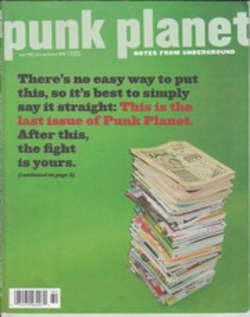
The announcement went up on punkplanet.com on 18 June 2007, telling readers the final issue was in the mail. Issue 80 carries a July and August cover date and a photograph of a stack of back numbers going all the way down to issue one, with the text printed over it: there's no easy way to put this, so it's best to simply say it straight, this is the last issue of Punk Planet, after this the fight is yours. The site itself stayed up for two more years and then closed with a note saying it just seemed time.
In January 2021 all eighty issues were uploaded to the Internet Archive. punkplanet.com still answers, and it redirects straight into that collection, sorted by date, every issue free to read. A magazine that spent thirteen years losing money on distribution now has perfect distribution and no costs at all.
I was not reading it. American punk zines did not travel to Turkish newsstands and the scene it documented was a continent and an argument away from the internet cafes I was in around 2004. I read issue 80 off a scan.
~ leave a rose ~
an anonymous tribute. one rose per visitor per day.
@}-->-- ... roses left here
~ leave a wreath ~
a rose fades by morning. a wreath stays on this grave for good, with your name on it.
paid once through stripe. payments are handled by OÜ Lakeview, the small company that keeps rip.so running. the money pays for the hosting and the nightly digging. adopt it and the headstone reads "maintained in memory by" you. the groundskeeper plants new wreaths at the next tending, usually within a day.
» one email a week: new graves and the anniversaries of the dead. subscribe
other community: Rukkola.hu, NaNoWriMo, livedoor キーワード, MacTalk Australia
also died in the 2000s: Siberian Wikipedia, Teltone Corporation, DVD Shrink
~ leave a note ~
visitors before you have left these graveside notes. anonymous welcome.