Radio North Sea International
~ the eulogy ~
The last transmission from this ship went out in 1974, a decade ahead of my own arrival, so everything below is reconstruction. Two Swiss engineers, Erwin Meister and Edwin Bollier, spent around four million Swiss francs converting a 1948 freighter called the Silvretta into a radio ship. They named it from the first two letters of each surname, which gave them Mebo, and the second and larger vessel was the Mebo II: 53 meters and roughly 630 tonnes, its hull painted in wide diagonal bands of red and yellow. It carried a medium wave transmitter rated at 105 kW, with an FM transmitter on top of that.
It dropped anchor off Noordwijk on 22 January 1970 and the first test transmissions went out the following day on FM and short wave. Medium wave tests started on 11 February, live programs a week after that, and a regular schedule from 28 February. The legal theory was the one every offshore station used: the ship sat outside territorial waters, so no national broadcasting law applied to what came off its mast. No prosecution ever reached the ship in four and a half years.
Everything else did. A British jamming transmitter arrived in April 1970. In September that year Radio Veronica, the Dutch commercial station it was taking listeners from, paid a million guilders to have it shut up, and the silence lasted until January 1971. Then came the bomb. The station never ran out of listeners or money in the way dying stations usually do, and when it did die it was because a parliament in The Hague caught up with it.
~ the dossier ~
| Born | 23 January 1970, first test transmissions off Noordwijk |
|---|---|
| Peak | 105 kW rated on medium wave, plus short wave and FM, from a single ship |
| Killed | 31 August 1974, the Dutch service closing at 20:00 |
| Lifespan | 4 years, 7 months, with two forced silences |
| Made by | Erwin Meister and Edwin Bollier, aboard the Mebo II |
| Killed by | the Dutch Marine Offences Act, in force 1 September 1974 |
~ the jammers ~
The British Post Office switched on a jamming transmitter against the medium wave signal at 20:30 on 15 April 1970, from a naval base in Kent. When the station moved frequency the jamming followed, and a second and more powerful unit at Canewdon near Southend took over. This was peacetime jamming of a commercial pop station by a Western European government, and the interference it threw out was wide enough to land on BBC Radio in Kent as well.
The station's answer was to intervene in a general election. In the week of the 18 June 1970 vote it renamed itself Radio Caroline International, put Ronan O'Rahilly and Simon Dee on a bus around marginal constituencies, and told its audience that a Labour win would put it off the air. The campaign song was "Who Do You Think You Are Kidding, Mr. Wilson?". The Conservatives won against the forecasts, and the claim that a pirate station swung it has been repeated ever since by people who have no way to measure it, including on days when the jamming was so heavy that hardly anyone in Britain could hear the station at all. The owners gave up on 23 July 1970 and moved the ship back to Scheveningen, and the jammers went quiet.
~ 15 may 1971 ~
At about ten to eleven on the night of 15 May 1971, with the DJ Alan West live on air, three men came out from Scheveningen in a rubber dinghy and put explosives against a pipeline running to an oil tank on the Mebo II. West broadcast a Mayday. The damage came to roughly thirty thousand pounds and the arrests came the next afternoon. Norbert Jurgens, the advertising manager of Radio Veronica, was picked up on 17 May, and Veronica's managing director Hendrik Verweij admitted he had paid twelve thousand guilders for it, with the aim of driving the ship into territorial waters where the Dutch state would deal with it. His account of his instructions was that it be done without any risk to life. Five men got twelve months each. The competitor that paid for the bomb was itself an offshore station working the same stretch of water, which is what the business came down to: a Dutch advertising market with two sellers in it and no referee anywhere.
~ 220 metres ~
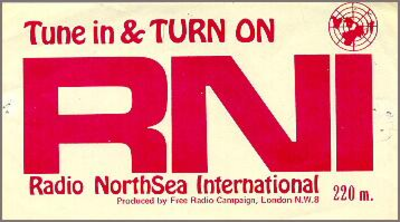
The best surviving piece of its identity is a sticker. Red on white, it reads "Tune in & TURN ON" above the letters RNI, printed four times the size of anything else on the sheet. Under them sits "Radio NorthSea International" with the wavelength the ship settled on from August 1970, 220 m. The small print at the bottom says "Produced by Free Radio Campaign, London N.W.8". A Swiss-owned ship anchored off the Netherlands, and its merchandise was made by a pressure group in north-west London. Turkey got its own unlicensed broadcasting years later and on dry land, when private stations appeared at the start of the nineties with no legal basis whatsoever and the state spent a couple of years arguing about whether to switch them off before writing a law in 1994.
~ the last hour ~
The Netherlands finally passed its own Marine Offences Act, in force on 1 September 1974, which made it a crime for a Dutch citizen to work for or supply an offshore station. The English-language International Service closed at midnight on 30 August. The Dutch service ran on through the final day and ended at eight in the evening on 31 August 1974, a few hours ahead of the deadline, with Ferry Maat among the last voices on it.
The ship was towed to Slikkerveer with another broadcasting job lined up in Italy, and Dutch authorities impounded it on 10 October 1974. It was sold to Libya and renamed El Fatah, and was eventually destroyed as a target in rocket practice in the Gulf of Sidra. The sources cannot agree whether that happened in 1981 or in 1984.
~ leave a rose ~
an anonymous tribute. one rose per visitor per day.
@}-->-- ... roses left here
~ leave a wreath ~
a rose fades by morning. a wreath stays on this grave for good, with your name on it.
paid once through stripe. payments are handled by OÜ Lakeview, the small company that keeps rip.so running. the money pays for the hosting and the nightly digging. adopt it and the headstone reads "maintained in memory by" you. the groundskeeper plants new wreaths at the next tending, usually within a day.
» one email a week: new graves and the anniversaries of the dead. subscribe
other media music: MSN Radio, Songza, Current TV, Nimbit
also died in the pre-1980s: Woodhull & Claflin's Weekly, Le Temps (Paris), Telesaar
~ leave a note ~
visitors before you have left these graveside notes. anonymous welcome.