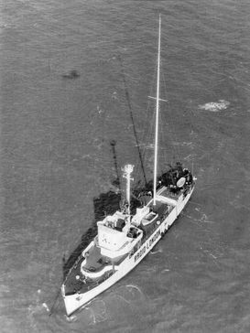
Wonderful Radio London
~ the obit ~
Don Pierson sold cars in Eastland, Texas and had been the town's mayor. In the summer of 1964 he read a newspaper report about two ships anchored off the south-east coast of England selling advertising into a country whose broadcasting was a state monopoly, and his reaction was arithmetic. He set the number of stations serving northwest Texas against the two serving the whole of the United Kingdom. He flew to England, chartered a small plane, photographed Radio Caroline and Radio Atlanta from the air, and went home to raise money for something bigger.
Five hundred thousand dollars came in from fewer than twenty people, most of them Texan car dealers and oilmen, through a company registered in the Bahamas. In September 1964 they paid twenty-eight thousand pounds for a ship impounded in Miami over unpaid harbor dues. She had been the USS Density, an Admirable-class minesweeper with three battle stars from the Pacific, credited with an aircraft shot down off Okinawa and something like five hundred mines cleared before the Navy was finished with her. RCA fitted a studio and a transmitter into her in Miami. She sailed on 22 October, put her antenna mast up in calm water on the way across, and reached the Thames Estuary on 19 November as the MV Galaxy.
The station was nearly called Radio KLIF London, after the Dallas station whose taped output was supposed to fill the schedule. When that was dropped in favor of live British presenters, Philip Birch suggested Radio Galaxy instead, and the compromise gave the name to the ship and left the station as Radio London. The jingle package had already been ordered from PAMS in Dallas under the name Big L, because KLIF called its own hometown Big D. It was the singers who turned it into Wonderful Radio London. The first broadcast went out at six in the morning on 23 December 1964, Pete Brady presenting, opening with Cliff Richard.
Almost everything came live out of a studio in the ship's hold. The metal bulkheads made the room sound wrong, so the first fix was to line the walls with mattresses and blankets taken off the crew's bunks, which solved the acoustics and meant nobody could sleep in daylight. The transmitter, an RCA Ampliphase in a steel shed on the rear deck because it would not fit below, was rated at fifty thousand watts and sold on air as a Tower of Power, which was true at the top end and generous at the start, since it opened at seventeen kilowatts. From April 1965 the station read out its own position every morning at eight, as a navigation aid: fifty-one degrees forty-seven point nine minutes north, one degree twenty point five five minutes east.
~ the rap sheet ~
| Born | 23 December 1964 at six in the morning, from the MV Galaxy off Frinton-on-Sea |
|---|---|
| Peak | 8,140,000 listeners in the July 1966 National Opinion Poll survey, from a single ship |
| Killed | 14 August 1967, at three in the afternoon |
| Lifespan | 2 years, 7 months and 22 days |
| Made by | Don Pierson of Eastland, Texas, with Philip Birch running it out of Curzon Street |
| Killed by | the Marine Offences Act 1967, which made its revenue illegal |
~ who paid for it ~
Advertising was sold by a company called Radlon (Sales) Ltd, because British authorities refused to register anything called Radio London on the grounds that it was too close to an existing firm. Philip Birch, an account director at J. Walter Thompson who had moved from the agency's American offices to its London ones, owned Radlon and ran the station. The thing he is credited with is the tuning: taking a Texan format and reworking it until it sounded like it belonged to British teenagers. Caroline was run by music people. Radio London was run by salesmen.
The other income was stranger. Seven o'clock every evening went to The World Tomorrow, a religious commentary from Herbert W. Armstrong or his son Garner Ted, whose Worldwide Church of God in Pasadena bought the slot outright. Accounts of what it paid differ by an order of magnitude, but they agree on the effect: that one program covered what the ship cost to run. Kenny Everett kept making fun of it on air and was sacked in November 1965 when the sponsors complained. He went to Radio Luxembourg, was sacked there too, came back in June 1966, and finally left the ship on 21 March 1967, seven weeks before Radio London got an eight-day exclusive on Sgt. Pepper's Lonely Hearts Club Band and played it on 12 May.
~ their final hour ~
The Marine, &c., Broadcasting (Offences) Act 1967 received Royal Assent on 14 July and named no commencement date. That came in a separate Order in Council, made at Buckingham Palace on 28 July, appointing 15 August. The Act did not go after the transmitter, which sat outside British waters and beyond reach. It went after everyone on land, making it an offense to supply a station like this with music, commentary, advertising, fuel or food, with an exception only for saving life. Radio London had said it would carry on. Birch looked into relaying a signal from a foreign country and could not find a base, and his sales people could not find enough advertisers outside Britain or enough inside it willing to break a new law. The closure was announced on 28 July, the same day the Order was made.
Three in the afternoon on 14 August was chosen to catch a large audience and to let everyone get ashore at Harwich and onto a train. Their Final Hour was taped the evening before and went out from two o'clock, and it ran slightly short because the ship's generator was turning faster on playback than it had on the recording. It carried farewells from Mick Jagger, Cliff Richard, Ringo Starr and Dusty Springfield. The last live thing on the station was Paul Kaye reading the half past two news, which was fitting, since he had been the first voice on the test transmissions the previous December. Birch thanked the staff and the politicians who had argued for them and claimed twelve million listeners in Britain. Nobody measured that. The measured figure, from a National Opinion Poll survey in July 1966, was 8,140,000 from one ship, against 8,818,000 for Caroline from two.
The last commercial was for Consulate cigarettes. The last record was A Day in the Life, from the album the BBC had banned. Then Paul Kaye said "Big L time is three o'clock, and Radio London is now closing down", the PAMS theme the crew called Big Lil played out, and the engineer Russell Tollerfield cut the transmitter just after three, nine hours ahead of the Act. On Caroline South, a few miles away, Robbie Dale broadcast a tribute and held a minute of silence. When the staff reached Liverpool Street at twenty to seven that evening, there were crowds on the concourse in black armbands carrying placards that read "Freedom went with Radio London", and the police had to push them off the platform.
~ what radio 1 took ~
In February 1967 a BBC producer named Johnny Beerling made a quiet trip out to the Galaxy to watch how the thing worked. What impressed him was Kenny Everett running the desk and the records himself, where the BBC still used three people and a script. Beerling and Robin Scott took Everett to lunch at a restaurant at the top of Regent Street that spring, and Everett told them that if they wanted their new station to sound like pirate radio they would have to have jingles. The BBC commissioned them from PAMS in Dallas, the same house, off the same package. "Wonderful Radio London" was inverted into "Radio 1 is Wonderful".
Radio 1 went on the air on 30 September 1967, forty-seven days after Big L stopped. Its original presenter list, published on 4 September, ran to twenty-nine names, of whom seventeen came off the pirate ships. Eleven of those seventeen came off this one: Tony Blackburn, Kenny Everett, John Peel, Ed Stewart, Dave Cash, Pete Brady, Keith Skues, Duncan Johnson, Chris Denning, Mike Lennox and Pete Drummond. The new BBC service was built out of Big L's staff list and Big L's jingle supplier in the same summer that Parliament put the ships out of business. Philip Birch came back when Britain finally licensed commercial radio, running Piccadilly in Manchester from 1973.
~ what happened to the galaxy ~
The ship went to Hamburg on 19 August and was laid up. Erwin Meister and Edwin Bollier tried to buy her for what became Radio Nordsee International, the deal collapsed, and she was sold for scrap in 1970 and then left where she was. In the mid-1970s she was towed to Kiel and moored beside the ruins of a U-boat bunker that had been blown up in 1946. A visitor in 1976 found the studios still holding the remains of sound systems and records. In April 1979 nobody pumped out her aft machine room, it filled, and she went down onto the rubble of the bunker, which held her up far enough that people kept climbing aboard for another seven years. The accounts that describe this as a deliberate sinking for an artificial reef are wrong. She was raised in the summer of 1986, with two cranes and some care because she was close to breaking in half, once her fuel tanks started splitting with rust. She was scrapped on a slipway a few yards away.
The name is still on the air in a way that needs separating. Radio London Ltd, which holds the trade mark, runs the archive of the station online and says in its own words that there is currently no permanent Radio London broadcast. An internet oldies station at bigl.co.uk uses the Big L name from the same stretch of Essex coast, and between 2005 and 2008 it broadcast on medium wave as Big L 1395 with one original Big L presenter on the roster, though today its pages make no claim on the ship at all. And the BBC named a local station Radio London in October 1970, three years after this one stopped, which is the collision most people run into first.
~ leave a rose ~
an anonymous tribute. one rose per visitor per day.
@}-->-- ... roses left here
~ leave a wreath ~
a rose fades by morning. a wreath stays on this grave for good, with your name on it.
paid once through stripe. payments are handled by OÜ Lakeview, the small company that keeps rip.so running. the money pays for the hosting and the nightly digging. adopt it and the headstone reads "maintained in memory by" you. the groundskeeper plants new wreaths at the next tending, usually within a day.
» one email a week: new graves and the anniversaries of the dead. subscribe
other media music: Kerrang! TV, Riffage.com, Soundstream, Red Light Radio
also died in the pre-1980s: DC-International, Rajyasamacharam, Hallicrafters
~ leave a note ~
visitors before you have left these graveside notes. anonymous welcome.