Frank Leslie's Illustrated Newspaper
~ the last words ~
Frank Leslie was a pen name. The man was Henry Carter, born 1821, son of a comfortable English glovemaker who did not want his boy engraving wood for a living. Carter did it anyway, sailed for New York in 1853 and adopted the pseudonym on arrival. No established paper would hire him as an illustrator, so he opened an engraving shop on Broadway instead. One of his early clients was P. T. Barnum, who had commissioned him years before for a Jenny Lind concert program and who hired him as chief engraver for a paper called The Illustrated News in 1853. That paper failed inside its first year.
So Leslie published for himself. In 1854 he put out two titles, a fashion paper called Frank Leslie's Ladies' Gazette of Fashion and an illustrated fiction monthly called Frank Leslie's Journal of Romance. Both made money. In 1855 he added a third, an illustrated news weekly with his own borrowed name across the top. Volume 1, number 1 is dated 15 December 1855. Harper's Weekly did not put out a first issue until 3 January 1857, so the American illustrated news weekly had been publishing for a year and nineteen days before the title everyone remembers turned up.
The first years were thin, with a national business crisis in 1857 to get through. Then the Civil War made it, as it made Harper's: tens of thousands of readers wanted to see the war and these were the two papers that showed it to them. Leslie's ran sixteen pages on average, with supplements and themed special editions on top. By 1873 it was employing more than three hundred people, seventy of them illustrators, inside a publishing house that ran seven titles. One of its freelancers, James R. O'Neill, is believed to be the only Civil War correspondent killed in action.
~ the record ~
| Born | 15 December 1855, volume 1 number 1, New York |
|---|---|
| Peak | over 300 staff by 1873, 70 of them illustrators, across seven titles |
| Killed | 17 June 1922, folded into Judge the following week |
| Lifespan | 66 years and 6 months |
| Made by | Frank Leslie, born Henry Carter in England |
| Killed by | receivership, after sixteen months as a monthly |
~ how the block came apart ~
The thing Leslie's actually invented was a workflow. A sketch came in, an editor picked it, an illustrator turned it into an outline drawing, and the outline was transferred onto a block built from layered Turkish boxwood while specialist artists added the detail. Then the large block was taken to pieces. Each section went to a different engraver in the engraving department, who cut away the white and left the black in relief, and when the sections came back they were rejoined, converted to an electrotyped copper plate and printed.
All of the value sits in that one step. A single engraver working an intact block takes days; several engravers working several pieces of the same block take an evening. It is why Leslie's could run an event inside a week of it happening while its competitors were still cutting, and it is the mechanism underneath every claim the paper ever made about being timely.
~ the second frank leslie ~
Leslie died in 1880 owing something like three hundred thousand dollars, with his will contested by creditors. His widow, Miriam Florence Leslie, took the business over and put it back on a paying basis, which she would end up doing twice. In June 1881 she had her own name legally changed to Frank Leslie. The trademark was worth more than her own name was, so she became it.
By 1902 no connection to the Leslie family was left in the business at all. The name stayed up on the masthead regardless, since selling papers was the only job it had ever had. Miriam died in 1914 and made Carrie Chapman Catt the residuary legatee of her estate, with the expectation that the money would go to winning women the vote. The gross figure was around one and three quarter million dollars. Catt netted about nine hundred and seventy seven thousand of it once the relatives and the lawyers were finished, and it became the Leslie Woman Suffrage Commission, which funded the final push for the Nineteenth Amendment. A fortune that began in a wood-engraving shop on Broadway ended up paying for the vote, and the paper that generated it outlasted the amendment by not quite two years.
~ the cover that became a poster ~
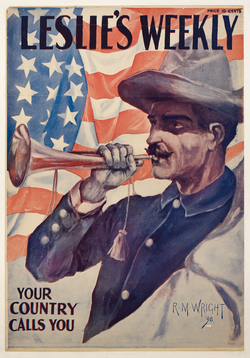
The paper had form at this. Its cover for the Spanish-American War year of 1898 is a bugler in uniform blowing the call against a flag filling the whole frame, signed R. M. Wright, with four words underneath: YOUR COUNTRY CALLS YOU. Ten cents, says the top corner. Eighteen years later, on 6 July 1916, the cover carried a James Montgomery Flagg painting of Uncle Sam pointing out of the frame at the reader, under the caption "What Are You Doing for Preparedness?". America was still neutral. Once it was not, the image got a new caption for recruiting purposes, and the recruiting version is the only one anybody reproduces now.
Harriet Quimby wrote for the paper for about ten years, first as a drama critic and travel writer, often credited as her own photographer. In 1911 she became the first American woman to hold a pilot's license and the paper made her its aviation editor. Her last pieces for it were about aviation safety. She died in a flying accident on 1 July 1912 and her final article appeared in the issue published a week later.
The pointing finger reached me decades ahead of any explanation of it. It arrives as a shape, on a T-shirt or in a parody, and whatever gets passed along with it, the original caption is never part of the package. The first nine months of that picture's life were spent on a magazine cover asking American readers what they were doing about preparedness, and none of that survived the poster.
~ what happened to the name ~
Late in life the title was simply Leslie's Weekly. Receivership came for the owners, and from February 1921 a paper that had been weekly for sixty five years began appearing once a month. The final issue is dated 17 June 1922. The merger into Judge, under the same ownership, took effect with what would have been the following week's number, 24 June. Norman Rockwell had drawn covers for it near the end.
~ leave a rose ~
an anonymous tribute. one rose per visitor per day.
@}-->-- ... roses left here
~ leave a wreath ~
a rose fades by morning. a wreath stays on this grave for good, with your name on it.
paid once through stripe. payments are handled by OÜ Lakeview, the small company that keeps rip.so running. the money pays for the hosting and the nightly digging. adopt it and the headstone reads "maintained in memory by" you. the groundskeeper plants new wreaths at the next tending, usually within a day.
» one email a week: new graves and the anniversaries of the dead. subscribe
other news: ThinkProgress, Nintendo Gamer, FS Magazin, DeepDotWeb
also died in the pre-1980s: The American Magazine, Blue Book, The Masses
~ leave a note ~
visitors before you have left these graveside notes. anonymous welcome.