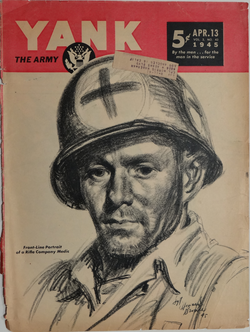
Yank, the Army Weekly
~ the last words ~
The idea came from Egbert White, who had worked on Stars and Stripes during the First World War and thought the next one needed its own paper. He put it to the Army in early 1942 and took a commission as a lieutenant colonel to run it. Major Franklin S. Forsberg handled the business side and Major Hartzell Spence edited the first issues. White was later removed from the staff over articles that had appeared in it. The magazine carried on without him.
The first issue carried a cover date of 17 June 1942. Twenty four pages, tabloid format, five cents, no advertising at all. The line across the top of the cover read: by the men, for the men in the service. It went to the Army overseas only at first, and by the fifth issue on 15 July 1942 it was available to soldiers inside the United States as well. It was never put on sale to civilians at any price. Enlistment was the circulation list.
At its height Yank printed more than 2.6 million copies a week in 21 editions across 41 countries, put together by staff scattered from New York to the Pacific. It ran four volumes and twenty eight numbers of the last one, and the most famous recurring feature was the pin-up on the back page.
~ the record ~
| Born | 17 June 1942, a 24-page tabloid with no advertising |
|---|---|
| Peak | more than 2.6 million copies a week across 21 editions |
| Killed | 28 December 1945 |
| Lifespan | 3 years, 6 months |
| Made by | the United States Army, written by enlisted ranks |
| Killed by | the war ending, exactly as designed |
~ who was allowed to write it ~
The governing rule was that Yank was written by enlisted men. Officers could manage it and a handful did, but the bylines belonged to the ranks, and the magazine was explicitly for the people doing the fighting rather than the people ordering it. The Army paid for it and then had to live with what its privates filed.
The talent that passed through is absurd in hindsight. Sergeant George Baker drew Sad Sack, about a private who could not win. Dave Breger drew the G.I. Joe cartoons, and he is generally credited with putting that phrase into the language. Bil Keane, who went on to draw The Family Circus for half a century, was in there. Jack Coggins spent more than two years producing illustrations and articles across two dozen issues, and John Bushemi shot the Pacific war for the covers until he was killed doing it. A photograph of a young woman named Norma Jeane Dougherty ran on 26 June 1945, about a year before she took the name Marilyn Monroe.
~ the trimmingham letter ~
On 28 April 1944 the magazine printed a letter from Corporal Rupert Trimmingham, a Black soldier, describing how white German prisoners of war inside the United States were being treated with more courtesy than he was. The Army's own magazine published it, in wartime, without softening it.
The mail came back in volume. In a follow-up printed on 28 July 1944, Trimmingham reported that he had received 287 letters, 183 of them from white soldiers, agreeing with him. The editors said the mail from GIs was overwhelmingly on his side. It turned into a short story by Robert E. McLaughlin that same year, called A Short Wait between Trains, and a one-act play by Ruth Moore the next.
~ the day it died ~
Yank did not fail. By late 1945 circulation had fallen from its peak to around 1.2 million and was still dropping fast, for the only reason that was ever going to apply: the readers were being discharged and sent home.
The last issue is dated 28 December 1945 and closes with a collage of the pin-ups. Joe McCarthy, the editor who had taken over after Spence, stayed on until the office formally shut on 31 December 1945. Most publications die of something. This one hit its end date.
In 2014 the 1st Stryker Brigade Combat Team at Fort Bliss revived the name for its own brigade publication, with covers that recreate original Yank photographs. That is a brigade newsletter borrowing a famous title rather than a continuation of one, and the men on those covers are standing where the 1945 originals stood.
~ leave a rose ~
an anonymous tribute. one rose per visitor per day.
@}-->-- ... roses left here
~ leave a wreath ~
a rose fades by morning. a wreath stays on this grave for good, with your name on it.
paid once through stripe. payments are handled by OÜ Lakeview, the small company that keeps rip.so running. the money pays for the hosting and the nightly digging. adopt it and the headstone reads "maintained in memory by" you. the groundskeeper plants new wreaths at the next tending, usually within a day.
» one email a week: new graves and the anniversaries of the dead. subscribe
other news: 癲狗日報 (Mad Dog Daily), Linux User & Developer, CBS Telenoticias, X*Press X*Change
also died in the pre-1980s: Atlas/Seaboard Comics, The Vault of Horror, Fire!!
~ leave a note ~
visitors before you have left these graveside notes. anonymous welcome.