Wonder Stories
~ the obit ~
In February 1929 Hugo Gernsback lost Amazing Stories, the magazine that three years earlier had made science fiction into a marketed category, when his company Experimenter Publishing went into bankruptcy. He moved extremely fast. By April he had set up Gernsback Publications Incorporated with two subsidiaries under it, and he was already mailing letters to likely subscribers announcing magazines that did not exist yet. The mailing lists were almost certainly assembled from Amazing Stories' own subscriber files, which by then belonged to Irving Trust as receiver. He denied it under oath. Historians have broadly concluded that he did it.
The letters asked recipients to vote on what the new title should be called and they picked Science Wonder Stories. The June 1929 issue reached newsstands on 5 May 1929 with Gernsback as editor-in-chief and David Lasser as editor, hired on the strength of a fresh MIT degree despite having no editing experience and not much interest in the genre. A companion called Air Wonder Stories followed on 5 June. In June 1930 the two were folded together into a single monthly, Wonder Stories.
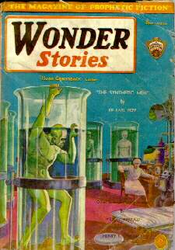
Gernsback's pitch throughout was that the stuff was educational. He had argued it in Amazing Stories and he went on arguing it in the new editorials, claiming that teachers encouraged science fiction because it gave a pupil a grounding in science and aviation. He had been calling it scientifiction over at Amazing; the shorter phrase science fiction, which he is usually credited with putting into general circulation, is the one that took hold here. The December 1930 cover carries the sales line across the top in capitals, THE MAGAZINE OF PROPHETIC FICTION, over a painting of a green man standing in a glass cylinder while a nurse works a machine beside him.
Editorially it had real moments. Lasser worked hard at lifting the quality of the fiction and got somewhere with it. Charles Hornig, a teenage fanzine editor who took the chair in November 1933, published Stanley Weinbaum's "A Martian Odyssey", which is still anthologized and still taught. Against that, Astounding Stories was steadily taking the field, and circulation sat at roughly 25,000 copies an issue in 1934, about level with a declining Amazing Stories and a quarter of what Amazing had managed at its best.
Ninety years and an ocean sit between this magazine and anything I could honestly say about reading it. The part that still comes straight off the page is commercial rather than literary. A publisher with a loyal audience and a distribution channel quietly eating him alive, who then tried going direct to his readers and left it far too late, would not look out of place in any decade since.
~ the rap sheet ~
| Born | 5 May 1929, when the June issue of Science Wonder Stories reached the newsstands |
|---|---|
| Peak | around 25,000 copies an issue in 1934, plus a chartered national fan-club network |
| Killed | 21 February 1936, sold to Ned Pines of Beacon Magazines |
| Lifespan | 7 years |
| Made by | Hugo Gernsback, through Stellar Publishing Corporation of New York |
| Killed by | slow payment and cover stripping, then a direct-subscription plan nobody answered |
~ the league ~
The most consequential thing Wonder Stories ever did was an administrative act. In 1934 it created the Science Fiction League, which linked scattered local science fiction clubs across the United States into one structure with chapters and a membership roll. Gernsback, who never missed an angle, sold the members buttons and insignia, and the League was good publicity and a decent earner besides.
What came out of it was the shape of modern fandom: local groups that met in person, connected by correspondence between readers who now knew each other's names. The conventions and the fanzines followed from that. A magazine letters column had been doing some of this loosely for years, and the League turned it into an institution you could join.
~ stripped covers ~
The money never worked. Gernsback had a reputation for paying slowly, which made him unpopular with the writers he depended on, and by 1936 he was failing outright to pay Laurence Manning, one of the most reliable authors on his list. Staff were asked more than once to hold their paychecks for a few weeks before cashing them. In November 1935 the magazine dropped from monthly to bimonthly, which in pulp publishing is the sound of a title running out of road.
Gernsback blamed the dealers, and he had a case. The practice bleeding him was cover stripping: a newsstand returned the covers of unsold copies for credit, then sold the coverless magazines underneath at a cut rate, so the publisher paid for the returns and competed against his own stock at the same time. His answer appeared in the March 1936 issue as a direct plea to readers to subscribe, with a proposal to distribute Wonder Stories by subscription alone and cut the newsstands out entirely. Very few people answered. He put the magazine up for sale, and on 21 February 1936 Ned Pines of Beacon Magazines bought it.
~ what pines did with it ~
Pines published a whole line with "Thrilling" in the title, so Wonder Stories became Thrilling Wonder Stories to sit properly alongside Thrilling Detective and the rest of them. The first Beacon issue appeared in August 1936, four months after the last one Gernsback produced, with Mort Weisinger editing and the schedule set to bimonthly. It ran until the Winter 1955 issue, then merged into Startling Stories, which lasted only to the end of that year before the pulp business finished collapsing underneath it.
So the magazine outlived Gernsback's ownership by nineteen years, under a name he had not chosen. What ended on 21 February 1936 is the thing this grave is for: a title edited by the man who had organized its readers into clubs, paid for by a newsstand system that was stripping the covers off his inventory and selling the rest.
~ leave a rose ~
an anonymous tribute. one rose per visitor per day.
@}-->-- ... roses left here
~ leave a wreath ~
a rose fades by morning. a wreath stays on this grave for good, with your name on it.
paid once through stripe. payments are handled by OÜ Lakeview, the small company that keeps rip.so running. the money pays for the hosting and the nightly digging. adopt it and the headstone reads "maintained in memory by" you. the groundskeeper plants new wreaths at the next tending, usually within a day.
» one email a week: new graves and the anniversaries of the dead. subscribe
~ leave a note ~
visitors before you have left these graveside notes. anonymous welcome.