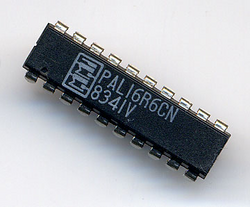
Monolithic Memories
~ the obituary ~
Monolithic Memories was founded in 1969 by Ze'ev Drori, an engineer who had come out of Fairchild Semiconductor and who, nearly forty years later, would briefly run Tesla. For most of its life MMI made the unglamorous half of a circuit board, the bipolar PROMs and 7400 series logic that sat around the processor and did the wiring.
Then in March 1978 it shipped the part that put it in the histories. The PAL, programmable array logic, was a chip you bought blank and configured yourself, blowing fuses to define what its outputs did with its inputs. A team under Drori built it, led by John Birkner with the circuit designed by H. T. Chua. The early twenty pin parts had ten inputs and eight outputs, and the numbering told you what you were getting. A PAL16R8 gave you eight registered outputs; a PAL16L8 gave you eight combinational ones.
What that meant in practice is the part worth stating plainly. One PAL could replace dozens of fixed logic packages. A board full of individual gate chips, each soldered down to do one unchangeable thing, collapsed into a single socket whose behavior lived in a file. That is the move every programmable logic device since has been a refinement of, and it is why a computer engineer who has never heard of MMI has still met its grandchildren: the CPLD on a lab board, the FPGA doing the vision pipeline. I learned the idea from the far end of that lineage and had no notion where it started.
~ the case file ~
| Born | 1969, founded by Ze'ev Drori out of Fairchild |
|---|---|
| Peak | the PAL, introduced March 1978, and PALASM given away free |
| Killed | 17 February 1988, merged into AMD |
| Lifespan | 19 years |
| Made by | Ze'ev Drori, John Birkner and H. T. Chua |
| Killed by | a $422 million stock swap with AMD |
~ the assembler ~
Birkner also wrote PALASM, the language that described what you wanted a PAL to do. MMI implemented the compiler in FORTRAN IV on an IBM 370/168 and then did something that reads oddly for a chip company in 1980: it handed the source code to its customers for nothing. By 1983 users were running their own ports on DEC PDP-11s and HP 2100s. The free tool existed to sell the silicon.
~ the swap and the merger ~
In the spring of 1987 Irwin Federman, MMI's president, agreed to combine the company with Advanced Micro Devices in a stock swap reported at $422 million. The Los Angeles Times ran it on 1 May 1987, and almost every account since gives 1987 as the year Monolithic Memories ended.
That is not quite what the filings say. An AMD disclosure to the SEC lays out two separate events: MMI passed entirely into AMD's ownership on 13 August 1987, its shareholders taking AMD stock for their shares, and then "on February 17, 1988, MMI was merged into AMD". For six months MMI sat inside AMD, owned outright and still legally itself. The date the company actually stopped existing is in 1988, and it survives in a routine paragraph of a Schedule 13D amendment filed eight years later about an unrelated stake in a third company.
~ the ground it left ~
AMD later packaged the programmable logic business as a spin-off called Vantis, and sold it to Lattice Semiconductor in 1999. The PAL trademark, first used in commerce on 21 February 1978 and registered in April 1980, belongs today to that same Lattice, in Hillsboro, Oregon, a company that did not exist yet when MMI first put the word on a chip.
The other inheritance is in the dirt. Monolithic Memories is filed among the Superfund sites in California, which is the quiet second life of a great deal of 1970s Santa Clara County semiconductor work. The industry's solvents went into groundwater under buildings that have long since become something else, and the federal cleanup lists outlasted most of the companies named on them. The chips got smaller every year. The remediation did not.
~ leave a rose ~
an anonymous tribute. one rose per visitor per day.
@}-->-- ... roses left here
~ leave a wreath ~
a rose fades by morning. a wreath stays on this grave for good, with your name on it.
paid once through stripe. payments are handled by OÜ Lakeview, the small company that keeps rip.so running. the money pays for the hosting and the nightly digging. adopt it and the headstone reads "maintained in memory by" you. the groundskeeper plants new wreaths at the next tending, usually within a day.
» one email a week: new graves and the anniversaries of the dead. subscribe
other gadgets: Basis B1 Watch, Nintendo e-Reader, Coupon-Eligible Converter Box, Xbox Live Vision
also died in the 1980s: Sirius Software, Liverpool Software Gazette, Viditel
~ leave a note ~
visitors before you have left these graveside notes. anonymous welcome.