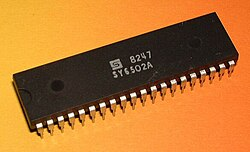
Synertek
~ the last words ~
Synertek's fab stood at 3050 Coronado Drive in Santa Clara and ran from 1974 to 1985. The address is still on the federal Superfund list, which is also how the closure got documented: the EPA site profile records that manufacturing operations ceased in 1985, and the longest-lived thing built on that site turned out to be contaminated groundwater.
Five people started it in 1973, four of them out of Fairchild Semiconductor, with Bob Schreiner as chief executive. A new semiconductor company that year had the hard part, which was a working fab, and none of the easy part, which is a catalog of chips somebody already wants. Synertek's answer was to trade for one. It cross-licensed its own product line to John Pavinen at MOS Technology and took the 6502 back in exchange, becoming a second source for the processor at roughly the moment the processor started to matter.
Steve Wozniak picked a Synertek ROM for the Apple II shortly before the 1977 West Coast Computer Faire, and what held the account afterward was duller than the design win. The parts arrived when they had been promised. Apple became a multi-million dollar customer and Atari was the largest customer for several years, which means a great many home computers and consoles ran on silicon with this name printed next to the date code.
~ the record ~
| Born | 1973, Santa Clara, five people and four of them out of Fairchild |
|---|---|
| Peak | the 6502 years, with Atari the largest customer and Apple a multi-million dollar one |
| Killed | 1985, when Honeywell shut down operations |
| Lifespan | 12 years |
| Made by | Bob Schreiner, the first chief executive |
| Killed by | the 68000, which took Apple off the customer list and Atari a year later |
~ the sym-1 ~
Synertek acquired Microcomputer Associates, a company consisting of the engineers Manny Lemas and Ray Holt, and renamed it Synertek Systems. In 1978 that subsidiary shipped the SYM-1, a single-board 6502 machine sold as an evaluation kit and closely derived from MOS Technology's own KIM-1. It had gone out first as the VIM-1.
The SYM-1 is why the name still means anything outside the chip trade. It was a board you could hold, 29 touch-sensitive keys and a six-digit LED display, documented well enough that you could teach yourself what the processor was actually doing. People still run them. The schematics and manuals sit on 6502 archive sites next to the KIM they were copied from.
~ the 68000 problem ~
Second-sourcing works until the first source stops mattering. Synertek kept signing licenses, taking on the Signetics 2650 and the Zilog Z8, and in 1982 it became the second source for Digital Equipment's DCT11. None of that replaced the 6502 business, because the 6502 business was Apple and Atari, and both of them were on their way out the door.
Apple moved to the Motorola 68000 and Atari followed the year after. Sales imploded. A second plant begun in Santa Cruz around 1983 was halted before it was finished and sold off. By 1985 there was nothing left to operate: the talent had gone and no new designs were coming out of the building. Honeywell, which had bought the company outright in 1979 and run it as a hands-off division, closed operations that year.
~ what is still on coronado drive ~
Solvents from chip manufacturing got into the groundwater under the site, and that has generated more paperwork than the company's products ever did, including a public health assessment from the Agency for Toxic Substances and Disease Registry dated 29 April 1992. A semiconductor firm that lasted twelve years leaves this kind of estate: a cleanup file, and parts.
This company reaches me only through objects: part numbers on boards older than anything I ever owned, and a kit computer kept alive by people who buy its chips off each other. The fab shipped its last parts in 1985 and the site profile for the address is still maintained.
~ leave a rose ~
an anonymous tribute. one rose per visitor per day.
@}-->-- ... roses left here
~ leave a wreath ~
a rose fades by morning. a wreath stays on this grave for good, with your name on it.
paid once through stripe. payments are handled by OÜ Lakeview, the small company that keeps rip.so running. the money pays for the hosting and the nightly digging. adopt it and the headstone reads "maintained in memory by" you. the groundskeeper plants new wreaths at the next tending, usually within a day.
» one email a week: new graves and the anniversaries of the dead. subscribe
other gadgets: Anki Cozmo, Osborne Computer Corporation, Apple HomePod (1st generation), Handspring Visor
also died in the 1980s: Osborne Computer Corporation, Imagic, Amdek
~ leave a note ~
visitors before you have left these graveside notes. anonymous welcome.