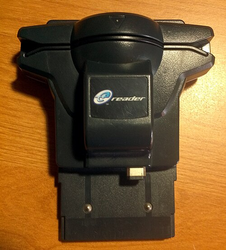
Nintendo e-Reader
~ the goodbye ~
The e-Reader was a scanner. It slotted into the cartridge port of a Game Boy Advance and stuck out sideways with a slit down one edge, and you fed cards through the slit. Printed along the border of each card was a strip of dot code, a technique Nintendo licensed from Olympus, dense enough to carry real software on paper.
Nintendo shipped it in Japan on 1 December 2001. North America got a revised version on 16 September 2002 with a link cable port and enough memory to hold a game between swipes. Australia followed on 31 October 2003. Europe never got it, and in 2004 Nintendo's European office said plainly that the market potential was not there.
What the cards held is the part worth explaining. Some were minigames and some were extra levels for Super Mario Advance 4, which is why that cartridge contains content most of the people who owned it never saw. The larger ones were full NES games split across five cards, so Excitebike arrived as a small stack of cardboard you swiped one after another. Pokemon trading cards carried dot code too, so a card bought for one purpose did something in another.
None of it reached me. Europe was never on the list and Turkey sat behind Europe on every Nintendo list there was, so this device was not late here, it was absent. My hardware in 2002 was a desktop PC on a TTNet line. Handhelds in Turkey then came through the gray market at prices that made a paper card accessory look like a joke.
~ the chronicle ~
| Born | 1 December 2001 in Japan, 16 September 2002 in North America |
|---|---|
| Peak | 2002 to 2004 in Japan, carried by the Pokemon-e card line |
| Killed | September 2008 in Japan, early 2004 everywhere else |
| Lifespan | six years and nine months, most of it in one country |
| Made by | Nintendo, using dot code scanning licensed from Olympus |
| Killed by | low sales outside Japan and the end of the Game Boy line |
~ how it landed ~
In Japan it worked. The e-Reader arrived inside a culture that already bought cards, and Pokemon had spent five years training a generation to treat cardboard as something worth keeping. Adding a scan strip to an object children were collecting anyway is a small ask.
In North America it did not. The device cost about forty dollars and the cards cost more on top, for content a normal cartridge would have simply included. Americans looked at a stack of cards that added up to Excitebike and asked why. By early 2004 Nintendo had stopped, quietly, without any statement.
~ the paper problem ~
Swiping was fiddly. You had to pull the card through at a steady speed, and if you went too fast or the strip was creased it failed and you started again. A five-card game meant five chances to get it wrong in a row. Children with slightly bent cards learned to hate the thing.
Storage was the other half of it. The e-Reader held one scanned game at a time, so switching meant swiping the whole stack again. Everything about the design assumed you would keep the cards flat and clean for years, which is not what happens to cardboard owned by a nine year old.
~ the next chapter ~
The idea outlived the hardware. Nintendo kept putting physical objects next to software for another twenty years, and amiibo is this device's argument with a chip instead of ink and a price point that finally worked.
What actually survived is the software. The dot code format was reverse engineered and every card that ever shipped has been dumped, which means the Super Mario Advance 4 levels once locked behind a scanner nobody in Europe could buy are now just files. Nintendo put those levels back into the game itself on Switch Online in 2023, twenty years after printing them on cardboard.
~ leave a rose ~
an anonymous tribute. one rose per visitor per day.
@}-->-- ... roses left here
~ leave a wreath ~
a rose fades by morning. a wreath stays on this grave for good, with your name on it.
from $1, paid once through stripe. it keeps the graveyard running: the hosting and the nightly digging. adopt it and the headstone reads "maintained in memory by" you. the groundskeeper plants new wreaths at the next tending, usually within a day.
» one email a week: new graves and the anniversaries of the dead. subscribe
other gadgets: Basis B1 Watch, Coupon-Eligible Converter Box, Xbox Live Vision, JUMP Bikes
also died in the 2000s: Xdrive, iPublish, Peppercoin
~ leave a note ~
visitors before you have left these graveside notes. anonymous welcome.