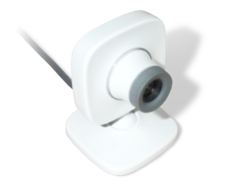
Xbox Live Vision
~ the obituary ~
My gaming years ran through a PC and an internet cafe counter. Counter-Strike in Turkey between 2002 and 2005 was a room full of machines and an hourly rate, with no accessory economy anywhere in it. Buying a forty dollar camera to clip onto a television so that strangers could watch your face while you played cards was not a purchase that made sense from where I was sitting.
The camera was announced at E3 2006 and went on sale in north america on 19 september that year, with europe following on 2 october. It was small, about forty five millimeters square, and it hinged onto the top edge of a television. 640 by 480 at 30 frames a second, 1.3 megapixels for stills, straight into the USB port on the front of the 360.
Thirty nine dollars and ninety nine cents got you the camera, a wired headset, a month of Xbox Live Gold and download codes for Uno and a couple of arcade games. That bundle tells you Microsoft already knew the camera could not be sold on its own merits. It needed a reason to be in the box alongside other things.
What it was actually for was your gamer picture. Xbox Live had built an identity layer out of a gamertag and a score, and the Vision camera let you put your own face in the tile next to them. That is a real feature and it is also a very small one. Everything else the camera did was a demonstration.
In 2006 I was twenty two and finishing university on a TTNet line at home. The distance here is not really about Turkey. It is that I came up through a keyboard and a mouse in a room where everybody could already see each other, and a console webcam was solving a loneliness the internet cafe did not have.
~ the case file ~
| Born | 19 september 2006 in north america, 2 october in europe |
|---|---|
| Peak | over thirty games with video chat or face mapping support |
| Killed | 2010 |
| Lifespan | four years |
| Made by | microsoft |
| Killed by | kinect |
~ the accessory problem ~
A console peripheral has to clear a bar no PC peripheral does. On a computer a webcam works with whatever software you point at it, so the value is general. On a console the camera only exists inside whatever the platform holder and a handful of publishers decide to build for it, and every one of those things needs somebody on the other end who bought one too.
Microsoft never solved that second half. The video chat worked and it was genuinely decent for 2006, running over Xbox Live with the console handling the encoding. But the person you wanted to call had to own the camera as well and be online at the same time, which in practice meant most Vision cameras spent their lives taking one photograph and then living in a drawer.
~ thirty games and no reason ~
Over thirty titles carried some kind of Vision support. Most of it was face mapping through middleware called Digimask, which scanned your head and pasted an approximation of it onto a player model. Burnout Paradise used the camera for mugshots, and Call of Duty: Black Ops II still carried support in 2012, six years in, which is roughly as long as that list stayed alive.
Then there is Uno. The Xbox Live Arcade card game shipped in 2006 and its video chat turned into one of the more notorious corners of the early 360, because a lobby of strangers holding cameras produces exactly what a lobby of strangers holding cameras produces. The accessory's most-discussed feature was the one nobody at Microsoft was ever going to put on the packaging.
~ what kinect took ~
Kinect launched on 4 november 2010 and absorbed the whole argument. It had a depth sensor and a microphone array, plus enough processing to track a skeleton without you holding anything or clipping anything on. Microsoft put its entire consumer story behind it, sold around 35 million units, and then killed that too in 2017.
Nobody announced that the Vision camera was over. There was no final date and no service to switch off. It stopped being manufactured, it stopped appearing in bundles, and the games that used it kept working for as long as anyone kept a 360 plugged in. That is the ordinary way a peripheral dies. It does not get killed, it just stops being ordered.
~ leave a rose ~
an anonymous tribute. one rose per visitor per day.
@}-->-- ... roses left here
~ leave a wreath ~
a rose fades by morning. a wreath stays on this grave for good, with your name on it.
from $1, paid once through stripe. it keeps the graveyard running: the hosting and the nightly digging. adopt it and the headstone reads "maintained in memory by" you. the groundskeeper plants new wreaths at the next tending, usually within a day.
» one email a week: new graves and the anniversaries of the dead. subscribe
other gadgets: JUMP Bikes, Transmeta, Nest Learning Thermostat (1st and 2nd gen), Basis B1 Watch
also died in 2010-2014: Realtime Worlds, BIGADDA, Adobe Device Central
~ leave a note ~
visitors before you have left these graveside notes. anonymous welcome.