Sega VMU
~ the goodbye ~
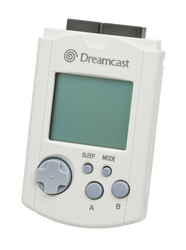
The memory card had a screen on it. That is the whole thing, and it is still a strange sentence to write almost thirty years later. Sega shipped the Dreamcast with a save device carrying a 48 by 32 pixel monochrome LCD, four buttons, a directional pad and a speaker, running off two watch batteries, and it slotted face-out into a window in the controller so you could see it without taking your hands off the pad.
It went on sale in Japan on 30 July 1998, four months ahead of the console it belonged to, in a Godzilla branded edition with a virtual pet already loaded onto it. In Japan the thing was called the Visual Memory System. Everywhere else it was the Visual Memory Unit, and it arrived bundled with the Dreamcast in North America in September 1999 and in Europe that October.
As storage it held 200 blocks, which is 100 kilobytes out of the 128 on the chip, the rest reserved for the system. The more interesting job was the second screen. It could show your remaining health in Resident Evil Code: Veronica without making you pause, or a play call in NFL 2K2 that the person sitting on the couch next to you was not allowed to see. And it ran downloadable minigames pulled off whatever disc you had just bought, on its own, in a pocket, away from the television.
The Dreamcast's entire life fits into a window when I was between fourteen and seventeen and on a modem. Consoles in Turkey then meant the PlayStation, which had a gray market deep enough that discs turned up on street tables, and Sega had nothing approaching that footprint. The Dreamcast was a machine you read about in magazines. The VMU is an object I have only ever seen in photographs.
~ the chronicle ~
| Born | 30 July 1998, Japan, as the Visual Memory System |
|---|---|
| Peak | 1999 to 2000, one slotted into every Dreamcast controller |
| Killed | 30 March 2001 |
| Lifespan | under three years |
| Made by | Sega, around an 8-bit Sanyo chip |
| Killed by | Sega leaving the hardware business in January 2001 |
~ the creature in your pocket ~
The best remembered use was Chao Adventure. Sonic Adventure let you raise a small creature inside the game, then pull the VMU out of the controller and take it with you, where it kept living while you were at school. You fed it, it wandered around a tiny monochrome landscape at its own speed, and you plugged it back into the Dreamcast to see what it had turned into. Two VMUs could be connected directly to each other so the creatures could visit.
This was 1998, doing something that would not become ordinary for another decade: game state that follows the player off the machine. Tamagotchi had already proved that people would care about a low resolution animal on a keychain. Sega's version was wired into a full console game, so the thing you carried around actually mattered to something larger when you got home.
~ the batteries ~
It ran on two CR2032 lithium cells and it went through them. Leaving the VMU in the controller with the beeper switched on would drain a set inside days, and when they died the clock and the display went with them, although the saved data on the flash chip survived. Plenty of people pulled the batteries out deliberately and used the thing as a plain memory card, which is what most of them quietly became.
The screen was also very small and had no backlight. Reading a health bar off it during a firefight was a real request to make of a player sitting two meters from a television, and a lot of the second-screen features that shipped were used once for the novelty and then ignored.
~ the day it died ~
Sega announced on 31 January 2001 that it was leaving the hardware business, and the Dreamcast went down with the announcement. The VMU was discontinued in Japan on 30 March 2001, under three years after it first went on sale, and there was never a version of it for anything else. It was built into one controller for one console and it could not be lifted out of that arrangement.
Nothing inherited it directly. The second-screen idea kept resurfacing for the next twenty years without ever tracing back to an 8-bit Sanyo chip in a save device. The VMU is just the version that showed up first and got the shortest run at it.
~ leave a rose ~
an anonymous tribute. one rose per visitor per day.
@}-->-- ... roses left here
~ leave a wreath ~
a rose fades by morning. a wreath stays on this grave for good, with your name on it.
from $1, paid once through stripe. it keeps the graveyard running: the hosting and the nightly digging. adopt it and the headstone reads "maintained in memory by" you. the groundskeeper plants new wreaths at the next tending, usually within a day.
» one email a week: new graves and the anniversaries of the dead. subscribe
other gadgets: Rocket eBook, Motorola, Inc., Acorn Archimedes, Acorn Electron
also died in the 2000s: PageNet, Ireland On-Line, Doblog
~ leave a note ~
visitors before you have left these graveside notes. anonymous welcome.