Tamagotchi (the cultural fad)
~ the obit ~
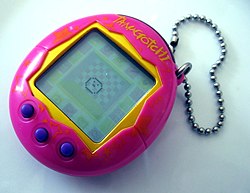
tamagotchi launched in japan on 23 november 1996. it was made by bandai, designed by aki maita and akihiro yokoi. the device was a small egg-shaped plastic keychain about 5 cm tall, with a small LCD screen and three buttons. you turned it on and a tiny pixel-art creature hatched. it was your virtual pet. you had to feed it, play with it, clean up its digital poop, and discipline it when it misbehaved.
the cultural impact was immediate and massive. the first-generation tamagotchi sold about 40 million units globally between 1996 and 1999. it was on every news show. there were stories about kids in tears at school because their tamagotchi had died. there were stories about teachers banning them because students could not stop checking. there were stories about adults bringing tamagotchis to work. the device was the first piece of consumer electronics whose cultural footprint exceeded its hardware capabilities.
mine was a blue one, and the creature that hatched out of it was a dinosaur-looking thing. for the first few days i could not really tell what was going on, what to feed it or why it kept beeping. i figured it out eventually but it never really pulled me in. they were around in turkey in 1997 and 1998, sold at bakkals next to chiclets and trading cards, mostly knockoffs but the real bandai ones showed up too.
this grave is for the 1996-1998 cultural fad specifically. the tamagotchi as a product is not actually dead. bandai still produces new versions in 2026 (tamagotchi smart in 2021, tamagotchi uni in 2023). there are bandai retail experiences in japan dedicated to the brand. the keychain device is alive. the cultural fad of the late 1990s is what is gone.
~ the rap sheet ~
| Born | 23 November 1996 (Bandai launch in Japan) |
|---|---|
| Cultural peak | 1996 - 1998 |
| Cultural decline | around 2000 |
| First-generation cumulative sales | ~40 million |
| Made by | Bandai |
| Still produced today | yes (Tamagotchi Uni and other variants) |
| Killed culturally by | the smartphone, the death of the standalone gadget |
~ how it actually worked ~
the original tamagotchi had a simple game loop. when you turned it on, an egg appeared. after a few minutes the egg hatched into a tiny pixel-art creature. the creature had stats: hunger, mood, age, weight. you took care of it by pressing buttons:
- feed it (pick from a small menu of food)
- play with it (a simple guessing minigame)
- clean it (when it pooped, you had to flush)
- discipline it (when it cried for no reason)
- turn off the lights at night
if you ignored these tasks, the tamagotchi got sick. if it got sick and you did not give it medicine, it died. the death was final. you got an angel-with-wings sprite on the screen, and your tamagotchi was gone forever. you could reset the device to start a new one, but the previous tamagotchi was gone.
this finality was the brilliant design choice. modern virtual pets usually let you respawn. tamagotchi did not. when your pet died, it died. that mattered. kids treated their tamagotchis like real pets because the consequences of neglect were real (within the context of the device).
~ the school bans ~
tamagotchis required attention every couple of hours. they would beep when they needed something. the beeping happened during class. kids would pull tamagotchis out of their pockets to feed or clean them. teachers got annoyed. schools banned them.
the bans were widespread. in japan in 1997, most schools officially prohibited tamagotchis on premises. similar bans appeared in the US, UK, australia, and most european countries through 1997 and 1998. there were stories of students hiding tamagotchis in lockers and rushing to feed them between classes, only to find their pet had died during recess.
this was the first time a personal electronic device had been disruptive enough at scale to require school policy. it would not be the last. the same script would replay with mobile phones in the early 2000s and with smartphones in the 2010s. tamagotchi was the prototype.
~ what killed the fad ~
the cultural fad died in 1999-2000. several reasons:
oversaturation. by 1998 every kid in the developed world had a tamagotchi. the novelty was gone. peer pressure no longer pushed new purchases.
fad cycles. kid fads tend to last 18 to 36 months. tamagotchi peaked in 1997. by 1999 the same kids had moved to pokemon trading cards, beanie babies, and digimon. the cultural attention shifted.
mobile phones. by the early 2000s, kids had mobile phones. the phone could do more than the tamagotchi. phone games filled the same psychological niche. the dedicated keychain device became unnecessary.
~ why it is technically still alive ~
bandai never stopped making tamagotchis. they made the tamagotchi connection (2004) which let two devices interact via infrared. the tamagotchi friends (2014) added more social features. the tamagotchi smart (2021) added a touchscreen. the tamagotchi uni (2023) connects to the internet.
none of these have had the cultural footprint of the original. they sell to a niche audience of nostalgic adults and to japanese kids. the brand is alive. the tamagotchi factory shops in japan have new product. the manufacturing has been continuous since 1996.
some HN readers, when this site first went up, pointed this out. tamagotchi is technically not dead. fair point. what is dead is the 1996-1998 cultural fad: the school bans, the news coverage, the universal kid-attention-grabber. that fad is over. the keychain product is a living legacy.
~ what survived ~
the streak. modern apps that try to keep you engaged with daily check-ins (duolingo's streak, snapchat snaps, pokemon go's daily bonus) all descend from tamagotchi's basic loop. show up every day or lose progress. the design pattern was popularized by tamagotchi a quarter-century before app developers started using the same pattern at scale.
the virtual pet as a category. neopets (1999), club penguin's puffles (2005), pou (2012), and dozens of other virtual pet products all owe something to tamagotchi. the basic loop of "feed, play, clean, repeat" was tamagotchi's contribution to game design.
the public moral panic about screens and kids. tamagotchi was the first device to trigger widespread "is this hurting our children" concern. those questions have been recurring ever since (gameboy, smartphones, tiktok). each new device gets the same panic in slightly different form. tamagotchi was the original pattern.
~ leave a rose ~
an anonymous tribute. one rose per visitor per day.
@}-->-- ... roses left here
~ leave a wreath ~
a rose fades by morning. a wreath stays on this grave for good, with your name on it.
paid once through stripe. payments are handled by OÜ Lakeview, the small company that keeps rip.so running. the money pays for the hosting and the nightly digging. adopt it and the headstone reads "maintained in memory by" you. the groundskeeper plants new wreaths at the next tending, usually within a day.
» one email a week: new graves and the anniversaries of the dead. subscribe
~ epitaphs from visitors ~
"I still buy one when I see then in a store, I like colecting them. The cost of the batteries is expensave so I don’t buy batters for them often. xD Just mostly have them as momorbela of the cuteness!"
left by darkocean, 2026-09-26
other gadgets: Karotz, Pontiac, Thinking Machines Corporation, PlayStation TV
also died in the 1990s: TAURUS, Thinking Machines Corporation, Sega Game Gear
~ leave a note ~
visitors before you have left these graveside notes. anonymous welcome.