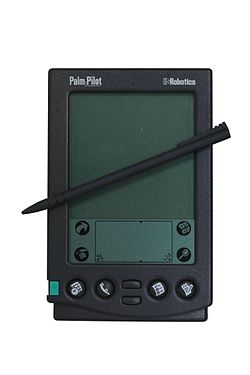
Palm Pilot
» see palm.com as it lived, on the wayback machine
~ the obit ~
the palm pilot launched in march 1996. it was a small device, about the size of a deck of cards, with a monochrome touchscreen, a stylus, and four physical buttons. the buttons opened your calendar, contacts, todo list, and notes. that was the entire product. it did those four things well, and that was enough.
for the second half of the 1990s, the palm pilot was the dominant PDA. competitors existed (psion, casio cassiopeia, sharp wizard) but palm sold the most units and got the most cultural attention. by 2000 there were over 13 million palm devices in the world. peak total sales over the platform's lifetime were around 30 million units.
palm pilots were a US business-class thing. in turkey they were rare even among engineers. i saw maybe one or two in the late 1990s in offices where someone had bought one on a business trip abroad. by the time PDAs became affordable globally, smartphones were already six months away. i went straight from a paper notebook to a nokia 3310 to a smartphone in the late 2000s. palms skipped a generation that did not have them in turkey.
the smartphone era killed it slowly. palm tried to make smartphones (treo, then later the centro) and the early treos were decent. then the iphone shipped. palm's response was webOS in 2009, which was technically interesting but commercially too late. HP bought palm in 2010 for 1.2 billion dollars and killed all palm hardware nine months later in february 2011.
~ the rap sheet ~
| Born | March 1996 (Pilot 1000, Pilot 5000) |
|---|---|
| Renamed Palm Pilot | 1997 |
| Peak | ~30 million units sold cumulatively |
| Bought by HP | April 2010 ($1.2 billion) |
| Killed by HP | 9 February 2011 (webOS hardware discontinued) |
| Lifespan | ~15 years |
| Killed by | the iPhone, the smartphone era, HP's strategic confusion |
~ what it actually did ~
the palm pilot's job was to be a small organizer. you used the stylus to tap on the screen. the screen was small (160x160 pixels on the original, monochrome). there was no internet connection. there was no camera. there was no music player. it had a battery that lasted about two weeks on two AAA batteries.
this minimalism was the appeal. the device did calendar, contacts, todos, and memos. that is what most people who carried one used it for. you synced with your desktop computer through a "hotsync" cable, which would copy your appointments and contacts back and forth between palm and windows or mac.
some people used palms for more elaborate things. there was a developer ecosystem with thousands of small apps. games. ebooks. database tools. a few brave souls used their palm as a primary computing device for travel. but the median palm user just wanted a calendar in their pocket, and that is what they got.
~ graffiti ~
the most distinctive palm pilot feature was graffiti. it was a handwriting recognition system that worked by requiring you to write each letter in a specific simplified shape. an A was a single triangle stroke. an N was a downward stroke followed by a diagonal. you wrote in a designated input area at the bottom of the screen.
graffiti worked because it required you to learn it. you could not just write your normal handwriting. you had to learn the palm-specific letter shapes, which were close to natural handwriting but simplified to be machine-distinguishable. learning graffiti took maybe a week. once you had it, input was fast. you could write a full sentence in 15 seconds.
graffiti is also what most people who never used a palm pilot remember the device for. there is a whole generation of office workers in the late 1990s who can still draw the graffiti A from memory in 2026. the muscle memory persists long after the device is gone.
~ the treo ~
palm's smartphone attempt was the treo, which launched in 2002. the treo combined a palm pilot with a phone, a keyboard, and (later) a small camera. for a few years around 2003 to 2005, the treo was a real competitor to the early blackberry in the corporate smartphone market.
the treo 600 (2003) and 650 (2004) were the cultural peaks. they had real keyboards. they ran palm OS. they had a developer ecosystem. they synced with desktop computers in the same way as the original palm pilots. some early adopters in tech and startup circles preferred treos to blackberries because the OS was more flexible.
by 2007 the treo was already starting to feel old. palm OS had not been seriously updated. the hardware was good but predictable. then the iphone shipped, and the treo's specific niche disappeared overnight.
~ the webOS coda ~
palm's last serious effort was webOS, launched in 2009 with the palm pre. webOS was technically brilliant. it had real multitasking long before iOS or android did. the gesture-based interface was elegant. notifications worked the way you would expect notifications to work, eight years before ios got similar features.
the problem was timing. webOS shipped two years after the iphone, into a market that had already chosen ios and android. palm could not get developers to make webOS apps. without apps, the platform could not compete. HP bought palm in april 2010, partly to acquire webOS for use in tablets and printers. nine months later, on 9 february 2011, HP cancelled all palm hardware. webOS itself was open-sourced, then sold to LG, who has been using it in TVs ever since.
~ what we lost ~
the small pocket organizer. modern smartphones do everything palm pilots did and a thousand other things. but the smartphone is not really a focused tool. you open it to check your calendar and 40 minutes later you are still scrolling instagram. the palm pilot did not have that problem because it could not. it just showed you your calendar.
graffiti as a writing skill. handwriting recognition went a different direction (full-letter recognition, no special shapes). graffiti's specific simplified-letter alphabet is gone except in nostalgia.
webOS's gesture system. several years of mobile UX research were poured into webOS. then HP killed it. ios and android eventually got similar features over the next decade. the webOS team's work shipped in fragments, in other companies' products. the original platform did not get to be the platform that mattered.
~ leave a rose ~
an anonymous tribute. one rose per visitor per day.
@}-->-- ... roses left here
~ leave a wreath ~
a rose fades by morning. a wreath stays on this grave for good, with your name on it.
paid once through stripe. payments are handled by OÜ Lakeview, the small company that keeps rip.so running. the money pays for the hosting and the nightly digging. adopt it and the headstone reads "maintained in memory by" you. the groundskeeper plants new wreaths at the next tending, usually within a day.
» one email a week: new graves and the anniversaries of the dead. subscribe
~ epitaphs from visitors ~
"My memory on the pre is that it not only gave us the last gasp of Palm via webOS, but it gave us multitouch on anything that wasn’t iOS. Apple had had multitouch for years, and Android phones were hardware capable of..."
left by Nemo, 2026-05-20
other gadgets: Amazon Glow, Pyramid Technology, Sendo, Nokia X
~ leave a note ~
visitors before you have left these graveside notes. anonymous welcome.