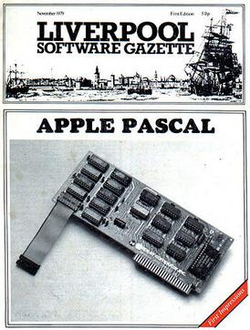
Liverpool Software Gazette
~ the goodbye ~
Microdigital opened in July 1978 on Brunswick Street in Liverpool, one of the first computer shops in Britain, and Bruce Everiss ran it. In the first stretch it mostly sold kits. The Nascom 1 went for about £200 with 2K of RAM and over a thousand solder joints left for the buyer to do, and there was Science of Cambridge's MK14 alongside it. The shop also ran a fixed-price repair service, because by Everiss's own account faulty Nascoms were arriving from all over the country.
The magazine came out of that counter. His explanation, written up thirty years later, is a single sentence: there was a shortage of knowledge for their customers, so they set up a magazine to try and plug it. The first issue of the Liverpool Software Gazette is dated November 1979, about fifty pages for 50p, and its reader was somebody whose machine already ran.
The stated audience was sophisticated and experienced computer users, which in 1979 meant more or less anybody who had got that far. Subjects ran from machine code and processor profiles to languages and operating systems, with astronomy turning up more than once. The articles went deeper than what was on the newsagent shelves.
~ the chronicle ~
| Born | November 1979, issue 1, about 50 pages at 50p |
|---|---|
| Peak | the fifth issue, up to 100 pages at 75p |
| Killed | February 1981, the last one a double issue dated February and April |
| Lifespan | 1 year, 3 months, eight issues |
| Made by | Microdigital Ltd of Liverpool, run by Bruce Everiss |
| Killed by | the shop, which needed more of the company than the magazine did |
~ pets corner and apple pips ~
The regular columns were organized by machine, since in 1979 there was no other sensible way to organize anything: Pets Corner for the Commodore PET, Apple Pips for the Apple II, Nascom Notes for the Nascom, and a general column called Nybbles.
Two issues were specials. Issue 6 went to Pascal and led with an article warning that prolonged use of Pascal may seriously damage your mental health. Issue 7 went to CP/M, covering disk operating systems and the Sharp MZ-80K. Elsewhere in the contents lists there is a piece on wiring a General Instruments AY-3-8910 sound generator onto a 6502 bus, and an article on cheap architectural software by Paul Coates, then at the School of Architecture at Liverpool Polytechnic.
~ what was behind the counter ~
Of the two things Microdigital made, the shop mattered more. Everiss calls it a talent incubator and names the people who worked there, Mark Butler and Eugene Evans among them. Butler co-founded Imagine Software in 1982 and Evans became its best-known young programmer. Everiss himself turned up at Imagine to handle operations and publicity, which is how his name ended up in the liquidation file of a different Liverpool company three years later.
A computer shop in 1979 was often the only place in a city where any of this knowledge was held, so one room produced a retailer and a magazine at the same time. Everiss's own claim is that the Liverpool games industry of the eighties came largely out of that address, and the staff list makes it difficult to argue with.
~ the double issue ~
The magazine was put up for sale inside its own final edition, which is an abrupt way to learn that your subscription is ending. That last one is a double, listed as issue 8/9 and dated February and April 1981, priced at £1.50. An Apple magazine bought it and immediately dropped every article that was not about Apples.
Eight issues across fifteen months. Four of them are readable today as PDFs on a mirror of an old 80-bus fan site, and the issue 4 architecture piece survives because a university kept a copy. That is nearly all of the print record.
~ leave a rose ~
an anonymous tribute. one rose per visitor per day.
@}-->-- ... roses left here
~ leave a wreath ~
a rose fades by morning. a wreath stays on this grave for good, with your name on it.
paid once through stripe. payments are handled by OÜ Lakeview, the small company that keeps rip.so running. the money pays for the hosting and the nightly digging. adopt it and the headstone reads "maintained in memory by" you. the groundskeeper plants new wreaths at the next tending, usually within a day.
» one email a week: new graves and the anniversaries of the dead. subscribe
other news: Official Nintendo Magazine, Gossip Cop, Rocky Mountain News, Voice of Russia
also died in the 1980s: Sirius Software, Viditel, Creative Computing
~ leave a note ~
visitors before you have left these graveside notes. anonymous welcome.