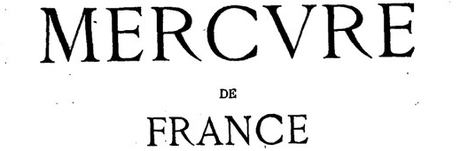
Mercure de France
~ the goodbye ~
It was decided in a café at the end of 1889. Louis Dumur and Édouard Dubus wanted a review, Gabriel-Albert Aurier was in on it, and they took the idea to Alfred Vallette; the constitutive meeting happened at the Café Français near the gare Saint-Lazare. Vallette and his wife, the novelist Rachilde, took over a dying Symbolist sheet called La Pléiade and started again under a new title. André Billy recorded the mechanics: the first number of the Mercure de France appeared on 25 December 1889, dated January 1890. Jean Moréas and Jules Renard were in it, and so were Remy de Gourmont and Alfred Jarry. Rachilde sat on the editorial committee until 1924, and her Tuesday salon on the rue Jacob was the room where French letters got argued about.
What the review did best was go first. It printed unpublished Mallarmé and unpublished Heredia. The house founded alongside it in 1894 brought out the first French translations of Nietzsche, then the first books of André Gide and Paul Claudel, and later Colette and Apollinaire. It also published the twenty-odd volumes of Paul Léautaud's Journal littéraire, the most useful record anybody kept of how a French literary office actually operated. It was monthly from 1890, twice a month from 1905, and back to monthly in October 1939 when the war started. The nameplate spelled itself MERCVRE, with the Latin V, above a woodcut of the god running across clouds with his caduceus up.
Then it got complicated. Vallette died in September 1935 and Georges Duhamel took over, having edited the thing since 1912, and was pushed out in 1938 over his position on the coming war. Jacques Bernard ran it after him and was sentenced to five years in 1945 for collaboration, though the review itself had not published a line since August 1940: its return was a single double issue, number 999 over 1000, dated from 1 July 1940 to 1 December 1946 as though the six years in between had been one long month. Gallimard bought the house in 1958, after money ran out. Gaëtan Picon was the last director of the review, from 1963, co-directing with Yves Bonnefoy and two others. The final issue is tome 354, numbers 1221 and 1222, a July and August double number for 1965. Nobody has turned up a farewell editorial or any announcement at all. It stopped.
~ the chronicle ~
| Born | printed 25 December 1889, cover-dated January 1890, out of a Symbolist group that met in cafés near the gare Saint-Lazare |
|---|---|
| Peak | monthly from 1890, twice a month from 1905 until September 1939 |
| Killed | July/August 1965, tome 354, numbers 1221 and 1222 |
| Lifespan | 75 years as a review, interrupted three times by war and once by nothing anyone recorded |
| Made by | Alfred Vallette and Rachilde, then the Société du Mercure de France |
| Killed by | insolvency in 1958, then seven more years under an owner who kept the books and let the review go |
~ the claim on 1672 ~
The 293-year span that gets quoted for this title is a thing the title gave itself. The Bibliothèque nationale's catalog record carries a flat little note saying that from number 6, in June 1890, the review claims to continue Le Mercure galant of 1672. Not continues. Claims to continue. Vallette's five-month-old magazine reached back more than two centuries and annexed a dead gazette, and the claim stuck so well that it is now in the encyclopedias as a date range.
The gazette was real enough. Jean Donneau de Visé founded Le Mercure galant in 1672 as a quarterly of court news and verse, with Thomas Corneille co-directing from 1680; it became Mercure de France in June 1724 under Antoine de La Roque. Its May 1734 issue contains the first attested use of the word baroque as an insult, in an anonymous notice of Rameau's Hippolyte et Aricie. Under Charles-Joseph Panckoucke it reached fifteen thousand subscribers, an enormous number for the late eighteenth century and the only hard circulation figure anybody has for any version of this title in three centuries.
~ seized and replaced ~
The Revolution did not kill it. The numbering simply ran on: Mercure de France ends at number 50 on 10 December 1791 and Mercure français picks up at number 51 a week later, same editors, new politics. The real kill came under the Restoration. Chateaubriand had been a proprietor until an imperial order folded the review into another title in 1807, it missed April to September 1815 for obvious reasons, and in February 1818 the authorities seized it outright and replaced it with La Minerve française, staffed by the same writers under a name with no history attached. The title came back in July 1819 as Mercure de France et chronique de Paris, stripped of politics, and ran out in 1820.
There was one more life before Vallette's. From 1835 the title came back as an annexe of a family magazine called Musée des familles, running at first as an independent monthly. By 1844 it was a free supplement, and from 1846 it was printed inside the host magazine's wrappers, until by the 1880s it had shrunk to a single token article under an old name. Charles Delagrave bought Musée des familles in 1882 and the rubric died with the sale.
~ 26 rue de condé ~
The address is the oldest surviving part of this. The cover of the issue dated 1 February 1925 sets it in Roman numerals under the contents, XXVI RVE DE CONDÉ, PARIS VIe, under a price of three francs fifty and a line promising the review on the first and the fifteenth of every month. That same street number is on the company register now. Éditions Mercure de France is a société anonyme at 26 rue de Condé in the sixth arrondissement with the Gallimard holding company on its board, and its registered activity is 58.11Z, book publishing. Simone Gallimard ran it from the acquisition until 1995 and is remembered mostly for publishing Romain Gary's novels under the Émile Ajar name, which got him a second Goncourt he was not allowed to have. Isabelle Gallimard held the presidency for thirty years after her, and handed it to Olivier Frébourg on 5 October 2026. The homepage carries a catalog and press clippings dated last month. The word revue does not appear on it once.
One more serial wore the name after the review stopped. The national library has a record for a Bulletin mensuel d'information published by Mercure de France from about 1965 until number 29 in spring 1971, and two of its issues went out with the bare title Mercure de France on them. A house newsletter wearing the dead review's name for six years only turns up in a catalog record, and no better handover appears to have been arranged.
Scopalto, a French shop that sells magazine subscriptions, keeps a page for Mercure de France. It lists nothing later than 1965 and there is no button to press, because the thing it is a page for has not existed since Charles de Gaulle's second term. I sat on that page longer than the information on it justified. There is a storefront for this magazine and no magazine behind it, which has been the condition of the title through most of its 293 claimed years: a name in good condition, waiting for the next group in the next café to decide it belongs to them.
~ leave a rose ~
an anonymous tribute. one rose per visitor per day.
@}-->-- ... roses left here
~ leave a wreath ~
a rose fades by morning. a wreath stays on this grave for good, with your name on it.
paid once through stripe. payments are handled by OÜ Lakeview, the small company that keeps rip.so running. the money pays for the hosting and the nightly digging. adopt it and the headstone reads "maintained in memory by" you. the groundskeeper plants new wreaths at the next tending, usually within a day.
» one email a week: new graves and the anniversaries of the dead. subscribe
other news: Dlisted, Mademoiselle, City Pages, Spy Magazine
also died in the pre-1980s: Wonderful Radio London, All the Year Round, Hallicrafters
~ leave a note ~
visitors before you have left these graveside notes. anonymous welcome.