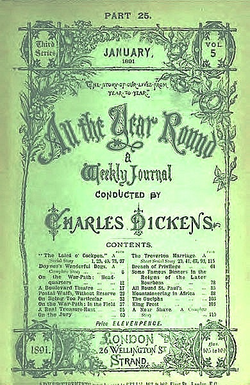
All the Year Round
~ the goodbye ~
The last number is dated Saturday 30 March 1895 and costs twopence, the same price it cost in 1859. Nothing inside it says goodbye. Margaret Moule's serial "Richenda" is at chapter twenty four and Mary Angela Dickens has an installment of "Prisoners of Silence" running. The reader is plainly expected back next week. The notice is on the back page, two lines in a box, dated the same day: after this date the publication of All the Year Round will be discontinued, and the magazine will be incorporated with Household Words. The four weekly numbers before it carry no warning of any kind.
It had been a serious publication for a very long time. The first number went out on 30 April 1859 with chapter one of A Tale of Two Cities in it and sold 125,000 copies, against the roughly 38,500 that Dickens's previous weekly had been managing. Through the 1860s it held about a hundred thousand a week and the Extra Christmas Numbers went as high as three hundred thousand. The Woman in White started in it that November, The Moonstone and No Name followed, Great Expectations ran through 1860 and 1861, and Trollope put The Duke's Children in it in 1879. Dickens took roughly £2,750 a year out of it.
Then he died, in June 1870, having signed the magazine over to his eldest son the week before. Charles Dickens Jr. already held a quarter of it through his father's will and bought out W. H. Wills' remaining share in January 1871, and from then on the magazine was his to own and to conduct, which he did until 1895. He also printed it: the imprint on the 1889 and 1891 issues reads Charles Dickens & Evans, Crystal Palace Press, his own firm with his father-in-law. By November 1894 the office had moved off Wellington Street to 12 St Bride Street, and the printing had passed to F. M. Evans & Co., Limited.
No reason for the 1895 ending is documented anywhere. There is no bankruptcy notice and no reported sale. What the record shows is a weekly that had been outbid for its novelists since the 1860s and a proprietor who would be dead inside sixteen months, and then a box on a back page.
~ the chronicle ~
| Born | Saturday 30 April 1859, leading on the first installment of A Tale of Two Cities |
|---|---|
| Peak | 125,000 copies of the first number, around 100,000 a week through the 1860s |
| Killed | 30 March 1895, number 326 of the third series |
| Lifespan | 35 years, 11 months |
| Made by | Charles Dickens, then his eldest son from 1870 |
| Killed by | absorption into a revived Household Words, announced on its own back page |
~ the dead man on the masthead ~
Every single number from the first to the last carries the same two lines above the title: "The story of our lives from year to year", and under it, CONDUCTED BY CHARLES DICKENS. That is on the issue of 30 March 1895, twenty five years after the Charles Dickens anybody means was buried in Westminster Abbey. It is on the volume title pages too.
No editor is named anywhere else in the magazine, ever, which was the policy from 1859 and was never relaxed. What the evidence supports is that the credit stayed literally true the whole time, because the owner, proprietor and conductor from 1870 was a man legally and actually named Charles Dickens, and the fact that readers would take it the other way was worth money. Nobody in the magazine or outside it ever wrote down which reading was intended.
~ the set from Wrexham ~
Articles in All the Year Round were published unsigned. For Household Words the office account book survived and Anne Lohrli worked out who wrote what in 1973; the equivalent ledger for All the Year Round was last seen by an editor around 1900 and has never turned up, so for over a century the authorship of thousands of pieces was simply unknown.
In July 2015, at a conference in Ghent, the bookseller and Dickens scholar Jeremy Parrott announced that he had bought a twenty volume set of the magazine from a second-hand bookshop in Wrexham, and that somebody had written the author's name beside almost every piece in it. The set covers the first series only, 1859 to 1868, and had sat with one North Wales family since the 1920s. It names 312 contributors. Parrott's own argument is that the hand is not Dickens's but belongs to two of his office staff, George Holsworth and Henry Walker, which has not stopped the press from describing it as Dickens's own annotations ever since. Leon Litvack published the scholarly account in Dickens Quarterly that December. The complete guide was announced for 2017 and then for 2018, and it does not appear to have been published.
~ what happened to Charley ~
Charles Dickens Jr. outlived his magazine by just under sixteen months and died on 20 July 1896, aged 59. He had spent a career being the son. A failed business in the 1860s was settled by his father giving him a job on the magazine, and the inheritance that followed left him conducting a weekly for twenty five years under a name that was his and was not. He compiled useful things on the side, including dictionaries of London and of the Thames, and he edited his father's novels for Macmillan in the early nineties. The estate he left was valued at under twenty pounds. In 1912 a public fund of about twelve thousand pounds was raised for his daughters.
Dickens Journals Online has every word of Household Words and the first eleven years of this one, corrected and free to search, and then it stops in 1870. The last twenty five years exist as scanned bound volumes on the Internet Archive with the OCR left rough, which is how I read the final number: a crooked column of broken capitals, the notice still perfectly legible in the middle of them.
~ leave a rose ~
an anonymous tribute. one rose per visitor per day.
@}-->-- ... roses left here
~ leave a wreath ~
a rose fades by morning. a wreath stays on this grave for good, with your name on it.
paid once through stripe. payments are handled by OÜ Lakeview, the small company that keeps rip.so running. the money pays for the hosting and the nightly digging. adopt it and the headstone reads "maintained in memory by" you. the groundskeeper plants new wreaths at the next tending, usually within a day.
» one email a week: new graves and the anniversaries of the dead. subscribe
other news: Hyper, DAG, GamePlay, Tips & Tricks
also died in the pre-1980s: Wonderful Radio London, DC-International, Rajyasamacharam
~ leave a note ~
visitors before you have left these graveside notes. anonymous welcome.